
2x Double Super Trend Quotex Trading Strategy
The double SuperTrend approach loads two SuperTrend indicators on the same Quotex chart, each set to a different period. The idea is simple: instead of trusting a single trend line, you wait for two lines to point the same way before you act. When both agree, you have a clearer read on the current swing. When they disagree, you stay out. This post walks through how the setup is built, the entry rules people use, and the honest limitation you need to understand before you rely on it.
What the Double SuperTrend Setup Is
SuperTrend is an ATR-based trend filter. It plots a line below price in an uptrend and above price in a downtrend, flipping colour when momentum shifts. Doubling it means running one faster (shorter period) line and one slower (longer period) line. A common starting point is SuperTrend 1 at period 14, multiplier 4, and SuperTrend 2 at period 15, multiplier 7. The faster line reacts to short swings; the slower line reflects the broader direction. Many traders also apply Heikin Ashi candles to reduce visual noise, though remember Heikin Ashi averages price and can hide the real open and close.
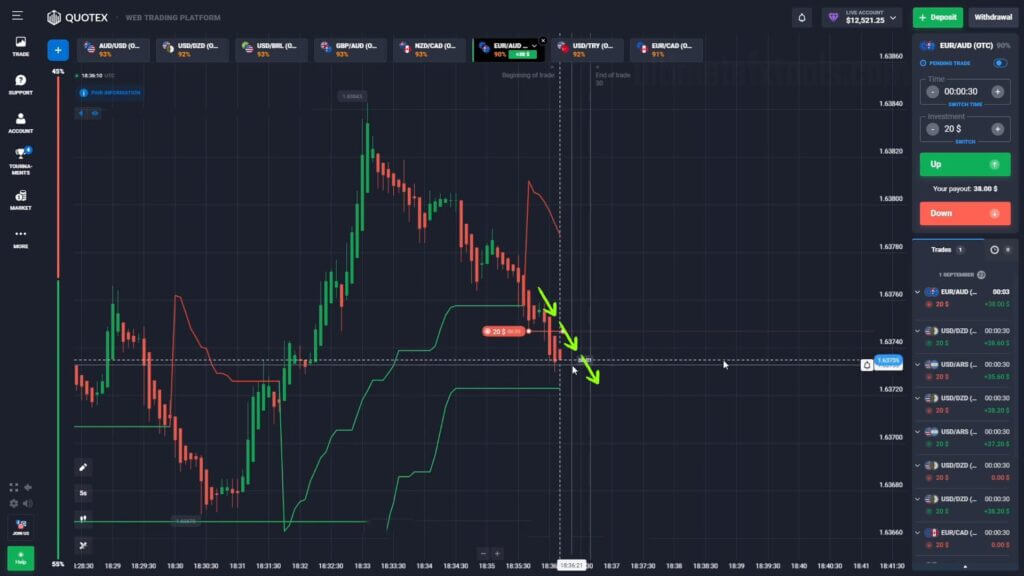
Settings, Timeframe and Entry Rules
Because Quotex short-expiry trades move fast, traders often use lower timeframes and align expiry to candle length. A practical framework looks like this:
- Both lines below price and green: bias is up. Consider a higher (buy) trade only after price pulls back and holds above the faster line.
- Both lines above price and red: bias is down. Consider a lower (sell) trade on a weak bounce that fails at the faster line.
- Lines disagree (one red, one green): no trade. This is the choppy middle where the setup gives the least reliable reads.
Keep expiry consistent with your chart. If the fast line flips against you before expiry, treat that as a warning that the move was shallow, not a signal to add more size.
The Chop Weakness (Read This)
Here is the honest part. Both SuperTrends are the same type of indicator built on the same price and the same ATR logic, so they are highly correlated. Using two of them does not give you two independent opinions. In a ranging or sideways market, both lines whipsaw and flip repeatedly, often flashing agreement moments before price reverses again. A slower second line lags more, so it can confirm a move that has already run out of room. Two lagging tools stacked together still lag, and they will hand you false signals in chop. The setup performs best when a clean directional swing is actually present, and it struggles when the market is quiet or news-driven.
Realistic Expectations
No indicator combination reads the market perfectly, and this one is no exception. The value of the double SuperTrend is not a magic edge but discipline: it forces you to skip the ambiguous middle and only act when direction is obvious. Treat it as a filter that removes some low-quality trades, not as a system that removes losses. Test it on a demo account across different sessions before committing real money, and compare it with simpler approaches like the Quotex easy strategy or a single-line setup such as the Quotex 1 minute strategy to see whether the second line genuinely helps your results.
Risk Management
Short-expiry trading carries substantial risk, so protect your capital first. Risk only a small, fixed fraction of your account per trade, and decide your position size before you click, not after a loss. Do not chase losses with a martingale (doubling stake after a loss) — a short losing streak can wipe an account fast, and no strategy makes that safe. Keep a trade journal, take breaks after consecutive losses, and never trade money you cannot afford to lose. Consistency comes from process control, not from a single indicator.
Frequently Asked Questions
Does the double SuperTrend strategy win every trade?
No. No strategy wins every trade. Two SuperTrends can still give false signals, especially in choppy or ranging markets, and losing trades are a normal part of trading. Anyone promising guaranteed wins is not being honest with you.
What settings should I start with?
A common starting point is SuperTrend 1 at period 14, multiplier 4, and SuperTrend 2 at period 15, multiplier 7. These are just a baseline. Adjust them to the asset and timeframe you trade, and test any change on a demo account first.
Is two SuperTrends really better than one?
Not always. Because both lines are built from the same ATR logic, they are correlated and tend to move together. The second line can filter out some weak signals, but it also lags more and will not save you in a sideways market.
Get the Full Toolkit
Prefer ready-made, pre-configured indicators instead of tuning settings by hand? Our full library of 100+ indicators and strategies is available for a one-time $39 lifetime payment, with MT4/MT5 compatible files and lifetime updates included.
Double Super Trend Quotex Strategy Video
This content is for educational purposes only and is not financial advice. Trading involves substantial risk; you can lose some or all of your capital. No result is guaranteed and past performance does not indicate future results. Trade only what you can afford to lose.


