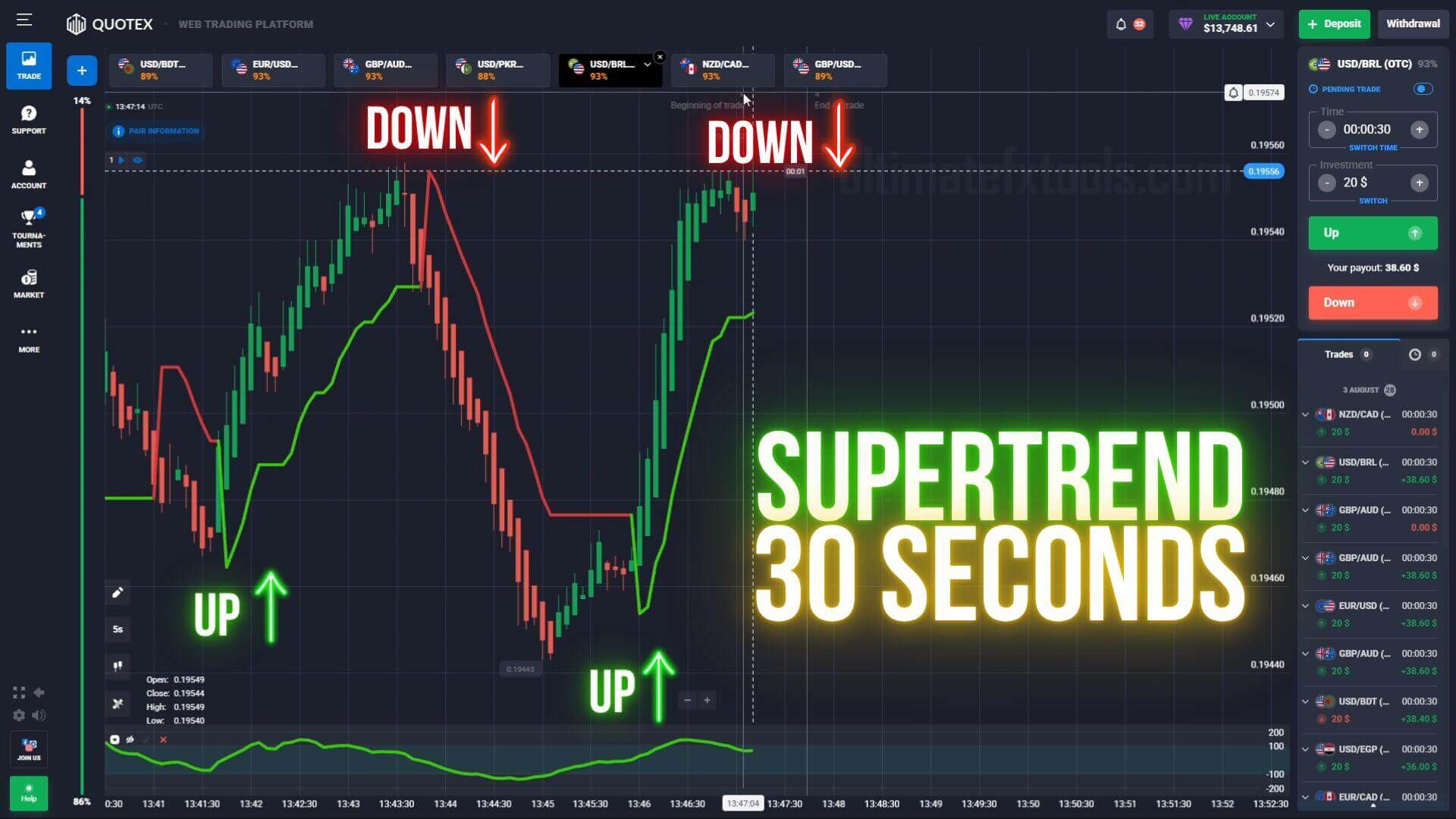
Effective Trading Approach Using SuperTrend and CCI
This 30-second Quotex setup pairs the SuperTrend indicator with the Commodity Channel Index (CCI) on a fast Heiken Ashi chart. The idea is straightforward: use SuperTrend to read the current direction, and use CCI to gauge whether momentum agrees before you commit to a short-duration trade. Neither tool predicts the future. They summarise recent price behaviour, so treat their signals as context rather than certainty, especially at the 30-second horizon where noise is heavy.
What SuperTrend and CCI Actually Do
SuperTrend plots a line that flips above or below price based on average true range. When the line sits below price and reads as an uptrend, buyers are broadly in control; when it flips above price, sellers have the upper hand. Because it is built on a moving average of range, SuperTrend lags price and will whipsaw during sideways, choppy conditions, printing colour changes that reverse almost immediately. It works best when a market is genuinely trending.
CCI measures how far price has moved from its recent average, which helps you read momentum and spot overbought or oversold stretches. In this setup CCI acts as a second opinion: if SuperTrend says "up" but CCI is drifting down or stalling at an extreme, the two disagree and the signal is weaker. The "Quotex lines" many traders add on top are simply support and resistance levels drawn from recent highs and lows, giving you a visual reference for where price has reacted before.
Settings, Timeframe and Entry Rules
- Chart: Heiken Ashi candles on a fast interval (many traders use 5-second candles) to smooth minor jitter.
- Expiry: a 30-second trade duration. This is high-variance by nature, so keep position sizes small.
- Buy context: SuperTrend reading as an uptrend and CCI turning up together.
- Sell context: SuperTrend reading as a downtrend and CCI turning down together.
- Stand aside when the two disagree, when SuperTrend is flipping colour repeatedly, or when price is coiling between your lines with no clear direction.
Settings are worth adjusting per asset and per session, since volatility differs a lot between pairs and between quiet and active hours. If you want the exact indicator files and the parameter values used in the video, they are part of the full toolkit available with $39 lifetime access.
 Unlock Indicator Settings
Realistic Expectations
A 30-second timeframe compresses a lot of randomness into each trade. Two confirming indicators can help you skip some obviously poor setups, but they cannot remove the whipsaws, the spread, or the sudden spikes that short expiries are exposed to. Expect losing runs, and judge the method over many trades rather than any single result. Practising on a demo balance first is the safest way to see how the signals behave before risking real money. If you like faster trend-and-filter setups, compare this with our Quotex 1 minute strategy and the more beginner-friendly Quotex easy strategy.
Risk Management
Risk control matters more than any indicator combination. Trade only money you can afford to lose, and keep each trade to a small fraction of your balance so one bad streak does not wipe you out. Set a daily loss limit and a daily stop, then walk away once either is reached. Avoid martingale style position doubling after losses: on a 30-second expiry a short losing run can escalate stake sizes very quickly and drain an account. Stick to a fixed, planned stake and keep a simple log so you can review whether the setup actually suits your assets and hours.
Frequently Asked Questions
Does this strategy win every trade?
No. No strategy wins every trade, and this one is no exception. SuperTrend lags and whipsaws in choppy markets, CCI can sit at an extreme while price keeps running, and 30-second expiries are inherently high-variance. Use the signals as a filter, size positions small, and expect losing trades as a normal part of the process.
Why use both SuperTrend and CCI instead of one?
A single trend line will fire on every colour change, including the false ones during chop. Adding CCI as a momentum check means you only act when direction and momentum broadly agree, which helps you pass on some of the weakest setups. It reduces signals rather than guaranteeing outcomes.
Is a 30-second expiry suitable for beginners?
It is one of the harder places to start because there is little time to react and randomness dominates short windows. Newer traders are usually better off practising on a demo account and on longer expiries first, then testing shorter durations once the entry rules feel automatic.
Watch the setup in action
This content is for educational purposes only and is not financial advice. Trading involves substantial risk; you can lose some or all of your capital. No result is guaranteed and past performance does not indicate future results. Trade only what you can afford to lose.


