Five Common Quotex Setups, Honestly Explained
Let's be clear up front: the heading calls these the "most profitable" and "most successful" Quotex strategies because that is how people search for them, but no setup here is ranked by profit and none is reliably profitable. Quotex trades close on a fixed expiry, so each position is a short, high-variance bet on direction. What follows are five common setups built on UltimateFXTools indicators - what each one uses, how to configure it, the conditions it suits, and where it breaks down. Treat them as structured ways to read a chart, not as win buttons.
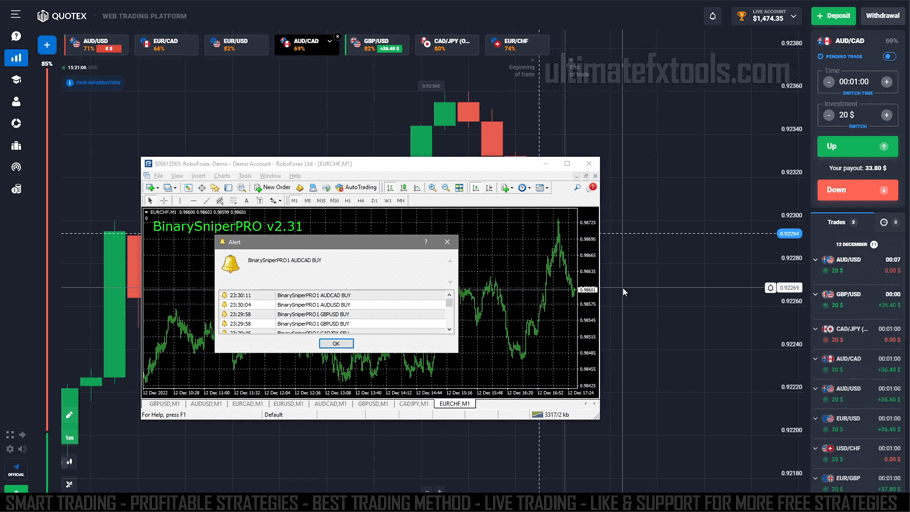
1. Binary Sniper Pro Arrow Signal
This setup reads the momentum arrows from Binary Sniper Pro plotted in MetaTrader against the matching Quotex chart. An up arrow flags a possible move higher, a down arrow a possible move lower. To set it up, keep the indicator on its default sensitivity, trade a small handful of liquid pairs, and let each candle close before you act. It suits calm, trending conditions on the one-minute chart. It fails in choppy, sideways markets, where arrows appear on every small wiggle - an arrow marks price that has already moved, so always confirm the context. For more on reading its alerts, see the Quotex Best Indicator guide.
2. Supertrend and ZigZag Reversal
Here the Supertrend line sets the prevailing direction while ZigZag marks the recent swing points, so you only take a signal in the direction Supertrend already favours. Set Supertrend to a standard ATR configuration and read it on the one-minute chart with a one-minute expiry. It suits a market that is trending but pulling back, letting you time an entry off a swing. The catch: ZigZag repaints - its most recent leg can redraw as new candles print, so a swing that looked confirmed can vanish. Never treat the latest ZigZag point as final. The Quotex 1 Minute Strategy walks through this combination in detail.
3. Donchian Channel and Schaff Trend Cycle
This pairing uses the Donchian Channel to frame the recent high-low range and the Schaff Trend Cycle to time momentum turns inside it. A signal forms when price reaches a channel edge and the Schaff Trend Cycle rolls over from an overbought or oversold extreme. It suits range-bound conditions where price respects the channel boundaries. It fails on a strong breakout, when price rides one channel edge and the oscillator stays pinned at an extreme without turning. Full entry rules are in Quotex Donchian Channel and Schaff Trend Cycle.
4. DeMarker and Super Trend Filter
A two-indicator method where Super Trend defines direction and DeMarker measures whether the move is stretched. You look for DeMarker leaving an extreme in agreement with the Super Trend direction. It suits short expiries on liquid pairs when a trend is taking a breather. It fails when the two disagree - a DeMarker extreme against a strong Super Trend is a reason to stand aside, not to fade the trend. See the full breakdown in Quotex DeMarker and Super Trend.
5. Alligator Trend Filter
The Alligator's three smoothed averages show whether the market is trending or resting. When the lines are tangled the market is range-bound and best left alone; when they fan apart and align, they confirm a direction for another entry signal. Use it as a filter on top of one of the setups above rather than as a standalone trigger. It suits filtering out flat markets. It struggles on very short expiries, where the smoothing lags fast reversals - see how unforgiving that gets in the 10 Seconds Quotex guide.
How to Apply These and Manage Risk
Whichever setup you use, the workflow is the same: read the indicator in MetaTrader, match the pair and time it against the Quotex candle, and only act when the context agrees. Filtering out conflicting signals matters far more than catching every one. Risk control is what keeps you trading: stake a small fixed fraction of your balance per trade, cap how many trades you take in a session, and stop for the day at a preset loss limit. Practise on a demo account until the reads feel automatic before risking real funds. No indicator removes losing trades - the aim is steady, repeatable decisions, not one big result.
FAQ
Which of these five is the most profitable?
None is ranked that way, and none can be called reliably profitable. Each is a common setup with its own strengths and failure modes. The best one for you is the one whose conditions match the market you trade and whose rules you can apply calmly under a short expiry.
Do I need to buy anything to use them?
Some indicators mentioned, such as the Alligator, are freely available in MetaTrader. Binary Sniper Pro and the other premium tools are included together in the single $39 lifetime plan. You can practise every method on a demo account first.
Can I use these on other platforms?
Yes. The signals are generated in MetaTrader and read against the Quotex chart, so the same combinations translate to other trading platforms such as IQ Option, Pocket Option and Olymp Trade.
This content is for educational purposes only. Trading involves risk. Past results do not guarantee future outcomes. Always practice responsible money management and limit your daily trades to avoid large losses.


