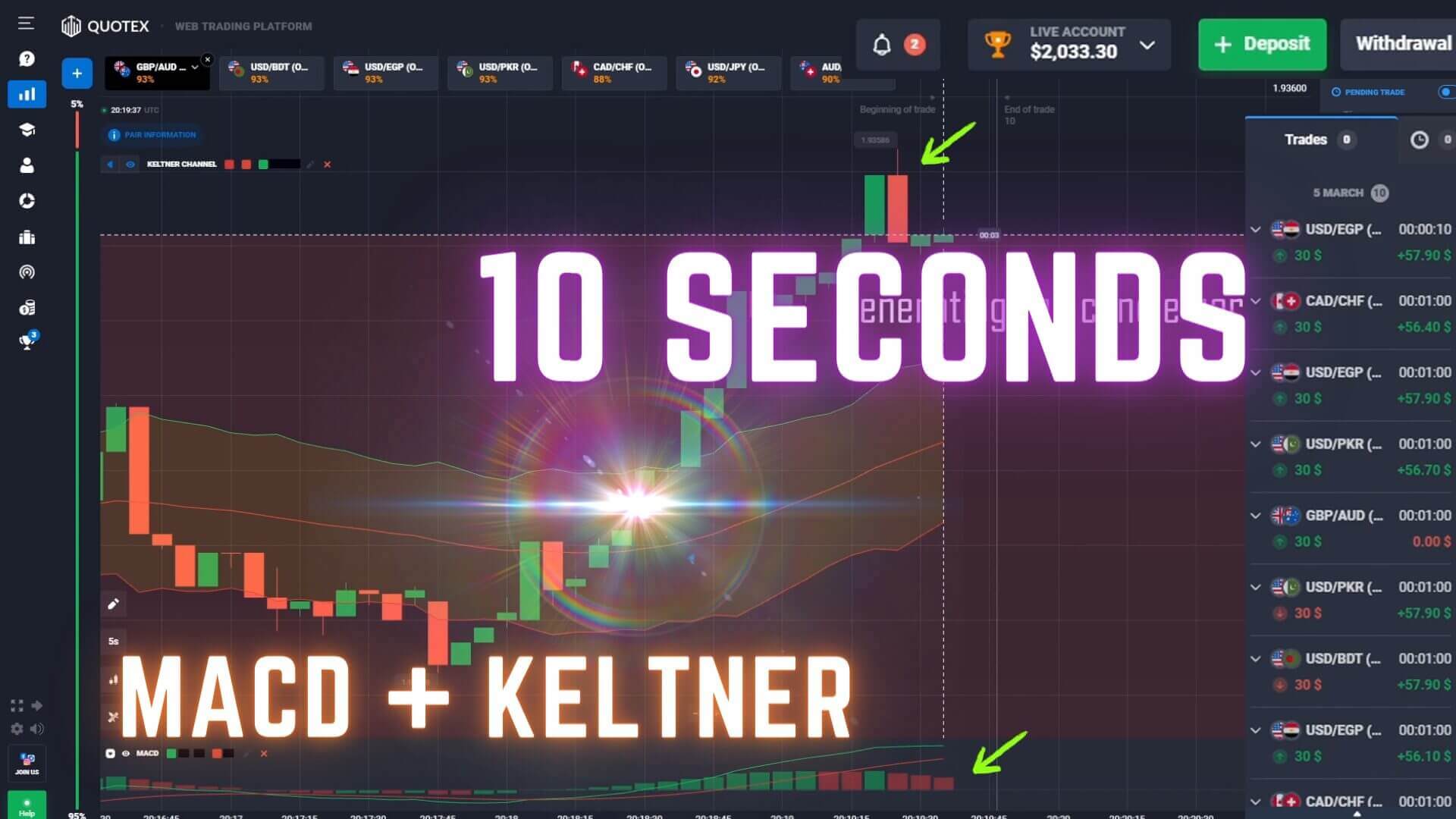
Ten-second trades on the Quotex web trading platform are about as fast as retail binary options get. You choose a direction, a ten-second timer runs, and the position settles the instant it expires. This page walks through the MACD-plus-Keltner Channel setup some traders use on that ultra-short expiry, along with an honest look at why this timeframe is one of the hardest ways to trade and how to protect your account while you experiment with it.
What the 10-Second Setup Is
The idea combines two well-known tools. The Keltner Channel draws volatility-based bands around price, so you can see when a candle has stretched unusually far from its average. The MACD adds a read on short-term momentum. When price pushes outside the channel and MACD lines up in the same direction, some traders treat it as a possible cue for the next ten seconds. None of that turns a coin flip into a certainty — on a ten-second window a single tick of noise can decide the outcome, so treat any signal as a rough lean, never a prediction.
Indicators, Timeframe and Entry Rules
- Indicators: Keltner Channel plus MACD, read together rather than in isolation.
- Chart timeframe: the shortest your platform offers, since your expiry is only ten seconds.
- Entry lean: wait for a candle to close outside the channel with MACD confirming the same direction, then judge whether the momentum still favors that entry.
- Skip the unclear ones: if the bands are tight and MACD is flat, there is no edge — sitting out is a valid choice.
For a slower, more forgiving version of channel trading, compare this with our Quotex 1-minute strategy and the simpler Quotex easy strategy.
Become a Member to get the Keltner Channel + MACD settings:
 Indicator Settings
Why 10-Second Trading Is So Hard
The ten-second expiry is the least forgiving timeframe there is. Over such a tiny window, random price noise dominates any real signal, which puts the result far closer to a coin flip than most beginners expect. Spreads, execution timing and platform latency all eat into a margin that is already razor-thin, and short losing streaks are completely normal — not a sign that anything is broken. Faster expiries mean more trades per hour, which mostly means costs and variance compound faster. Slower timeframes give a genuine trend room to develop.
Risk Management
A serious warning about the Martingale method. Doubling your stake after a loss to "recover" is dangerous — please do not do it. Each ten-second trade is an independent event, so raising your stake after a loss never improves the odds of the next one. It only enlarges what you stand to lose, and on this timeframe a short losing run can wipe an account out entirely.
Use fixed, disciplined staking instead:
- Fixed-fractional sizing: risk the same small percentage of your balance (say 1–2%) on every trade, and keep it fixed whether the last trade won or lost.
- A hard per-session loss cap: decide in advance the most you will lose in one session, and stop for the day when you hit it.
- Practice on a demo account first, and trade only money you can afford to lose.
Treat this as a high-variance experiment, not a reliable income. Even a setup that leans the right way will hand you losing streaks on a ten-second clock. Members who want the exact Keltner and MACD settings can unlock every indicator and strategy on the site through our $39 lifetime access.
Frequently Asked Questions
Does this strategy win every trade?
No. No strategy wins every trade, and on a ten-second expiry the outcome is close to a coin flip. Any indicator setup only shifts a small lean, so expect losing trades and losing streaks as a normal part of the process.
What timeframe and indicators does it use?
It pairs the Keltner Channel with MACD on the shortest available chart, matched to the ten-second expiry. The bands flag stretched price and MACD reads momentum; you act only when both point the same way.
Is Martingale a good way to recover losses here?
No. Martingale is a warning, not a plan. Because each trade is independent, doubling up after losses just grows your risk until one bad streak clears the account. Stick to fixed sizing and a session loss cap.
This content is for educational purposes only and is not financial advice. Trading involves substantial risk; you can lose some or all of your capital. No result is guaranteed and past performance does not indicate future results. Trade only what you can afford to lose.


