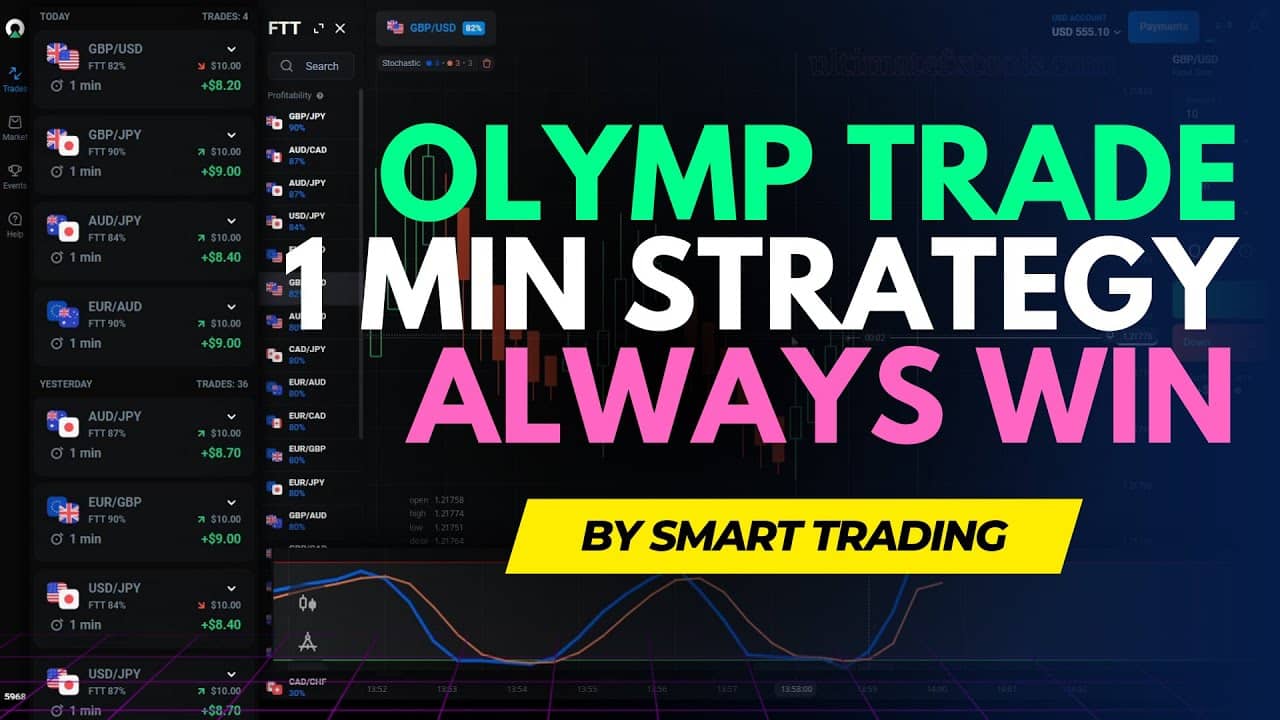
Dominate Olymp Trade with the 5-Second Quickler Strategy
"Dominate" in this title is a label, not a description of what actually happens on a live account. Nobody dominates a trading platform, and a five-second Quickler expiry on Olymp Trade is about the least forgiving timeframe you can trade. This guide walks through a Quickler setup built around the Vortex Indicator: how the signal is read, how to confirm it, the settings to start with, and — just as important — when the method breaks down. Treat every idea here as decision support, not a promise.
What Quickler and the Vortex Indicator Actually Do
Quickler is Olymp Trade's ultra-short instrument: a position can open and settle in as little as five seconds, so the only question is whether price is higher or lower when the timer ends. The Vortex Indicator is a two-line trend tool (VI+ and VI−) that tries to flag when a new short move is starting or an existing one is continuing. On a five-second horizon the tool has almost no room to be right or wrong — a single tick against you can close the trade out. That tiny window is exactly why so many Quickler ideas look great in screenshots and fall apart live: noise dominates over a few seconds, and no indicator filters that noise perfectly.
How to Set It Up
- Add the Vortex Indicator at its standard period of 14. Shortening it makes the lines cross far more often, which feels responsive but produces mostly false turns on a five-second read.
- Watch the first 5 to 30 seconds of price action after a fresh candle or tick cluster forms, rather than reacting to every flicker.
- Trade one or two liquid assets you actually know, not the whole list.
- Keep the chart clean so the two Vortex lines and the current price are easy to read under time pressure.
Entry Logic and Confirmation
The basic reads are deliberately simple so they can be applied calmly inside a few-second window:
- Up (higher): VI+ crosses above VI− and holds above it, and price is sitting above its recent short-term low. That agreement is your cue to consider an up position.
- Down (lower): VI− crosses above VI+, and price is failing under a recent short-term high.
- Stand aside: the two lines are tangled and repeatedly crossing, or price is flat. A crossing with no follow-through is the most common trap on Quickler — the lines touch, you enter, and price does nothing before the timer expires.
Confirmation matters more here than on any slower chart. Before committing, ask whether the wider one-minute picture agrees with the five-second cross. If the minute chart is drifting down while your five-second Vortex flashes an up cross, you are trading against the larger flow — usually a skip.
When This Method Fails (and Risk Management)
Be honest about the failure modes. During quiet, sideways periods the Vortex lines whipsaw and most signals are noise. Around news or thin liquidity, five-second candles gap and the read you saw is already gone by the time you click. And the expiry itself is unforgiving: even a correct direction can lose if you are half a second early.
Because of that, risk control is the whole game. Trades are independent events — a loss does not make the next trade more likely to win. Never respond to a losing streak by doubling your stake to "win it back"; that is the martingale trap, and on a five-second instrument it only concentrates your account into a few high-pressure clicks. Instead, stake a small, fixed fraction of your balance per trade, cap how many trades you take in a session, and stop for the day at a preset loss limit. Practice the whole routine on a demo account until the reads feel automatic before risking real funds. For slower, more readable variations of the same idea, the Olymp Trade Quickler 5-second and Quickler Option guides are a sensible next step, and the Vortex CCI 10-second method shows the same indicator applied with a little more breathing room.
FAQ
Is the 5-second Quickler strategy a way to "dominate" Olymp Trade?
No. "Dominate" is just the title's label. No strategy dominates a trading platform, and the five-second expiry is the hardest timeframe to trade well because it gives price almost no room to confirm. The Vortex setup is decision support that can make your entries more consistent, not a shortcut to guaranteed results.
What settings should I use for the Vortex Indicator?
Start with the standard period of 14 and leave it there until you have watched it on a demo for a while. Read signals off the first 5 to 30 seconds of fresh price action, and confirm the five-second cross against the one-minute trend before entering. Every indicator discussed on the site is included in the single $39 lifetime plan.
Should I increase my stake after a loss to recover?
No. Each Quickler trade is independent, so doubling down after a loss does not improve your odds — it just puts more of your balance at risk on the next click. Keep your stake a small, fixed fraction of your account and hold a firm daily loss limit.
This content is for educational purposes only. Trading involves risk. Past results do not guarantee future outcomes. Always practice responsible money management and limit your daily trades to avoid large losses.