Easy Trend Secret - Pocket Option
Let's be honest first: there is no secret here. The word sells, but the two tools behind this Pocket Option method — the Schaff Trend Cycle and the Momentum indicator — are standard, well-documented, and free on almost every charting package. They describe momentum that has already happened; they do not predict what comes next. Nothing here wins every trade, and any page that says otherwise is selling a fantasy. What follows is a clear way to read these two reversal signals on a two-minute expiry, and an honest account of when it breaks down.
What the Two Indicators Actually Plot
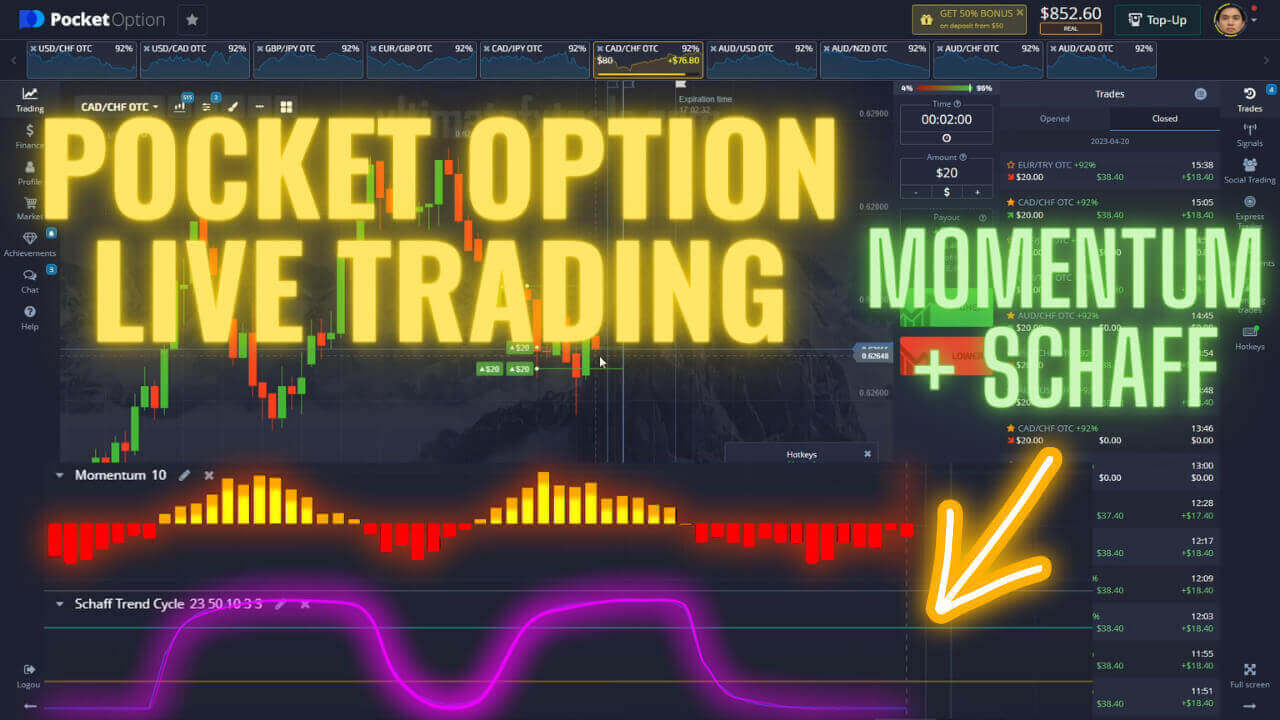
The Momentum indicator measures the rate of change of price — how fast the market is moving compared with a set number of candles ago. When Momentum pushes hard away from its centre line and then flattens or turns, it hints the current push is losing steam. The Schaff Trend Cycle (STC) is a faster, smoothed oscillator built on MACD-style calculations and a cycle component. It swings between roughly 0 and 100, and traders watch for it to reach an extreme and curl back the other way. Neither tool sees the future; both repackage recent price action into an easier-to-read line. A reversal signal is only ever a description of momentum that is already fading — which is why it fails so often in a strong trend, where price can keep running long after the oscillator looks "overbought."
The Setup and Settings
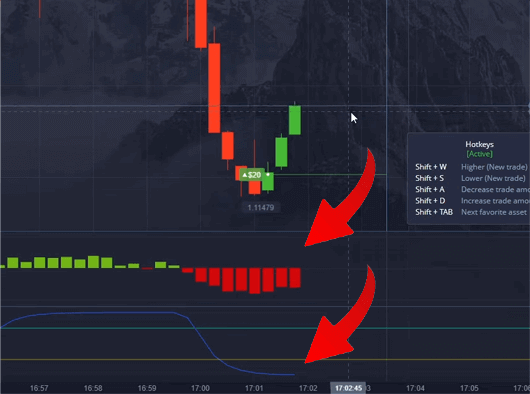
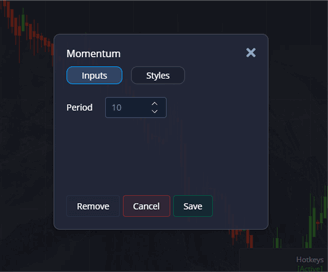
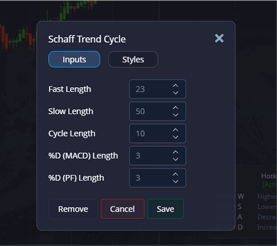
Read the signals in MetaTrader and time them against the matching Pocket Option chart. Analyse the trend first, then watch how Momentum fluctuates while the Schaff Trend Cycle sits at an extreme. Let each candle fully close before you act — a signal that looks valid mid-candle can vanish once the candle prints. The settings shown here are:
- Momentum: period 10.
- Schaff Trend Cycle: Fast Length 23, Slow Length 50, Cycle Length 10, %D (MACD) Length 3, %D (PF) Length 3.
- Timeframe / expiry: a 15-minute chart read down to a two-minute expiry. A two-minute expiry is high variance — a single unexpected candle decides the outcome, so treat the reads as probabilities, not certainties.
Entry Rules
Keep the rules simple so they can be applied calmly:
- Call (up): the Schaff Trend Cycle is turning up out of its lower extreme and Momentum has stopped falling and is curling higher, with price holding above a recent swing low.
- Put (down): the Schaff Trend Cycle is rolling over from its upper extreme and Momentum is turning down, with price failing under recent resistance.
- Stand aside: the two indicators disagree, or price is trending strongly in one direction with no sign of exhaustion. When only one tool signals, treat it as noise and wait.
When This Method Fails
This is the part most "secret" pages leave out. Reversal signals fail most in strong, one-directional trends: the STC can pin itself at an extreme while price keeps grinding the same way, printing loss after loss for anyone fading it. Both indicators also lag, since they are built from candles that have already closed, so in fast moves the signal arrives late. And because a two-minute expiry gives the market so little time to resolve, ordinary noise can flip a good read into a loss. The realistic goal is not to catch every reversal but to skip weak setups and stay consistent with the ones where both tools clearly agree.
Timeframe, Expiry and Risk
Risk control is what keeps you in the game long enough to matter. Stake a small, fixed fraction of your balance per trade, cap how many trades you take per session, and stop for the day once you hit a preset loss limit. Never chase a loss by increasing your next stake — that martingale-style doubling is how accounts get wiped out in a single bad streak, and no reversal signal justifies it. Practise on a demo account until the reads feel automatic before risking real funds.
Want to keep building? Compare it with the faster 1-minute crossover strategy, see the Schaff Trend Cycle paired differently in Donchian Channel and Schaff Trend Cycle, and browse the top Pocket Option strategies. It is also worth an honest look at how losses actually happen before you risk real money.
FAQ
Is there really a "secret" to this trend method?
No. The Schaff Trend Cycle and Momentum are standard indicators that anyone can add for free. There is no hidden edge and no setting that wins every trade — the value is in reading them consistently and skipping weak setups, not in a secret.
Why does the reversal signal keep failing in a trend?
Because reversal signals describe momentum that is already fading, not what price will do next. In a strong trend the oscillator can sit at an extreme while price keeps running, so fading it repeatedly produces losses. Standing aside during strong trends is part of the method.
Do I need to pay to use this?
No. The indicators and settings are shown here so you can build the setup yourself for free. If you would rather have the whole library, every indicator on the site is included with a single $39 lifetime plan.
This content is for educational purposes only. Trading involves risk. Past results do not guarantee future outcomes. Always practice responsible money management and limit your daily trades to avoid large losses.