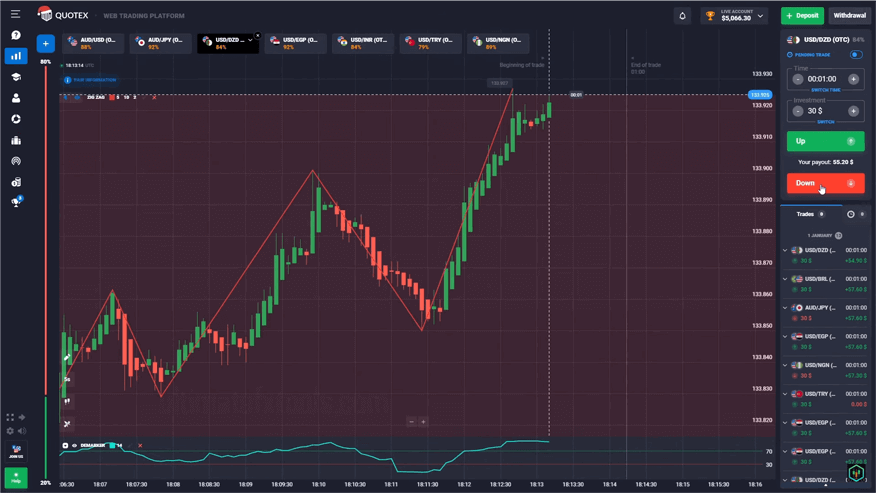
What Quotex Alert Signals Actually Are
An alert signal is a notification that a condition has already formed on the chart — it is not a prediction of what happens next. You will see sources promising a "remarkable 80 to 90% win rate" from alert signals; ignore them. No strategy has a knowable, fixed win rate, and any headline percentage is marketing, not a statistic. What alert signals actually do well is save you from staring at charts: they flag a moment worth a closer look. The decision to trade is still yours, and it should come after confirmation.
What an Alert Flags
Most Quotex-oriented alerts (for example the Binary Sniper Pro arrows read in MetaTrader) fire when price reaches a condition the indicator associates with a possible reversal or momentum shift. The alert points to direction and timing, but it cannot see the future — it is describing what price has just done. That distinction matters, because it tells you the alert is a starting point, not a finish line.
Alerts Can Repaint — Confirm on Candle Close
Many arrow and alert indicators repaint: the signal can appear mid-candle and then move or vanish before the candle closes. So the single most useful habit you can build is to wait for the candle that produced the alert to close before acting. If the signal is still there on the closed candle and it agrees with the wider trend, it is worth considering. If it disappeared, it was noise.
Reading and Confirming a Signal
Add one genuinely independent filter — a trend tool such as a moving average or Super Trend — and only take alerts that agree with it. Do not stack two momentum oscillators and call it confirmation; two tools that measure the same thing will usually agree and give you false confidence. Be selective: taking every alert is how traders over-trade and give back their gains.
Setup and Settings
Use the default indicator sensitivity to begin with, a one-minute chart with a one-minute expiry, and one or two liquid pairs rather than the synthetic OTC feed. Read the alert in MetaTrader, confirm on candle close against the trend, then place the Higher/Lower trade on Quotex. Practise the whole loop on a demo account first so confirming becomes second nature.
When This Approach Fails
Alerts misfire in choppy, directionless markets, around news, and whenever you chase every signal. Losing trades are normal; the goal is not to avoid them but to keep each one small. Never increase your stake to recover a loss — that martingale approach compounds risk fastest exactly when the market is against you and can empty an account in a short losing streak. Use a fixed, small stake and a hard daily loss limit. If you want the alert toolkit, the details are on the pricing page.
FAQ
Do Quotex alert signals really win 80–90% of the time?
No. That figure is a marketing claim, not a measured result. A signal flags a condition; it does not guarantee an outcome, and results vary with the market and your own execution. Treat any fixed win-rate promise as a red flag.
How do I confirm an alert before trading?
Wait for the candle to close, check that the signal agrees with the wider trend, and stand aside if price is ranging. See the Quotex alert signal guide and the Quotex 1-minute strategy for worked examples.
Which platform and settings suit a beginner?
Default sensitivity, a one-minute expiry, and one or two liquid pairs. The Quotex easy strategy and amazing Quotex alert-signal posts cover simple, honest starting points.
This content is for educational purposes only. Trading involves risk. Past results do not guarantee future outcomes. Always practice responsible money management and limit your daily trades to avoid large losses.


