Overview
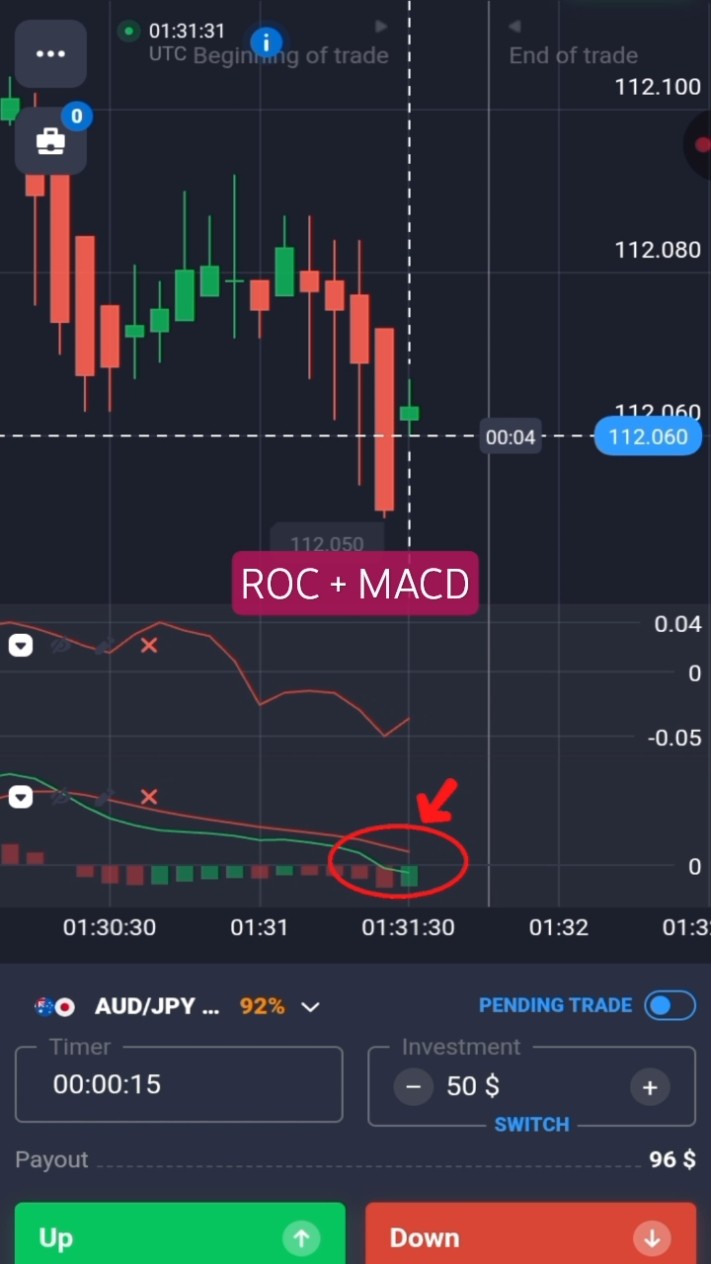
This is one of the simplest fast-expiry setups you can run on Quotex: just two built-in indicators, no scripts, no downloads. The Rate of Change (ROC) tells you how strong the current push is, and the MACD tells you which side is in control. When both agree — both pointing up or both pointing down — you take a 15-second trade in that direction.
Because the trades are so short, the chart is tuned for speed: 5-second Heikin Ashi candles smooth out the noise so the momentum reads stay clean, and the OTC pairs (AUD/JPY, USD/BRL, AUD/NZD and others) keep the setup available around the clock with payouts in the 88–92% range.
Chart Setup
Set the chart up first — the indicator readings only line up if the candles and time frame match:
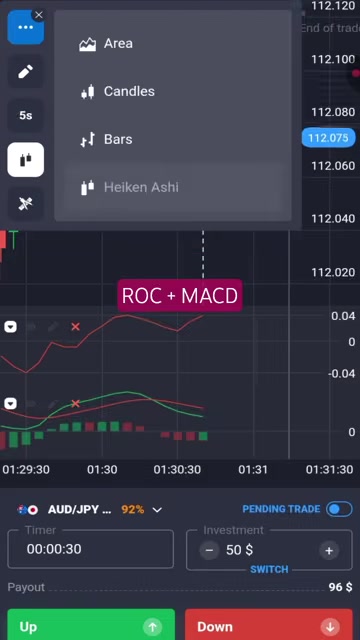
- Chart type: Heiken Ashi
- Time frame: 5 seconds
- Trade duration: 15 seconds
- Pairs: OTC pairs with high payout (92% shown in the video)
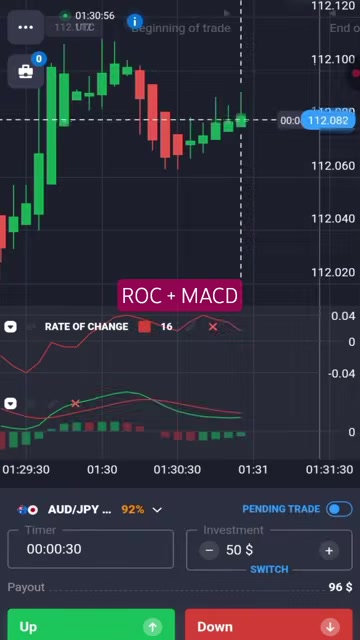
Indicator 1 — Rate of Change (16)
Add the Rate of Change indicator and set the period to 16. ROC measures how fast price is moving relative to 16 candles ago — when the line climbs, upside momentum is building; when it falls, sellers are pressing. On a 5-second chart it reacts quickly enough to catch the short bursts that a 15-second trade lives inside.
Indicator 2 — MACD (13, 22, 8)
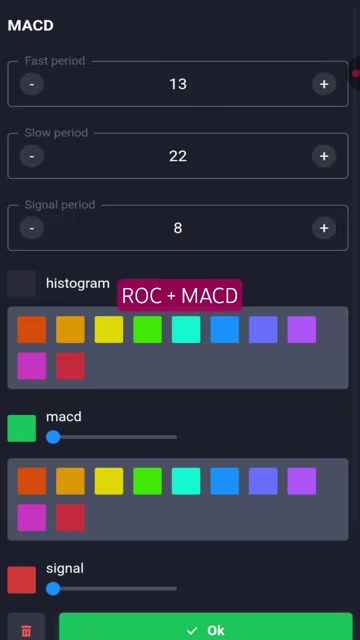
Add the MACD and change the default inputs to:
- Fast period: 13
- Slow period: 22
- Signal period: 8
These settings make the MACD a little quicker than the stock configuration, which suits the 5-second candles. Read it the classic way: MACD line above the signal line with green histogram bars = bullish control, MACD below the signal line with red bars = bearish control.
Entry Rules — Wait for the Sync
The whole strategy is one word: sync. You only trade when both indicators tell the same story at the same time.
UP (Call) Entry
- ROC is rising and pushing above its recent range
- MACD line crosses (or holds) above the signal line with green histogram bars
- Open an UP trade with a 15-second expiry
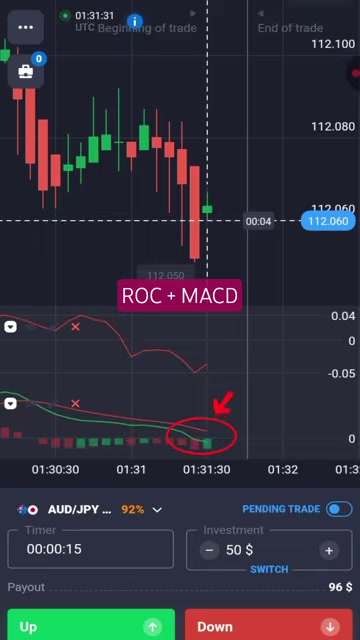
DOWN (Put) Entry
- ROC is falling, showing downside momentum
- MACD line crosses (or holds) below the signal line with red histogram bars
- Open a DOWN trade with a 15-second expiry
If one indicator is pointing up while the other is flat or pointing down, there is no trade — skip the candle and wait for the next clean sync. Most losing entries on fast expiries come from forcing a trade when the two indicators disagree.
Money Management
- Risk a fixed 1–3% of your balance per trade — never raise your stake to chase a loss
- No Martingale on 15-second trades — doubling down compounds risk far faster than it recovers value
- Stop after 2–3 consecutive losses and let the market reset before re-entering
- Set a session limit on total trades so a choppy OTC stretch can’t drain the account
Watch the Strategy in Action
See the full setup on Quotex — adding the Rate of Change and MACD, syncing the settings, and taking live 15-second entries on OTC pairs.
Risk Disclaimer
This content is for educational purposes only and is not financial advice. Trading involves significant risk, and 15-second expiries are among the fastest — and least forgiving — trade durations available. Past results do not guarantee future outcomes, and losses are a normal part of trading. Always practice on a demo account first, and only trade with capital you can genuinely afford to lose.
#Quotex #RateOfChange #MACD #HeikenAshi #15SecondTrading #BinaryOptions #OTCTrading #TradingStrategy #TradingEducation #RiskManagement