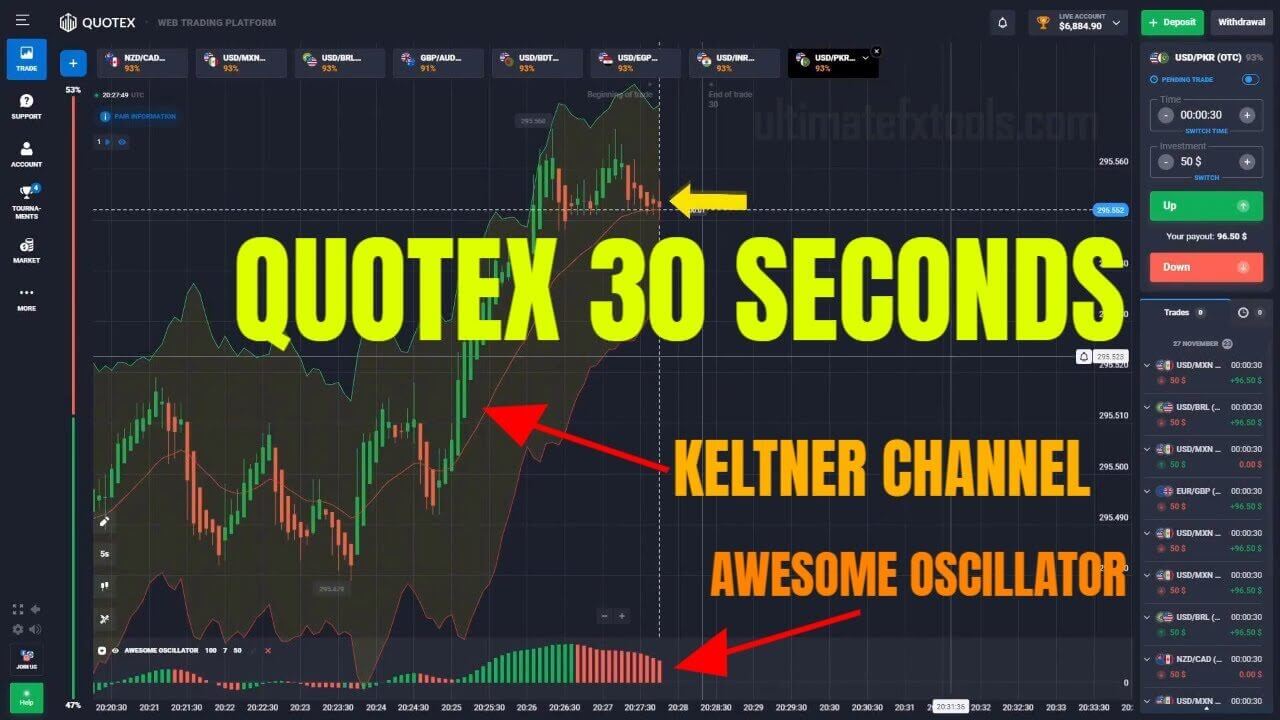
Quotex Keltner 30-Second Trading Strategy with the Awesome Oscillator
This approach pairs the Keltner Channel with the Awesome Oscillator (AO) to read short-term momentum on the Quotex platform. It is a fast, discretionary setup built for 30-second expiries. Before we go further, be clear-eyed about the timeframe: 30-second trades sit at the high-variance end of short-term trading, where a single tick can decide the outcome. No indicator combination removes that randomness, so treat this as a framework for reading price, not a shortcut to easy money.
What the Keltner Channel Actually Measures
The Keltner Channel is a volatility tool, not a reversal signal. It plots an exponential moving average (the middle band) and then adds and subtracts a multiple of the Average True Range to create the upper and lower bands. When volatility rises the bands widen; when it falls they contract. A price touch of an outer band simply means price has moved a set distance from its average — it does not confirm that price will bounce back. In a genuine trend, price can ride an outer band for many candles. Treat the bands as context for where price sits relative to recent volatility, and lean on the Awesome Oscillator to gauge whether momentum is building or fading.
Settings, Timeframe and Entry Rules
These are the reference settings for the strategy. Adjust them on a demo account before committing real funds, since different assets behave differently.
- Keltner Channel: EMA period 20, ATR period 10, multiplier 3
- Awesome Oscillator: short period 7, long period 50
- Candle timeframe: 5 seconds
- Trade duration: 30 seconds
The rules below describe conditions to look for — they are a filter, not a promise:
- UP trade: AO histogram bars are green and building upward while price holds around the middle band and turns higher. Skip the setup when price is already stretched to the outer band.
- DOWN trade: AO bars are red and building downward while price sits near the middle band and rolls over. Again, avoid entries when price is pinned to an outer band.
Waiting for both tools to agree cuts down on impulsive entries. If the AO and the channel disagree, the honest response is to take no trade at all. For a slower, less frantic version of the same idea, compare it with our Quotex 1-minute strategy.
Where This Setup Is Weak
The biggest trap is treating a band touch as a reversal trigger. It is not. During strong directional moves the channel expands and price hugs the outer band, so “fade the band” entries get run over. The 5-second candle also produces a lot of noise, and at 30 seconds the outcome is heavily influenced by spread and short-lived spikes. Ranging, low-liquidity conditions can chop both indicators into conflicting signals. Knowing these failure modes is what keeps you out of the worst trades.
Realistic Expectations
Any short-term method will produce losing runs. The point of a rule set is consistency and discipline, not certainty. Judge the strategy over a large sample on demo, track your entries, and only consider live trading once you understand how it behaves in trending versus ranging markets. If you prefer a simpler starting point, the Quotex easy strategy covers the same discipline with fewer moving parts. The packaged indicator versions and the wider library are available through our $39 lifetime access, but the free rules above are enough to start testing.
Risk Management
Risk control matters more than any signal on a 30-second chart. Keep each trade to a small fixed fraction of your balance so that a losing streak cannot wipe you out. Set a daily loss limit and stop for the day when you reach it. Do not use martingale or any stake-doubling recovery scheme — increasing size after losses can drain an account quickly and turns a bad run into a catastrophic one. Slower, flat staking gives you the survival time to actually learn the setup.
Frequently Asked Questions
Does this strategy win every trade?
No. No strategy wins every trade, and 30-second trading is especially high-variance. Expect losing trades and losing streaks, and size your positions so you can withstand them.
Is a Keltner band touch a reversal signal?
No. The Keltner Channel measures volatility, not exhaustion. Price can stay on an outer band throughout a trend. Use the band for context and let momentum and price action guide the decision.
Can I use these exact settings on any asset?
Not necessarily. Volatility varies across assets and sessions, so the EMA, ATR and multiplier values that suit one pair may be too tight or too loose on another. Test on a demo account first and adjust.
This content is for educational purposes only and is not financial advice. Trading involves substantial risk; you can lose some or all of your capital. No result is guaranteed and past performance does not indicate future results. Trade only what you can afford to lose.


