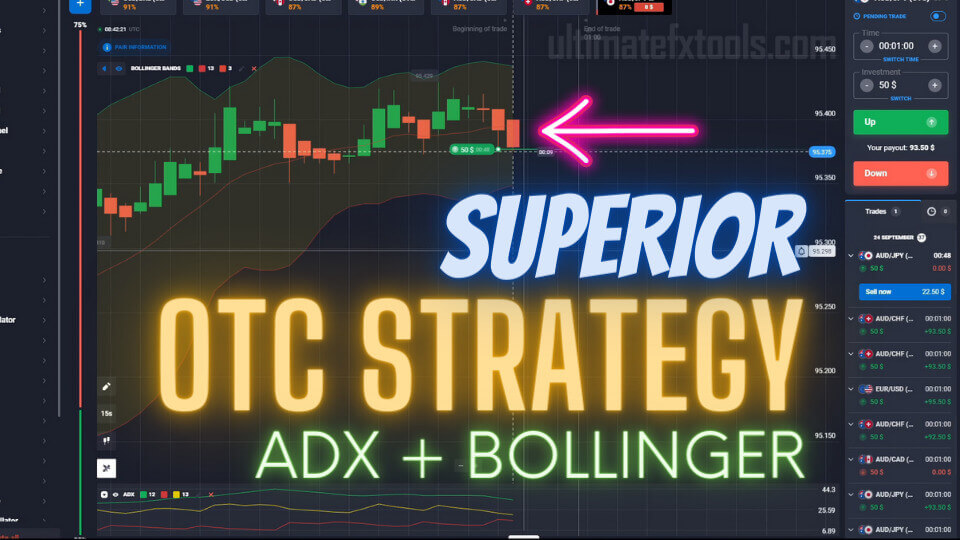
"Superior" is a big word in trading, so let's be honest about what this Quotex OTC method is and is not. It pairs two well-known indicators - the ADX (Average Directional Index) and Bollinger Bands - to filter short-term setups on the OTC market. Nothing here wins every trade. What it does is give you a clearer, rule-based reason to enter or to stand aside. Remember that OTC pairs are synthetic instruments generated by the platform, not live interbank currency, so treat them as their own environment and only risk what you can afford to lose.
What ADX Actually Measures
The most common mistake with ADX is assuming it tells you direction. It does not. ADX measures trend strength only - how strongly price is moving, regardless of whether it is going up or down. A rising ADX means the current move (up or down) is gaining conviction; a low, flat ADX means price is drifting sideways with no clear push. Direction comes from the two companion lines, +DI and -DI: when +DI is above -DI buyers have the edge, and when -DI is on top sellers do. In this setup we use ADX purely as a filter - a way to skip the choppy, rangebound conditions where short-term OTC trades tend to get whipsawed.
What Bollinger Bands Add
Bollinger Bands wrap a moving average in an upper and lower band set a number of standard deviations away, so they react to volatility. When price stretches to the outer band it is statistically extended from its average, which can hint at a stall or a snap back toward the middle. On a one-minute chart the bands help you time an entry after ADX confirms the move has strength. Used alone the bands produce plenty of false touches, which is exactly why the ADX filter matters.
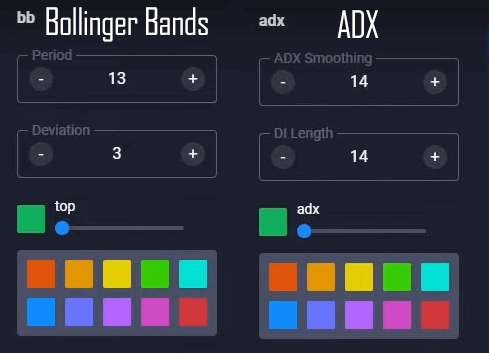
How the Two Combine: Timeframe and Entry Rules
The idea is simple: let ADX decide whether to trade and let Bollinger Bands help decide when. A workable one-minute framework:
- Only look for entries when ADX shows strength building rather than a flat, low reading.
- For a higher trade, wait for price to reach the lower band while +DI sits above -DI and a candle starts to turn back up.
- For a lower trade, wait for price to reach the upper band while -DI sits above +DI and momentum rolls over.
- Match your expiry to the timeframe - short expiries suit a one-minute read; test what fits your own routine on a demo first.
Reading a Setup
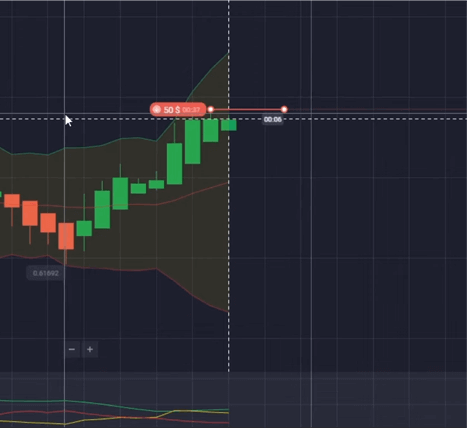
A long lower wick tapping the lower band can signal that sellers are losing control and price may lift for a few candles. If ADX confirms that momentum is present rather than fading, that alignment is a reasonable cue to consider a higher entry. Near a resistance level, if +DI and -DI converge and price is pressing the upper band, the odds of a pullback improve and a lower entry may make sense. These are cues, not certainties - some will still fail.
Realistic Expectations
No indicator pair predicts the next candle. ADX and Bollinger Bands both look at data that has already printed, so they describe conditions, not the future. Expect losing trades in any normal run, and judge the method over many entries rather than one or two. Free, legitimate resources like babypips.com and investopedia.com are good places to deepen your understanding before risking real money. For a gentler starting point read our Quotex Easy Strategy, and for a related ADX approach see 40 Second Quotex ADX Reversals.
Risk Management
Despite potential losses from trend miscalculations, do not try to "recover" them with a Martingale strategy (raising your stake after a loss). This is a serious warning: each trade is independent, so a bigger stake never improves the next outcome, and a normal losing streak makes the required stake balloon until it exceeds your balance and empties the account. Use fixed-fractional staking instead - a small, constant percentage of your balance per trade - and set a hard per-session loss cap that you stop at no matter what. Trade a demo until the rules feel automatic before committing real funds.
Frequently Asked Questions
Does this strategy win every trade?
No. No strategy wins every trade, and any claim otherwise is a red flag. ADX and Bollinger Bands only improve the quality of your entries by filtering out weak conditions; losing trades are a normal, expected part of the process.
Is ADX a direction indicator?
No. ADX measures trend strength, not direction. You read direction from the +DI and -DI lines - +DI above -DI favours buyers, -DI above +DI favours sellers - while ADX tells you how much conviction is behind the move.
Do I need to pay to use this?
No. Both indicators are standard and free on Quotex and most charting tools. If you later want our full library of indicators and strategies bundled together, that is available for a one-time $39 lifetime payment, but this method works with the built-in tools.
Superior Quotex OTC Strategy
This content is for educational purposes only and is not financial advice. Trading involves substantial risk; you can lose some or all of your capital. No result is guaranteed and past performance does not indicate future results. Trade only what you can afford to lose.


