Plenty of guides promise the single "most effective" 1-minute setup, but the honest truth is that no strategy is universally best. What works depends on the pair you trade, current market conditions, and how disciplined you are with entries and exits. The approach below is a clear, rules-based framework you can test for yourself. It gives you structure, but it is not a shortcut to guaranteed results, and it will not win every trade.
Powerful Pocket Option Strategy
This is a simple, trend-confirmation approach designed for short-term trading on a 1-minute or 30-second candle time frame. It combines two well-known indicators to help you filter out weak setups: Parabolic SAR and Moving Average Convergence Divergence (MACD). The idea is straightforward: use Parabolic SAR to read the direction and momentum of the current trend, and use MACD as a second opinion before you commit to a trade.
Indicator Settings
Parabolic SAR: Set the acceleration factor to 0.02 and the maximum acceleration to 0.2. The dots appear below price during an uptrend and above price during a downtrend.
MACD: Use the standard parameters — Fast Period 12, Slow Period 26, Signal Period 9.
Timeframe and Entry Rules
On such a fast timeframe, patience matters more than speed. Wait for both indicators to agree before you act:
Parabolic SAR confirmation: Look for at least four consecutive dots on the same side of price. Four or more dots below price suggests a developing uptrend; four or more above price suggests a downtrend.
MACD confirmation: Watch the crossover of the MACD line and the signal line. A cross from below that turns upward supports an up move; a cross from above that turns downward supports a down move.
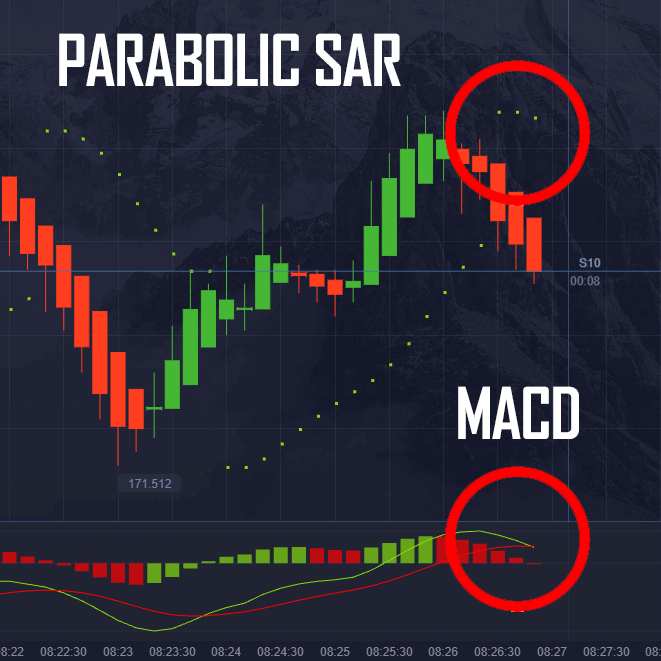
Only place a trade once both signals line up in the same direction, and wait for a clear candlestick that supports that direction. Skipping setups where the two indicators disagree is a feature, not a flaw — it keeps you out of choppy, low-conviction conditions.
Why Effectiveness Varies
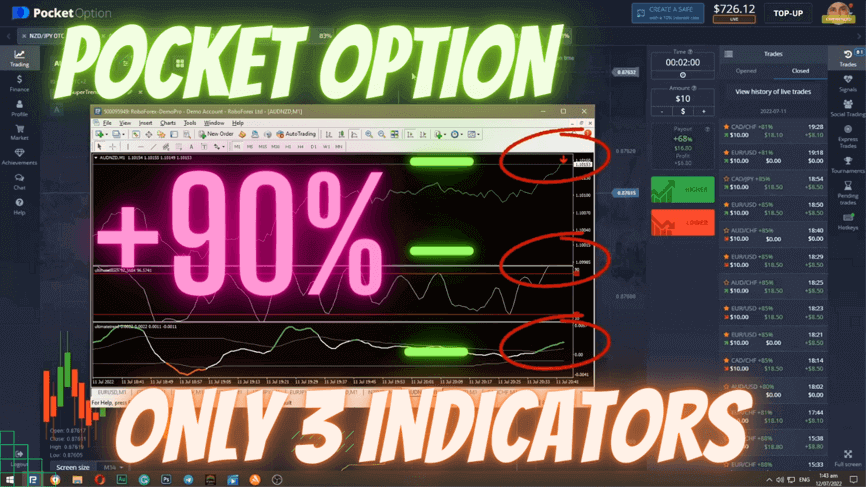
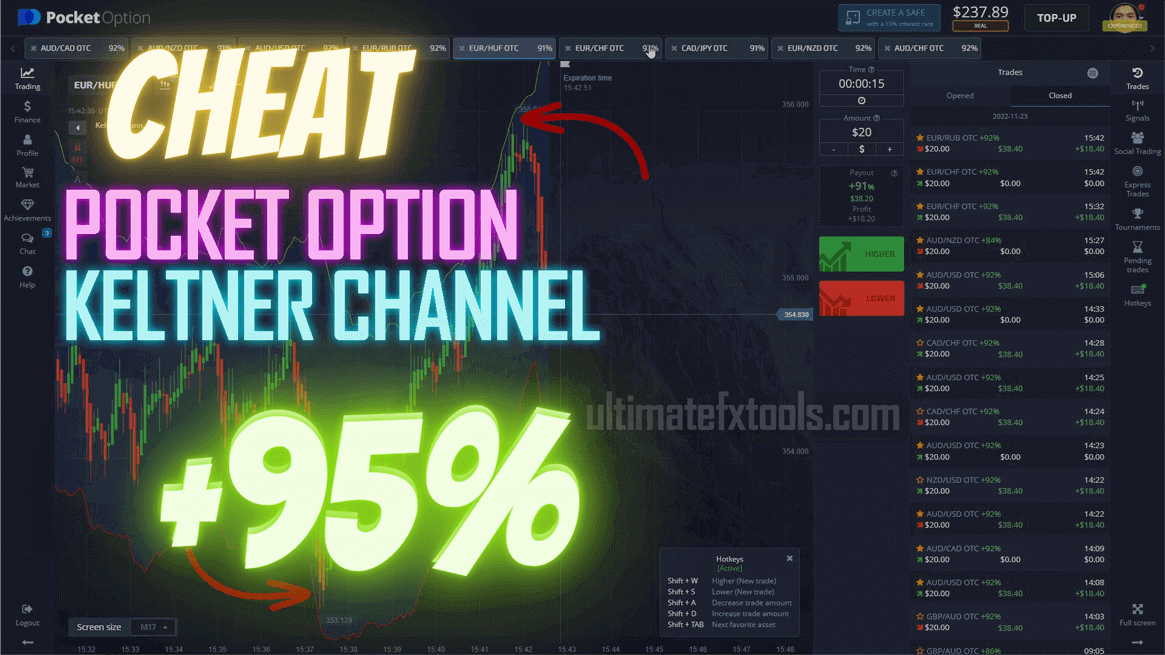
The 1-minute chart is high-variance by nature. Price is noisy at this speed, spreads and payout timing eat into small moves, and a run of losing entries can happen even when you follow every rule. Two indicators can both confirm and price can still reverse the moment you enter. That is normal market behaviour, not a broken strategy. If you prefer calmer conditions, the same logic works better on higher timeframes, and it pairs well with other approaches such as our 3-indicator Pocket Option method or the Keltner Channel strategy. Test any setup on a demo account across many sessions before you risk real money.
Risk Management
Because outcomes vary, risk control is what keeps you in the game long enough to learn:
- Risk only a small, fixed portion of your account per trade — many traders cap this at 1–2%.
- Set a daily loss limit and stop for the day once you hit it.
- Avoid martingale. Doubling your stake after a loss can wipe out an account quickly on a high-variance timeframe; it does not improve your odds.
- Keep a simple journal so you can see whether the strategy actually suits your style over time.
Frequently Asked Questions
Does this strategy win every trade?
No. No strategy wins every trade, and this one is no exception. Confirmation from Parabolic SAR and MACD can improve the quality of your setups, but losing trades are a normal part of trading and you should expect them.
Is a 1-minute timeframe good for beginners?
It is one of the hardest environments to trade because decisions happen quickly and price is noisy. Beginners often benefit from practising on a demo account and on slightly higher timeframes first, then scaling down once the rules feel automatic.
Can I automate these indicators?
Both Parabolic SAR and MACD are standard tools available on most trading platforms, and you can add alert-based versions to flag confirmations for you. Our full indicator library is available for a one-time $39 lifetime purchase if you want ready-made tools to build on.
This content is for educational purposes only and is not financial advice. Trading involves substantial risk; you can lose some or all of your capital. No result is guaranteed and past performance does not indicate future results. Trade only what you can afford to lose.