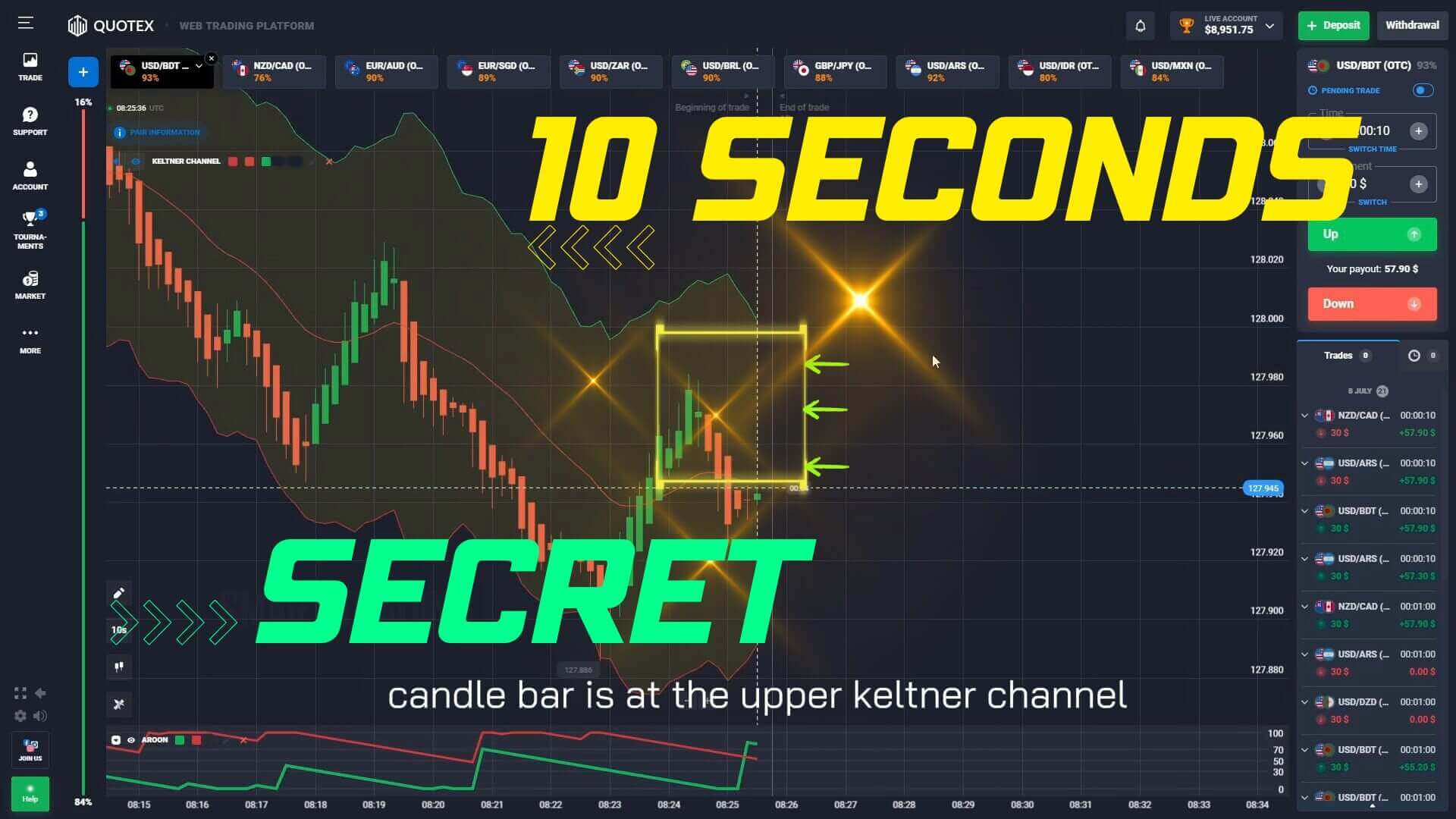
Perfect Trading Method Using Aroon Indicator and Keltner Channel
This Quotex setup uses just two indicators working together: the Aroon indicator and the Keltner Channel. The pairing works because each tool answers a different question. Aroon measures how fresh and strong a trend is by tracking how recently price made a new high or low, while the Keltner Channel maps a volatility envelope around a moving average. On their own, either indicator can fire at the wrong moment. Used together, one confirms the other, which is what you want on fast Quotex candles where noise is high and there is little time to react.
The approach is built for very short trades: 10-second candles with a matching 10-second expiry, taken without any Martingale recovery. It rewards patience over speed, because most candles will not offer a clean setup. The goal is not to trade every bar but to wait for the two indicators to agree, then act. Below is how each piece works and the rules that keep both signals aligned before you place a call or a put.
What the Aroon Indicator Does and How to Set It
Aroon plots two lines, Aroon-Up and Aroon-Down, each moving between 0 and 100. Aroon-Up rises toward 100 when price has recently made a new high, and Aroon-Down rises when price has recently made a new low. When Aroon-Up is high and sits above Aroon-Down, momentum leans up; when Aroon-Down is on top, momentum leans down. The moment the two lines cross is the trigger you watch for. A common starting period is 14, but on 10-second candles many traders shorten it so the lines react faster. Keep the period consistent while you learn the setup rather than changing it mid-session.
What the Keltner Channel Adds and Its Settings
The Keltner Channel draws an upper band, a lower band, and a central moving average (typically a 20-period EMA), with the bands offset by a multiple of Average True Range, often around 2x ATR. It gives context Aroon alone cannot: is price merely drifting inside the channel, or pushing decisively through the middle line toward a band? Treat the central EMA as the dividing line between bullish and bearish pressure, and use the outer bands as a caution zone. If price is already jammed against the far band, the easy part of the move may be over, so a fresh signal near the middle of the channel tends to be cleaner than one taken at an extreme.
Call and Put Rules, Timeframe, Expiry and Risk
Both indicators must agree before you act. For a buy or call: wait for Aroon-Up to cross above Aroon-Down while price holds above the Keltner central EMA (ideally rising from the middle of the channel, not already pinned to the upper band). For a sell or put: wait for Aroon-Down to cross above Aroon-Up while price sits below the central EMA. If the Aroon cross fires but price is on the wrong side of the Keltner line, skip the trade. The timeframe is the 10-second chart with a 10-second expiry, so decisions happen quickly; have your rules memorised before you start.
Risk control matters more than any single entry. Trade a small, fixed stake, avoid Martingale, and cap the number of trades per session so a run of losing entries cannot wipe out a day of steady work. Practise on a demo balance until the call/put rules feel automatic, and favour currency pairs with a strong payout rate on the platform. Consistency here comes from taking only aligned signals and walking away when the two indicators disagree.
See the Setup in Action
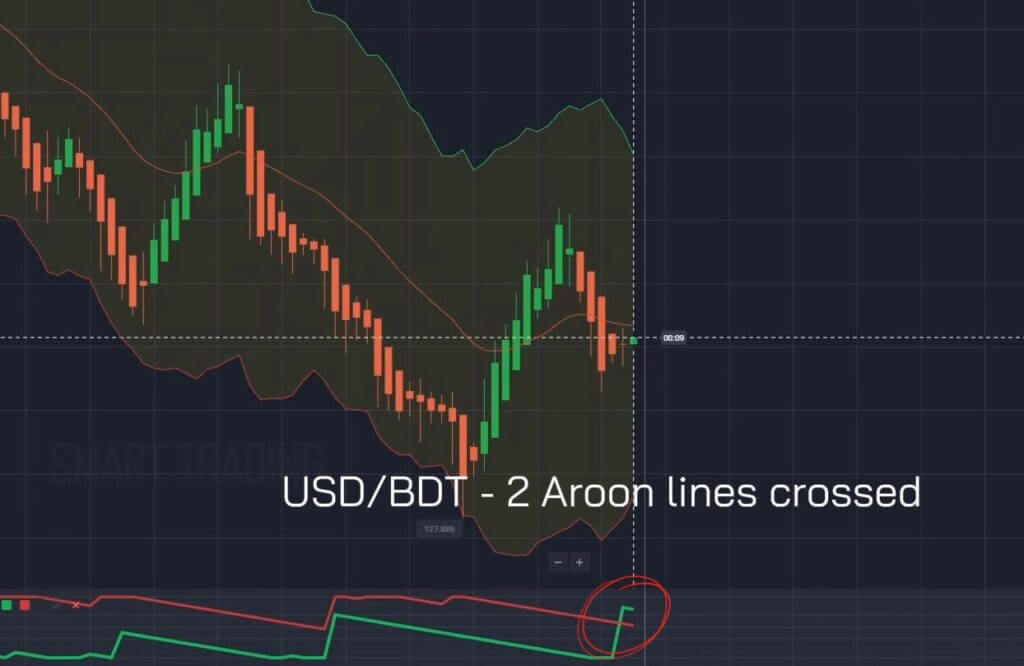
The walk-through video below shows the Aroon cross lining up with the Keltner Channel on a live chart, and covers the exact indicator periods and channel settings used.
For more short-expiry ideas, the 10 Seconds Hack Quotex guide pairs well with this method, while Master Quotex with these 3 Indicators shows how to add a third confirmation later. Beginners may prefer the simpler Quotex Easy Strategy first. To download the ready-made indicators and every settings file in one place, see our lifetime access on the pricing page.
FAQ
Do both indicators really need to agree before I trade?
Yes. The whole point of the pairing is confirmation. An Aroon cross tells you momentum may be turning, and the Keltner Channel tells you whether price structure supports it. If price is on the wrong side of the central EMA when the cross fires, treat it as no signal and wait.
What timeframe and expiry does this setup use?
It is designed for the 10-second candle chart with a matching 10-second expiry. That is fast, so practise on a demo balance until the call and put rules are second nature. If 10 seconds feels too quick, test the same logic on slightly longer candles first.
Can I use Martingale to recover a losing trade?
This method is shown without Martingale on purpose. Doubling stakes after a loss can grow risk far faster than any short-expiry setup can recover it. A small fixed stake and a daily trade limit are safer ways to manage a losing streak.
This content is for educational purposes only. Trading involves risk. Past results do not guarantee future outcomes. Always practice responsible money management and limit your daily trades to avoid large losses.


