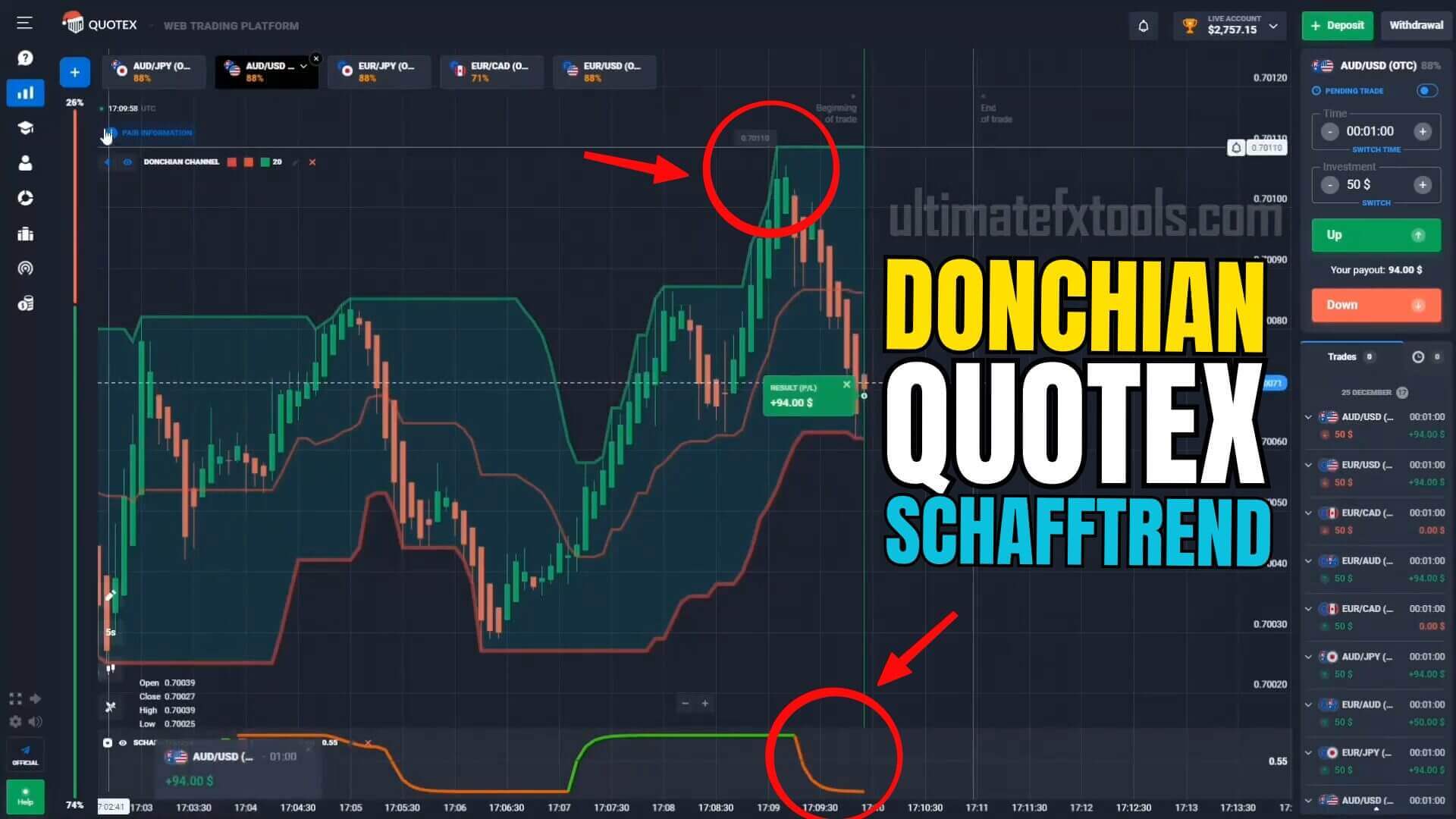
The Donchian Channel + Schaff Trend Cycle Strategy on Quotex
This 60-second Quotex setup pairs two well-known tools: the Donchian Channel to mark where price has stretched to a recent extreme, and the Schaff Trend Cycle (STC) to time the momentum shift. The idea is confirmation: the Donchian band spots a potential reversal zone, and the STC has to agree before you act. It is a reasonable framework, but the "80% win rate" in the title deserves an honest look before you risk a cent.
What Each Indicator Actually Does
The Donchian Channel plots the highest high and lowest low over a set number of candles, creating dynamic support and resistance boundaries. A touch of the upper or lower band shows price has reached a relative extreme, not that a reversal is guaranteed. In a strong trend, price can ride the outer band for many candles, and a band touch alone is a poor signal.
The Schaff Trend Cycle is a momentum oscillator that reacts faster than a plain MACD. It is meant to reduce lag, but that speed has a cost: in choppy, sideways conditions the STC whipsaws back and forth between colours, firing signals that reverse a candle later. Neither tool predicts the future. They describe what price has already done, which is why they only carry weight when they line up with each other and with the wider market context.
Is the "80% Win Rate" Real? No.
No indicator combination wins 80% of trades reliably, and any figure like that should be treated as marketing, not a forecast. On short 60-second binary options the outcome is close to a coin flip once the platform's payout is taken into account. It is also worth being clear that a payout percentage is not a win rate: an 80% payout means a winning trade returns 80% of your stake, while a loss costs you 100%. That math means you need a genuinely high proportion of winners just to break even, and results vary widely by asset, session, and volatility. Treat this method as a structured way to filter entries, not a promise of profit.
Timeframe and Entry Rules
- Platform: Quotex (including the OTC section)
- Chart timeframe: 60-second candles
- Trade duration: 60 seconds
- Donchian Channel: 20-period is a sensible default
- Schaff Trend Cycle: 10, 50, 5 is a common starting point
For a PUT (down) trade, wait for price to reach the upper Donchian band, then require the STC to turn red and slope downward before you enter. If the STC stays green, skip the trade. For a CALL (up) trade, do the exact opposite: price reaches the lower band and the STC turns green and slopes upward. If the STC stays red, skip it. When the two disagree, there is no trade. Full setup notes are in our Quotex Donchian Channel and Schaff Trend Cycle guide, and if you want a simpler entry point, the Quotex easy strategy covers the same discipline with fewer moving parts.
Realistic Expectations
Two things break this setup most often. First, false Donchian breakouts: a band touch in a trending market is not a reversal, it is often continuation. Second, STC whipsaws in a ranging market, where the oscillator flips colour repeatedly and drags you into low-quality trades. If you take two or three losing signals in a row, that is the market telling you conditions are choppy, so stop and wait rather than pushing harder.
Risk Management
- Position sizing: Risk only a small, fixed fraction of your account per trade, commonly 1-2%.
- Never use martingale. Doubling your stake after a loss to "recover" is how accounts are wiped out in a single losing streak. Avoid it entirely.
- Avoid high-impact news: Volatility spikes around major economic releases make 60-second entries unpredictable.
- Keep a journal: Log every trade, both winners and losers, so you can see whether the setup actually works for you before committing more.
Prefer to skip the manual setup? Our full library of indicators and strategies is available for a one-time $39 lifetime purchase, MT4/MT5 compatible.
Frequently Asked Questions
Is the 80% win rate in the title real? No. No strategy delivers an 80% win rate reliably, and a headline number like that is not something you should plan around. Test any approach on a demo account and judge it by your own recorded results.
Does the Schaff Trend Cycle work well on 60-second charts? It can help time entries, but it whipsaws in sideways markets and produces false signals in chop. It is a filter, not a crystal ball, and it works best alongside price context rather than on its own.
Can I automate this on Quotex? Quotex does not support custom indicator automation the way MT4/MT5 does, so this is a manual, discretionary method. Practice the entry rules on a demo account first.
This content is for educational purposes only and is not financial advice. Trading involves substantial risk; you can lose some or all of your capital. No result is guaranteed and past performance does not indicate future results. Trade only what you can afford to lose.


