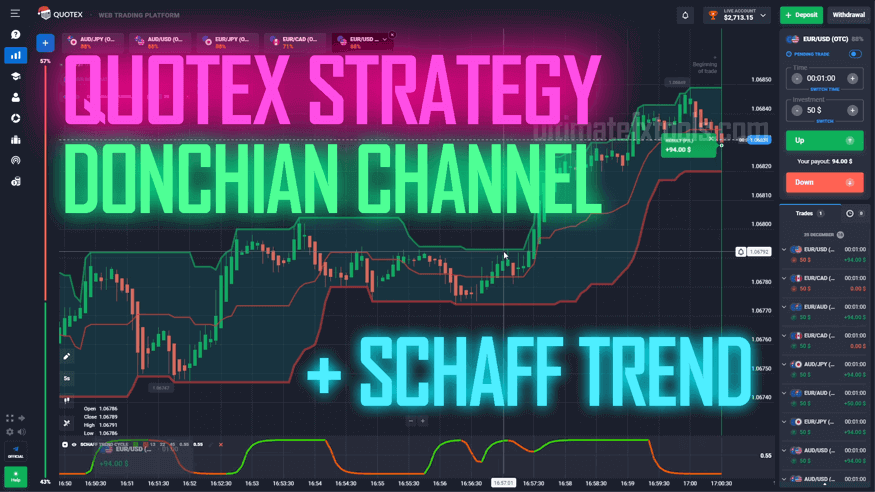
The Donchian Channel and the Schaff Trend Cycle solve two different problems on a Quotex chart, which is exactly why traders pair them. The Donchian Channel marks where price is relative to its recent range, while the Schaff Trend Cycle (STC) tries to time when momentum is turning. One draws the levels, the other reads the timing. Read this first: a signal is a prompt to check the context, not a reason to click blindly.
What the Donchian Channel Does
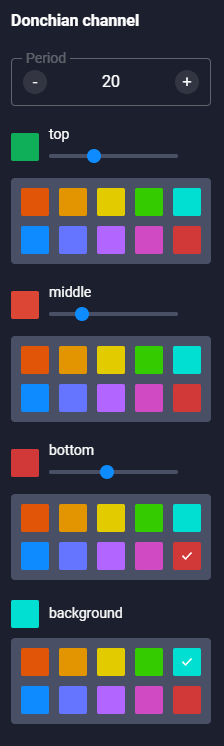
The Donchian Channel plots three lines: the highest high and the lowest low over the last N bars, plus a middle line halfway between them. That makes it a pure range-and-breakout tool. When price pushes to the upper band, it is making a new high for the lookback window; when it sinks to the lower band, it is making a new low. A flat, wide channel tells you the market is ranging, and a channel that is expanding and sloping tells you a trend is underway. The bands, built from actual highs and lows, double as visible support and resistance.
What the Schaff Trend Cycle Does
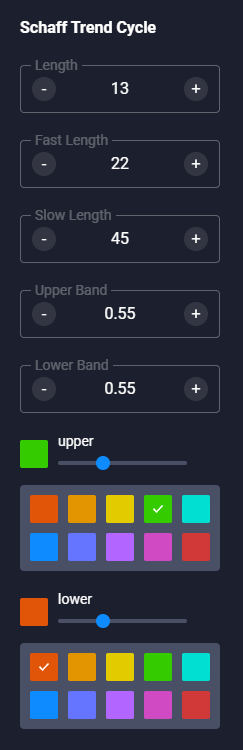
The Schaff Trend Cycle is a smoothed, faster relative of the MACD. It runs a MACD-style calculation through a cycle-and-smoothing process, then scales the result between 0 and 100. The aim is to flag a turn earlier than a standard MACD would, with high readings pointing to overbought momentum and low readings to oversold. The trade-off is that this speed makes the STC jumpy: in a sideways market it can flip up and down and print turns that never follow through, so it is most reliable when the wider market is actually moving.
Why Pair Them on Quotex
Quotex is a fixed-expiry platform, so every position closes when the timer runs out and the only question is direction. The Donchian Channel answers "where are we?" and the STC answers "is momentum turning here?". When both line up, the case for a trade is stronger; when they disagree, you stand aside. Using the channel as the level filter keeps you from acting on STC signals that are stranded in the middle of the range.
How to Set It Up
Add both indicators from the Quotex indicator list and match the values shown in the settings images above. A Donchian Channel period around 20 bars is a common starting point: shorter reacts faster but catches more noise, longer is smoother but slower. Leave the Schaff Trend Cycle on its default cycle and smoothing inputs so the 0-100 scale behaves as designed. Trade a small number of liquid pairs you know well, let each candle fully form before you read a signal, and keep the chart uncluttered.
Entry Logic
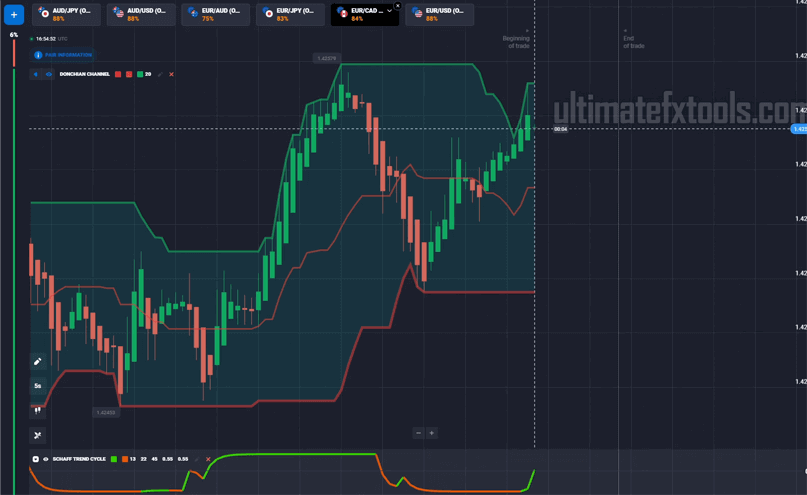
- Up (buy / higher): price is testing or holding the lower Donchian band and the Schaff Trend Cycle is turning up out of its oversold zone. The band gives the level, the STC times it.
- Down (sell / lower): price is testing the upper Donchian band and the STC is rolling down out of its overbought zone.
- Stand aside: the channel is flat and narrow, price is stuck in the middle, or the STC is chopping without a clear turn. A conflict between the two is a skip, not a trade.
When This Setup Fails
The weak spot is a quiet, ranging market. There the Donchian bands sit flat and the Schaff Trend Cycle produces its most false signals, snapping to overbought and oversold on moves that go nowhere. A breakout through a band can also fake out and snap back inside, so a single band touch is not a signal by itself. This is why risk management carries the setup: stake a small, fixed fraction of your balance per trade, cap how many trades you take in a session, and stop once you hit a preset daily loss limit. No indicator removes losing trades, so aim for steady, repeatable decisions and practise the rules on a demo account until the reads feel automatic before risking real funds. For related range-and-momentum ideas, see the 1-minute Quotex ATR and Donchian setup, the Fractal and Donchian mobile method, and this Schaff Trend Cycle with Momentum guide.
FAQ
Is the Donchian Channel a trend or a range tool?
Both, depending on what price is doing. Flat, parallel bands describe a range and mark the edges to fade; expanding, sloping bands describe a trend and mark where breakouts happen. Reading which state you are in is the first job before acting on any STC signal.
Why does the Schaff Trend Cycle give false signals?
Its speed is the reason. The STC is built to turn earlier than a MACD, and that same sensitivity makes it flip on small, directionless moves when the market is quiet. Filtering its signals through the Donchian bands and skipping flat conditions is how you cut down on those false turns.
Do I need to buy anything to try this?
No. Both indicators are available inside Quotex, so you can test the method on a demo account for free. If you later want the full library of UltimateFXTools indicators and strategies, it is all included in one $39 lifetime plan.
This content is for educational purposes only. Trading involves risk. Past results do not guarantee future outcomes. Always practice responsible money management and limit your daily trades to avoid large losses.


