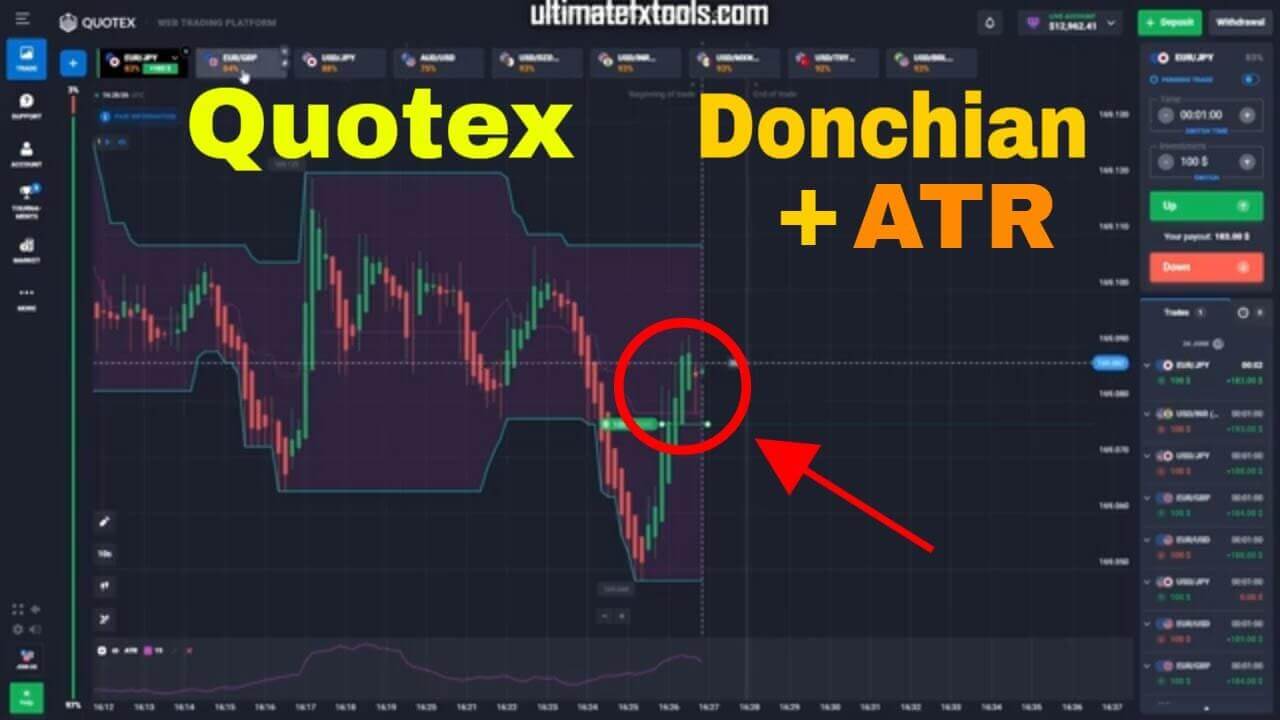
1-Minute Quotex Strategy with ATR and the Donchian Channel
This is a short-expiry Quotex setup that reads two different tools side by side: the Donchian Channel, which maps the recent trading range, and the Average True Range (ATR), which measures how much price is actually moving. Read this first: a chart setup is decision support, not a promise — you still confirm the context and manage risk on every position.
What the Donchian Channel Shows
The Donchian Channel plots three lines from the last N candles: the upper band is the highest high over that lookback, the lower band is the lowest low, and the middle line is the average of the two. That makes it a pure range-and-breakout tool. A push to a fresh upper band is a new short-term high, a drop to the lower band a new short-term low, and the middle line a rough centre price swings around. Nothing here predicts direction on its own — it describes where price sits inside its recent range, which is why a second input helps.
What ATR Measures — and What It Does Not
ATR is a volatility gauge, not a direction signal. It averages the true range of recent candles: how far price travels per bar. A rising ATR means candles are getting bigger and the market is speeding up; a falling ATR means moves are shrinking and going quiet. ATR does not say whether the next candle is green or red, and treating a high reading as a buy signal is a common mistake. Its job here is context and sizing: it tells you whether a break of a Donchian band has real momentum behind it or is happening in a dead market where the move is more likely to stall.
The Setup and Settings
Keep the chart clean with just these two indicators loaded. The settings below are a starting point — adjust them to the pair you trade, and confirm any change on demo first.
- Donchian Channel period: 20 — frames the recent range without reacting to every candle.
- ATR period: 14 — a standard volatility window that reacts quickly enough for a one-minute chart without flipping on noise.
- Chart timeframe: 1-minute, with a matching 1-minute trade duration.
- Pairs: a small number of liquid pairs you know well.
Entry Logic
The idea is to trade a Donchian move only when ATR shows there is genuine energy behind it:
- Up (buy / call): price breaks and holds above the Donchian upper band, or pushes up through the middle line, while ATR is rising — the expanding volatility suggests real momentum, not a single stray candle.
- Down (sell / put): price breaks below the lower band, or falls through the middle line, while ATR rises in step with the move.
- Stand aside: price nudges a band while ATR is flat or falling. A break on shrinking volatility is where false breakouts live — let it resolve.
When It Fails: False Breakouts
The main weakness of any Donchian setup is the false breakout. In a ranging market, price frequently pokes above the upper band or below the lower band and then snaps straight back inside — the break looks real for one candle and then fails. This is why ATR matters as a filter: a break into a quiet, low-ATR backdrop has little behind it, while a break as ATR expands is more likely to follow through. Even then, nothing removes losing trades. Ranges can whipsaw both indicators at once, and news spikes can blow price through a band and reverse in seconds. Treat every signal as a probability.
Risk Management and Practice
Risk control keeps you in the game far more than any indicator combination. Stake a small, fixed fraction of your balance per trade, cap the number of trades per session, and stop for the day once you hit a preset loss limit. Never try to recover a loss by doubling your stake on the next trade — a martingale-style progression can wipe an account in a short losing streak, and it is not part of this method. Let each candle fully form before you read the signal, and practise the rules on a Quotex demo account before risking real funds. The aim is steady, repeatable decisions and more consistency.
FAQ
Does ATR tell me whether to buy or sell?
No. ATR only measures volatility — how far price is moving — not direction. Use it as a context and sizing filter alongside the Donchian Channel, which frames the range and the break.
Can I use this setup on platforms other than Quotex?
Yes. The Donchian Channel and ATR are standard indicators, so the same reading applies to other trading platforms such as IQ Option, Pocket Option and Olymp Trade. Every indicator on the site is part of one $39 lifetime plan.
What is the best timeframe and expiry?
This is built around the one-minute chart with a one-minute expiry. In choppier conditions, stepping up to a two-minute reading can filter out weaker breaks.
Related reading: compare this with the Quotex Donchian Channel and Schaff Trend Cycle method, and see how volatility is filtered in IQ Option ATR and Aroon and ATR with Williams Percentage Range on Pocket Option. For a trailing-stop take, see IQ Option Advance ATR Trading.
This content is for educational purposes only. Trading involves risk. Past results do not guarantee future outcomes. Always practice responsible money management and limit your daily trades to avoid large losses.


