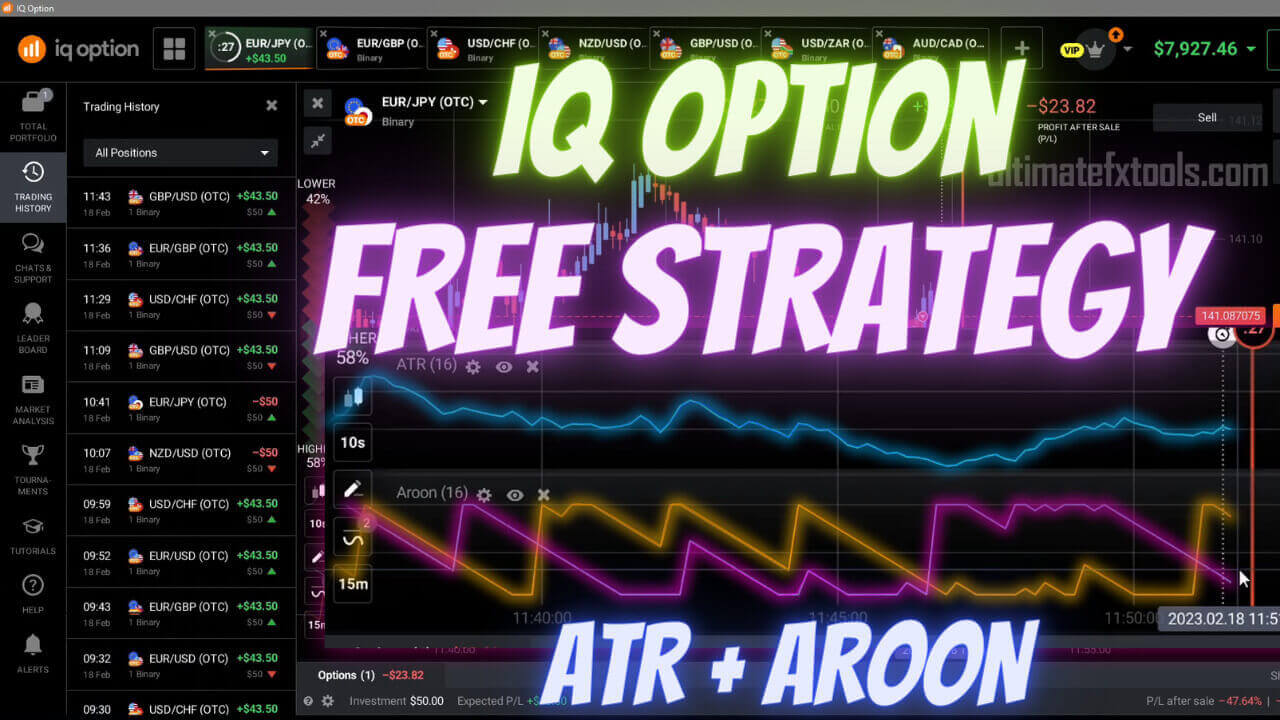
IQ Option ATR and Aroon Indicator
Pairing ATR (Average True Range) with Aroon gives IQ Option traders two very different but complementary readings of the same chart. Aroon tells you the direction and strength of a trend, while ATR tells you how much the market is actually moving. On their own, each can produce a lot of noise, but together they help filter out weak setups. The idea is simple: only act when Aroon confirms a clear trend and ATR confirms there is enough volatility to make that trend worth trading — the same filtering logic experienced traders use to avoid flat, choppy conditions.
What the Aroon Indicator Contributes
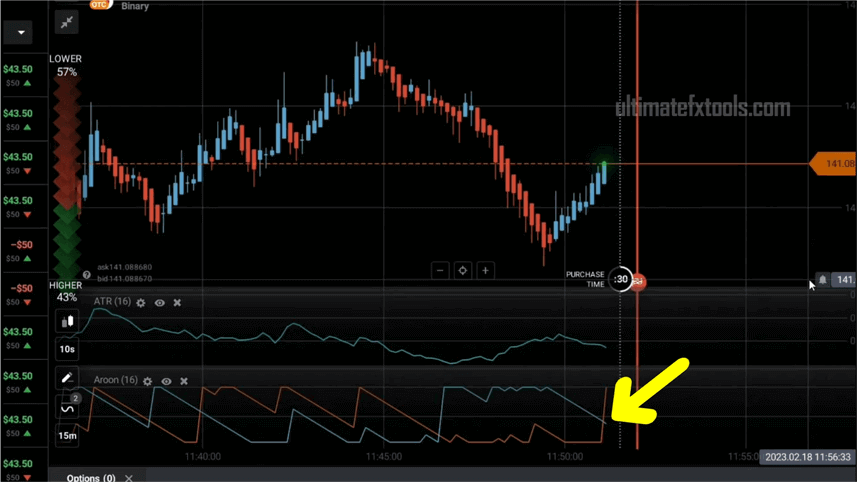
Aroon is built from two lines, Aroon Up and Aroon Down, each scaled from 0 to 100. Aroon Up rising toward 100 means the market has recently printed new highs and buyers are in control. Aroon Down rising toward 100 means fresh lows and seller control. When the two lines cross, it often marks the start of a new directional move. On IQ Option, Aroon is your trend-direction filter: it answers the question "which way is momentum leaning right now?" and keeps you from trading against a strong move.
What ATR Contributes
ATR does not tell you direction at all. Instead, it measures the average size of recent price ranges, which is a clean read on volatility. A rising ATR means candles are getting larger and the market has energy behind it; a flat or falling ATR warns that price is drifting. Used as a filter, ATR keeps you out of dead, low-range periods where even a correct trend call may not travel far enough before your expiry closes.
Settings and How to Combine Them
The strategy works well with the standard defaults, so you do not need to over-tune it. Use Aroon set to a 14 period and ATR set to a 14 period — these are the widely used baseline values and are a sensible starting point on IQ Option. Add both to the same chart. Aroon becomes your primary signal for direction, and ATR sits underneath as confirmation that conditions are active enough to trade. If you later prefer faster or slower reads, adjust both in small steps and re-test on a demo account before risking real funds. For traders who want a related Aroon-based approach, the IQ Option 15-seconds candle RSI and Aroon walkthrough shows how Aroon behaves on very short candles.
Buy/Call and Sell/Put Rules
Both indicators must agree before you act — that agreement is the entire point of the pairing:
- Buy / Call: Aroon Up crosses above Aroon Down and pushes toward 100, and ATR is rising (or clearly above its recent lows), showing the up-move has volatility behind it.
- Sell / Put: Aroon Down crosses above Aroon Up and pushes toward 100, and ATR is rising, confirming the down-move has enough range to carry.
- Stand aside: if Aroon lines are tangled near the middle, or ATR is flat and low, treat it as no trade. A missed setup costs nothing; a forced one in dead conditions usually does.
A deeper look at ATR as a standalone filter is covered in IQ Option advance ATR trading, and you can see Aroon paired with a different confirmation tool in Aroon and Stochastic 5-seconds Quickler.
Best Timeframe, Expiry and Risk
This pairing tends to read cleaner on the 1-minute and 5-minute charts, with expiries matched roughly to your chart timeframe so a signal has time to play out before it closes. Start on a demo account, trade a small fixed stake per entry, and keep your position size consistent rather than chasing losses by escalating. Cap the number of trades you take per session so a rough patch cannot snowball. If you want the full indicator set that pairs with strategies like this, see the pricing page for one-time lifetime access.
IQ Option Free Trading Strategy ATR and Aroon Indicators
FAQ
Do ATR and Aroon need to agree before I enter a trade?
Yes. The strength of this setup comes from confirmation. Aroon points to the direction and ATR verifies there is enough volatility to support it. If only one indicator lines up, it is better to wait for the next clean signal.
What settings should I use for ATR and Aroon on IQ Option?
The standard 14-period setting works for both indicators as a starting point. Keep them identical while you learn the pattern, then adjust in small steps on a demo account if you want a faster or slower response.
Which timeframe works best for this strategy?
The 1-minute and 5-minute charts give the clearest reads for short-term IQ Option trading. Match your expiry to the chart so each signal has room to develop before the position closes.
This content is for educational purposes only. Trading involves risk. Past results do not guarantee future outcomes. Always practice responsible money management and limit your daily trades to avoid large losses.