IQ Option 1 minute Strategy
IQ Option 1 minute Strategy

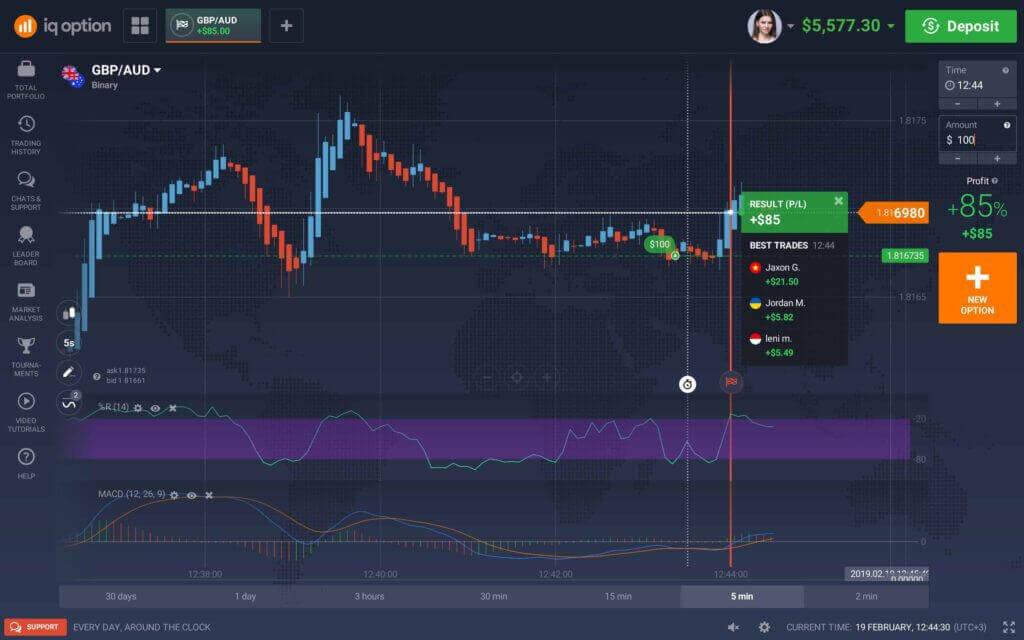
You might be curious about the best strategies in IQ Option. These are some tips to help you trade IQ Option. Candlestick patterns can be used to trade options. This article will outline some of the most effective techniques to maximize your profits. Continue reading to find out more. This strategy is one way to structure a 1-minute trade on IQ Option, and no strategy can make anyone consistently successful.
Trading 1 minute IQ Option
A trading portfolio is one of the best ways to trade. You can use an Excel document or your software to keep track. This is the secret to successful trading. You can keep a journal to record your trades and also help you file your taxes. Keep your emotions at bay. They can distract you from the actual analysis of the numbers. You'll be better informed about the trades that you make.
Trading is as simple as registering an asset and then thoroughly analyzing it. After you have done this, you can click on buy or sell. Beware. But, speculating inaccurately can result in losing more than what you have invested. Before you place trades, make sure to research the market thoroughly. This will help increase your profits. This will help you spot trends and prevent you from making costly mistakes.
IQ Option's award-winning platform makes it easy to analyze and trade different financial assets quickly. More than 300 assets are available, including currencies, stocks, indices, and cryptocurrencies. It is easy to use and offers many trading tools, including multi-chart layouts and technical analysis. There are also stock screeners, historical quotations, stock screeners, and economic calendars. Trades can be made in over 30 currencies with competitive spreads. You can also open demo accounts to test out different trading strategies and learn more about how to trade.
Capital management strategies in IQ Option
Capital management is the part of trading that decides how much of your account you put at risk on any single trade. You will often see the Martingale and Fibonacci systems mentioned here, because both tell you to increase your stake after a losing trade in the hope of winning it all back at once. It is important to understand what that actually does to your account before you ever consider it. Increasing your position size after a loss does not make the next trade more likely to win, and it turns an ordinary run of losses into a threat to your entire balance. The safer and more honest approach is to keep the amount you risk small and consistent, and to accept that losing trades are a normal, unavoidable part of trading.
If you are a beginner, the most sensible capital management method is fixed-fractional staking: you risk the same small percentage of your account on every trade, win or lose. Because your stake shrinks in absolute terms when the account is smaller and only grows as the account grows, no single losing streak can wipe you out. This is far less exciting than trying to double your way back to breakeven, but it is what keeps traders in the game long enough to learn. Never chase a loss by putting more on the next trade than you planned.
Leverage is a separate idea that also belongs under capital management. Leverage means controlling a larger position than your own cash would allow, which magnifies both gains and losses. For a new trader it multiplies risk, so if you use it at all, use the smallest multiplier available and size your trades so that a losing streak still leaves your account intact. Your capital management choices should always be built around surviving the worst run, not around the best one.
What the Martingale strategy really does to a trading account
You may have heard the Martingale strategy described as a way to recover losses, but you should treat it as a warning rather than a method. Martingale tells you to double your stake after every losing trade so that a single win recovers everything you lost plus a small gain. On paper it can look like it always recovers. In reality it only appears to work until the one losing streak that is longer than your account can survive, and that streak will eventually come. Nobody knows in advance which streak it will be.
Why doubling after a loss is so dangerous
Each trade on IQ Option is independent. A losing trade does not make the next trade more likely to win, so doubling your stake does not improve your odds at all — it only increases the money at risk. Losing streaks of five, six, seven or more trades in a row are normal and expected, not rare. When you double after each loss, the stake required grows geometrically: a small starting stake becomes an enormous one after only a handful of losses. Long before you recover, you run into either the limit of your balance or the platform's maximum stake, and the whole doubling chain collapses into one large, unrecoverable loss. This is why Martingale can empty an account faster than almost any other approach.
IQ Option Martingale is not a risk management strategy.
Traders should not use the Martingale strategy to manage their capital. It is the opposite of risk management: it forces you to put more money at risk exactly when you are losing, which is the worst possible time to increase exposure. There is no "if done right" version that makes it safe. Capping the number of doubles only changes how big the final loss is, not whether it happens. Any system that requires you to bet more after a loss is simply moving the danger to a future trade, not removing it.
Risk management is a must in trading.
Real risk management works in the opposite direction to Martingale. Instead of increasing your stake after a loss, you keep it small and constant, and many traders reduce their size during a losing run rather than raise it. A common guideline is to risk only a small fixed percentage of your account on any single trade — many use around 1% to 2%, and 5% should be treated as a hard ceiling rather than a target — so that even a long string of losses leaves you with enough capital to continue. Position sizing, not stake-doubling, is what protects you when your analysis is wrong, and your analysis will be wrong regularly.
IQ Option trading indicators help you build a plan, not a shortcut.
Beginners often ask whether Martingale makes sense once they add indicators to their charts. It does not, because no indicator changes the fact that doubling after a loss puts your whole account on the line. Indicators are there to help you read the market and choose your entries and exits with a little more structure, not to justify betting bigger after you lose. Most people who trade without a plan lose their capital over time, so the goal is consistency: a repeatable process with fixed, sensible position sizes. These habits will not make you rich overnight, but they can help you improve your trading over the long term while keeping your account alive.
Discipline matters more than any single technique with IQ Option.
The trading approach that actually lasts is built on patience and discipline rather than on any staking trick. Keep your position sizes small and consistent, watch the economic indicators that move your chosen asset, and combine technical and fundamental analysis so you understand why the market is moving rather than just reacting to it. Combining fundamental and technical analysis helps you understand the market's workings and the underlying financial principles. This combination helps you keep your emotions under control and stops you from chasing losses, which is the exact temptation that Martingale feeds. Protecting your capital and staying in the market is what gives you the time to get better.