Amazing Strategy with IQ Option Using Dream X
An IQ Option strategy using the Dream X indicator - what it plots, how to confirm a signal, the settings, and when the setup fails.
What Dream X Actually Plots
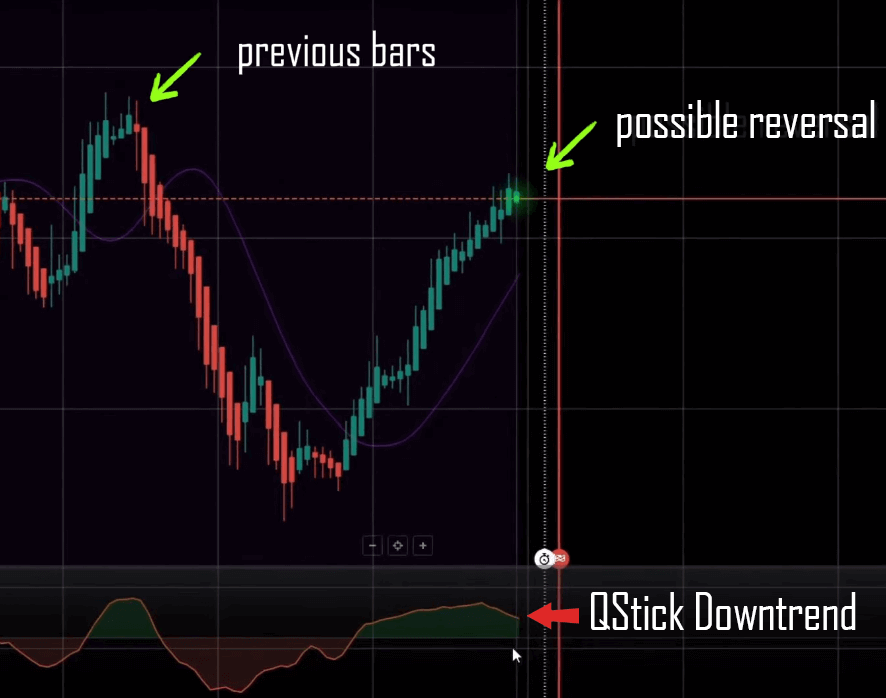
Dream X combines two readable layers on the MetaTrader chart. The first is a QStick-style momentum reading built from moving averages, measuring the balance between closing and opening prices to track whether short-term momentum tilts up or down. The second is a pair of High Low Bands — an upper and lower envelope that frame recent price action. When a candle stretches to touch or pierce a band, price sits at an extreme where a pause or reversal becomes more likely. Neither layer knows what happens next; together they simply describe the current condition in a way you can act on with clear rules.
How to Confirm a Signal
A single alert on its own is noise. The condition worth trading appears when the two layers agree. Wait for a candle to reach one of the High Low Bands and for the QStick momentum line to cross back through its middle in the same direction. An up cross as price tags the lower band points to a possible move higher; a down cross at the upper band points lower. Because IQ Option runs on its own chart, read the setup in MetaTrader on the matching pair and time your IQ Option entry against the candle forming there. Let the signal candle close before you commit — acting mid-candle is one of the most common ways to get faked out.
Recommended Settings and Setup
Keep Dream X close to its defaults so alerts appear only on meaningful turns rather than on every small wiggle:
- Load Dream X on a clean MetaTrader chart with no other clutter competing for your eye.
- Leave the QStick/moving-average period at its default (around 8–10) so it reacts to short-term momentum without flipping on every candle.
- Keep the High Low Bands at their default length so the envelope frames recent swings rather than hugging price too tightly.
- Trade a small handful of liquid pairs you know well instead of jumping across the whole watchlist.
- Match a one-minute chart with a one-minute expiry for this reversal style; step up to two minutes when the market is choppy.
Entry Logic in Plain Terms
The rules are deliberately simple so you can apply them calmly inside a short expiry window. For a higher (call) position: price tags the lower High Low Band and QStick crosses up through its middle. For a lower (put) position: price tags the upper band and QStick crosses down through its middle. If the two layers disagree, or price is stuck flat in the middle of the bands, stand aside — skipping the unclear setups is the single biggest factor in trading with more consistency rather than chasing every candle.
When This Setup Fails
Be honest about what breaks it. In a strong trend, price can ride one of the High Low Bands for many candles, so a "touch" that looks like a reversal is really the trend continuing — band tags work best in ranging, back-and-forth markets, not runaway moves. Thin liquidity, news spikes and low-volume sessions all produce erratic candles that trigger false crosses. No setup removes losing trades, so treat risk control as the real edge: stake a small, fixed fraction of your balance per trade, cap how many trades you take in a session, and stop once you hit a preset loss limit. Never try to recover a loss by doubling your next stake — that martingale habit turns one bad run into a blown account. Practice on a demo account until the reads feel automatic before risking real funds.
FAQ
Does the Dream X indicator guarantee winning trades on IQ Option?
No. Dream X flags a market condition; it does not predict outcomes and has no win rate. Losing trades are a normal part of binary options. Consistent risk management is what makes the difference over time, not any single alert.
Which platforms and pairs work with this setup?
The signal is generated in MetaTrader (MT4 / MT5) and read against the IQ Option chart, and the same band-plus-momentum logic translates to other trading platforms such as Quotex, Pocket Option and Olymp Trade. Stick to a few liquid major pairs you know well. Dream X and every other tool on the site are included with a single $39 lifetime plan.
Where can I learn more about Dream X?
Start with the main Dream X indicator page, see the color-changing Dream X setup on Pocket Option for a variation of the method, and compare it with this IQ Option 1-minute strategy to see how the same reversal ideas are applied elsewhere.
This content is for educational purposes only. Trading involves risk. Past results do not guarantee future outcomes. Always practice responsible money management and limit your daily trades to avoid large losses.