IQ Option No Loss Strategy PDF Download
Search for an "IQ Option no loss strategy PDF" and you will find plenty of files promising a way to trade without ever taking a losing position. This guide covers what such a PDF usually contains, why the "no loss" label is misleading, and how to build a disciplined, rule-based approach instead. The honest headline first: there is no strategy that avoids losses. Any file, video, or signal service that claims otherwise is showing you a red flag, not a shortcut.
IQ Option is a popular trading platform thanks to its clean interface and range of instruments. Used with realistic expectations, it can be a reasonable place to practise a strategy. Used with the belief that losses are optional, it becomes a fast way to blow an account.
Why "No Loss" Is Impossible
Every trade is a probability, not a certainty. Price can move against a technically sound entry for reasons no indicator can predict — news, liquidity gaps, or simple randomness. Because of that, a run of losses is a normal part of any method, and no combination of settings removes it.
The phrase "no loss" often hides one of two things. Sometimes it means the PDF quietly relies on a martingale approach — doubling the stake after each losing trade so a single win "recovers" everything. This is not a no-loss system; it is a way to turn several small losses into one catastrophic one, and it can wipe an account in a single bad streak. Treat any martingale instruction as a warning sign, not a feature. Other times "no loss" is simply marketing to get you to download the file. Either way, the claim should lower your trust, not raise it.
What the Strategy Actually Uses
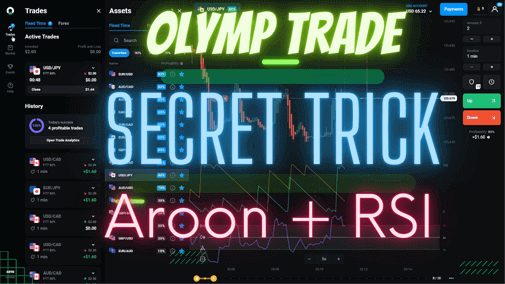
Stripped of the hype, the useful core of most of these guides is a reversal setup that pairs a trend tool with a momentum oscillator. A common pairing is Aroon with the RSI:
- Timeframe: the 5-minute chart is more forgiving than the 1-minute for reading these signals; faster charts produce more noise.
- Aroon: use it to gauge whether a trend is fading, so you are not fighting strong momentum.
- RSI: look for readings stretched into overbought or oversold territory as the trend loses steam, rather than acting on the oscillator alone.
- Confluence: only consider an entry when both tools agree, and ideally near a visible support or resistance level.
Some versions swap in the DeMarker oscillator in place of the RSI for the same job. Whichever you use, treat every signal as a candidate to be confirmed, not an instruction to trade.
Risk Management
Because losses cannot be avoided, controlling their size is the real skill. This is where a sensible plan separates itself from a "no loss" fantasy.
- Risk only a small, fixed fraction of your balance per trade — many traders cap it around 1–2% — so a losing streak is survivable.
- Never increase your stake to chase back a loss. Fixed sizing keeps one bad session from becoming a blown account.
- Test any strategy on a demo account first, and keep a simple journal of what worked and what did not.
- Trade only money you can afford to lose, and step away when you are tilted or tired.
If you want a faster setup after you understand the risk, the same discipline applies to our IQ Option 1-minute strategy, and dialing in your tools with sensible indicator settings matters more than any single "secret" file.
Realistic Expectations
A good strategy aims to keep winners larger than losers over many trades and to survive the inevitable losing runs — not to eliminate them. Approached that way, the material in these PDFs can be a useful teaching aid rather than a false promise. If you want a full, organised library of indicators and strategy guides in one place, our $39 lifetime access bundles them together, but the free ideas above are enough to start practising responsibly.
Frequently Asked Questions
Is this really a no-loss strategy?
No. No strategy avoids losses. Markets are uncertain, and losing trades are a normal, unavoidable part of trading. The goal is to manage the size and frequency of losses, not to pretend they can be removed.
Should I use the martingale method some PDFs suggest?
It is best avoided. Doubling your stake after a loss can recover small setbacks for a while, but a single extended losing streak can wipe out your entire balance. Fixed position sizing is far safer.
What timeframe works best for the Aroon and RSI setup?
The 5-minute chart is a sensible starting point because it filters out much of the noise found on 1-minute charts. Always confirm signals with price structure rather than relying on the indicators alone.
This content is for educational purposes only and is not financial advice. Trading involves substantial risk; you can lose some or all of your capital. No result is guaranteed and past performance does not indicate future results. Trade only what you can afford to lose.