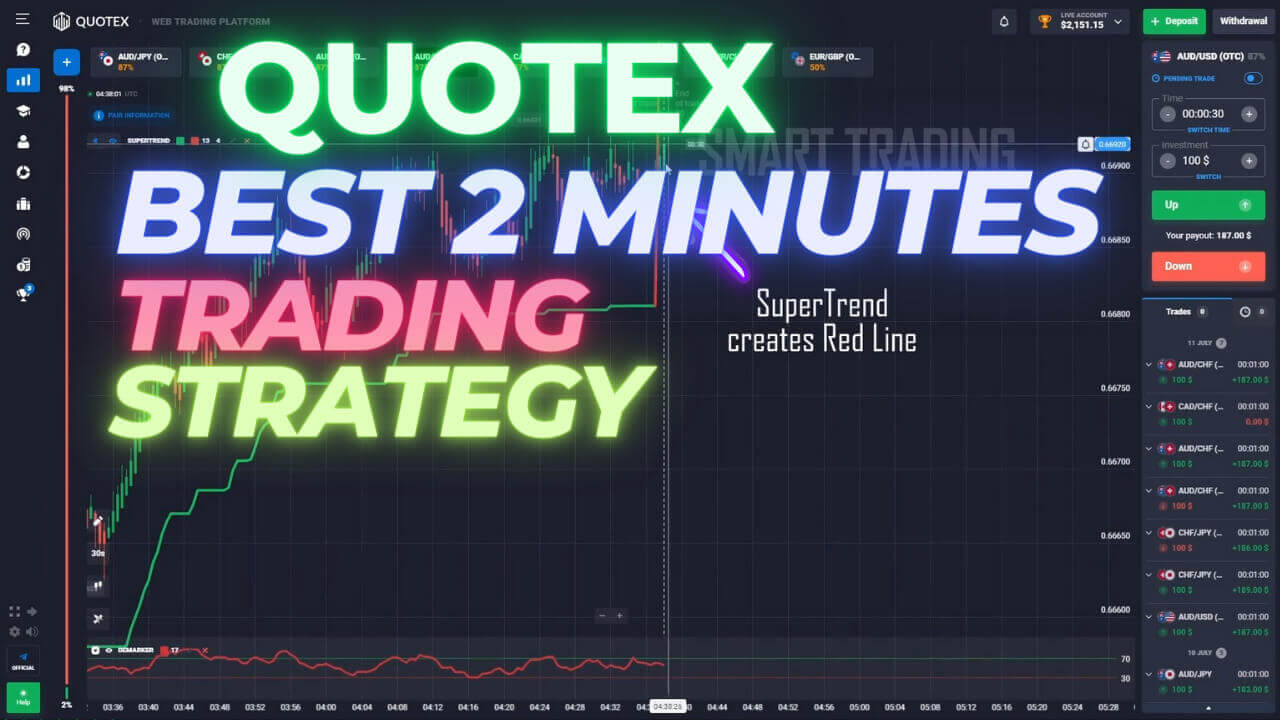
Why No 2-Minute Quotex Strategy Is Really the "Best"
The title of this page calls this the "best" 2-minute Quotex strategy because that is what traders search for, but be honest: no strategy is objectively the best, and none has a fixed, knowable win rate. What you have here is one reasonable, rule-based approach among many. On Quotex every trade closes on a fixed expiry, so the only question is whether price is higher or lower when the 2-minute timer runs out. A 2-minute expiry is slightly more forgiving than 30-second or 1-minute scalps because a single stray tick has less power to decide the outcome, but it is still short-term trading and still high variance. Treat the setup below as a framework for calmer decisions, not a shortcut to easy money.
What the Indicators Plot
This approach reads two standard tools on a MetaTrader chart and applies the reading to the matching Quotex asset. The first is a pair of exponential moving averages (EMAs) acting as a trend filter: when the faster EMA sits above the slower one, momentum leans up; when it sits below, momentum leans down. The second is a momentum oscillator, either RSI or the Stochastic, which plots on a 0-100 scale and shows when price is stretched or turning. Together they answer two questions: which way is the pressure, and is now a sensible moment to act. Neither tool predicts the future; they summarise what price has just done.
Recommended Settings
Keep the settings standard so the tools behave predictably:
- Fast EMA 9, Slow EMA 21 on the 1-minute chart, read against a 2-minute Quotex expiry. The gap and slope between the lines is your trend read.
- RSI 14 (or Stochastic 5,3,3) as the momentum filter. Treat the 30 and 70 levels as zones where a turn becomes more likely, not automatic triggers.
- Trade a small handful of liquid pairs you know, and let each candle fully close before you read the signal.
Keep the chart clean so the reads are fast under a 2-minute clock.
Entry Rules
The rules are intentionally simple so they can be applied calmly:
- Call (up): the fast EMA is above the slow EMA, price pulls back toward the EMAs, and RSI is turning up from the lower half. A green candle forming off that pullback lines the entry up with the trend.
- Put (down): the fast EMA is below the slow EMA, price rallies back toward the EMAs, and RSI is turning down from the upper half.
- Stand aside: the EMAs are tangled and flat, or the trend and the oscillator disagree. Skipping unclear setups is the biggest lever you have on consistency; you are not paid for volume, only for good decisions.
When This Setup Fails
Be clear-eyed about the weak spots. In a flat, ranging market the EMAs cross back and forth and produce whipsaw signals that lose in both directions. Around high-impact news, price can spike through any level and make the indicators useless. And because the oscillator only tells you price is stretched, a strong trend can stay "overbought" or "oversold" far longer than a 2-minute trade allows, and Quotex OTC assets over weekends behave differently from live-market hours. None of this is unique to this strategy; every short-expiry method has the same blind spots, which is why risk management matters more than the entry.
Risk Management
This is the part that keeps you in the game. Stake a small, fixed fraction of your balance on each trade, cap how many trades you take in a session, and stop for the day once you hit a preset loss limit. Do not increase your stake to chase back a loss. Any "double your stake after a loss" (martingale) idea is a fast route to wiping out an account, because a normal losing streak grows the required stake far quicker than most balances survive; use a flat stake instead. No indicator removes losing trades, so the aim is steady, repeatable decisions. Practise on a Quotex demo until the reads feel automatic before risking real funds. To compare simpler variations, see the Quotex 1-minute strategy, this beginner-friendly Quotex easy strategy, or the trend-based Donchian Channel and Schaff Trend Cycle approach.
FAQ
Is this really the best Quotex 2-minute strategy?
No single strategy is the best, and anyone quoting a fixed win rate is guessing. This is one sensible, rule-based approach. What separates traders over time is discipline and risk control, not the label on a method. Every indicator used here is included in the single $39 lifetime plan.
Why choose a 2-minute expiry over 1 minute?
A 2-minute expiry gives a signal a little more room to play out, so one random tick is less likely to decide the trade. It is slightly more forgiving than ultra-short scalps but still high variance, not "safer" in any guaranteed sense. If you prefer faster trades, the Binary Sniper Pro tool is aimed at 1-minute reading.
Which platforms does this work on?
The signals are read in MetaTrader (MT4 / MT5) and applied to the matching Quotex asset. The same EMA-plus-oscillator logic also translates to other trading platforms such as IQ Option and Pocket Option.
This content is for educational purposes only. Trading involves risk. Past results do not guarantee future outcomes. Always practice responsible money management and limit your daily trades to avoid large losses.


