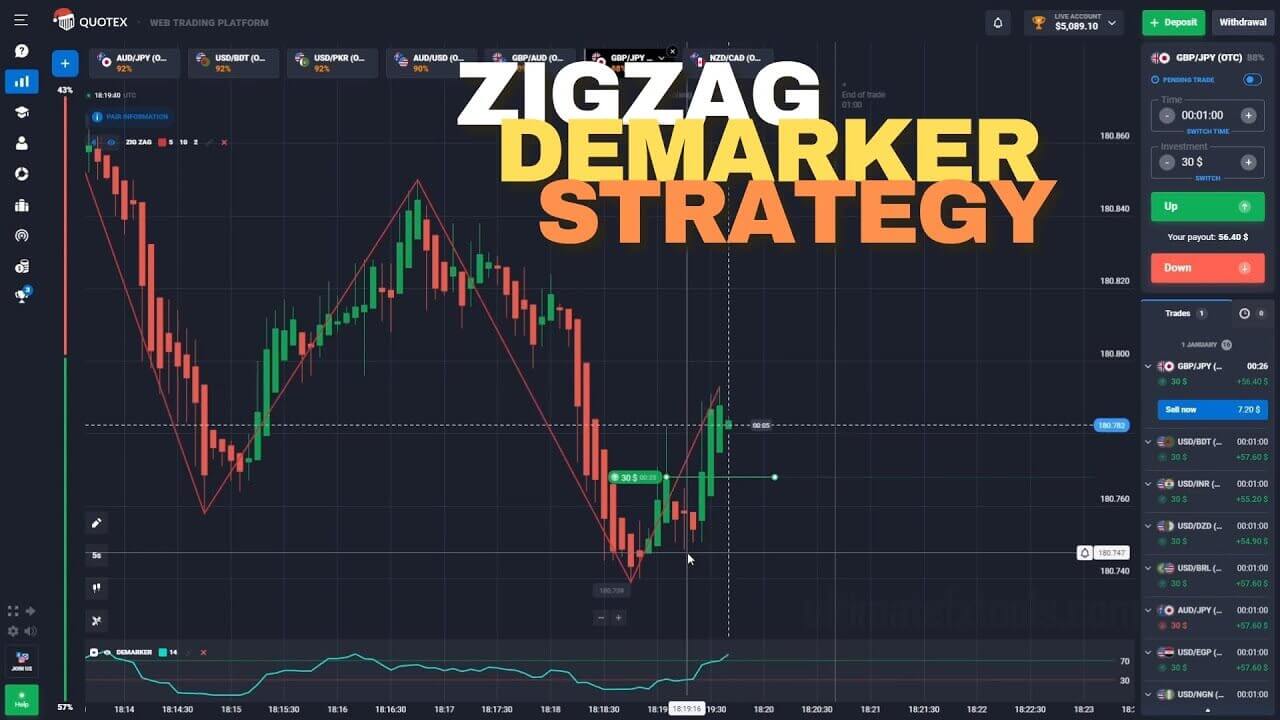
Easy Win with Quotex Using ZigZag and DeMarker? An Honest Look
Let's be straight about the "easy win" in the title: there isn't one. On Quotex every position is a fixed-time bet that price will be Higher or Lower when the timer expires, and no indicator pairing removes that uncertainty. What the ZigZag and DeMarker combination actually does is help you read two things at once — market structure and momentum exhaustion — so your entries can be more deliberate. Treat it as a decision-support method for spotting possible reversals, not a button that prints wins.
What Each Indicator Plots
The DeMarker (default period 14) is an oscillator that compares recent highs and lows to gauge whether a move is stretched. Readings near the upper band suggest an overbought, potentially exhausted rally; readings near the lower band suggest an oversold, potentially exhausted sell-off. It does not predict direction on its own — it only flags that the current push may be running out of fuel.
The ZigZag draws straight lines between significant swing highs and lows, filtering out minor noise so the underlying structure is easy to see. Here is the caveat that matters most: ZigZag repaints. Its most recent leg is provisional and will redraw as price moves — a swing that looks perfectly timed in hindsight was not actually confirmed at that spot in real time. Never treat the newest ZigZag point as a locked signal. Use it to mark structure that has already formed, not to call the current candle.
Setup and Settings
Preserve these settings on Quotex or on your MetaTrader chart:
- DeMarker: period 14.
- ZigZag: deviation 5, depth 10, back step 2.
- Assets: favour liquid pairs with a reasonable payout rather than chasing the highest-return exotic.
The original version of this guide pushed a 5-second candle. Be honest with yourself about that: five-second charts are extremely noisy, expiries are unforgiving, and the ZigZag repaint problem is worst on the fastest timeframes because the final leg barely settles before it redraws. If you are still learning the method, a slower 1-minute or 5-minute read gives each swing time to confirm and the DeMarker time to reach a genuine extreme.
The Entry Idea
The logic is simple, which is its strength: wait for the two tools to agree at a level.
- Higher: a completed ZigZag swing low forms, the DeMarker is down in oversold territory, and the current candle closes back up off that low. The exhaustion and the structure point the same way.
- Lower: a completed ZigZag swing high forms, the DeMarker is up in overbought territory, and the candle closes back down under that high.
- Confirm on the close. Because the last ZigZag leg can repaint, only act once the candle that made the swing has actually closed — never on the flicker of a still-forming bar.
When It Fails
This is a reversal method, so it struggles most in exactly the conditions traders love to force it into. In a strong trend the DeMarker can sit pinned at an extreme for a long time while price keeps running — an "overbought" reading is not a sell signal in a powerful uptrend. When the trend is strong and one-directional, the correct move is to stand aside. It also fails in dead, flat ranges where ZigZag whips back and forth and every small swing looks like a reversal. Skipping the unclear setups is not being passive; it is the method working as intended.
FAQ
Is this really an easy win on Quotex?
No. Fixed-time trading is uncertain by design and losing trades are normal. The ZigZag and DeMarker pairing helps you pick more deliberate entries and read momentum against structure, but it cannot guarantee an outcome. Consistency comes from disciplined risk control, not from the indicators themselves.
Does the ZigZag repaint problem make it useless?
No, as long as you respect it. Use ZigZag to map swings that have already closed and confirmed, never to predict the live candle. If a strategy looks flawless in a screenshot, remember that the last leg may have redrawn to fit — real-time trading never looks that clean.
Where can I get the indicators?
Both ZigZag and DeMarker ship as standards on MetaTrader and on Quotex. If you want the wider toolkit used across these guides, every indicator on the site is bundled in the single $39 lifetime plan.
For related reads, compare this with the ZigZag and DeMarker method covered elsewhere, a DeMarker and Super Trend pairing, and a pure ZigZag structure setup for OTC pairs.
This content is for educational purposes only. Trading involves risk. Past results do not guarantee future outcomes. Always practice responsible money management and limit your daily trades to avoid large losses.


