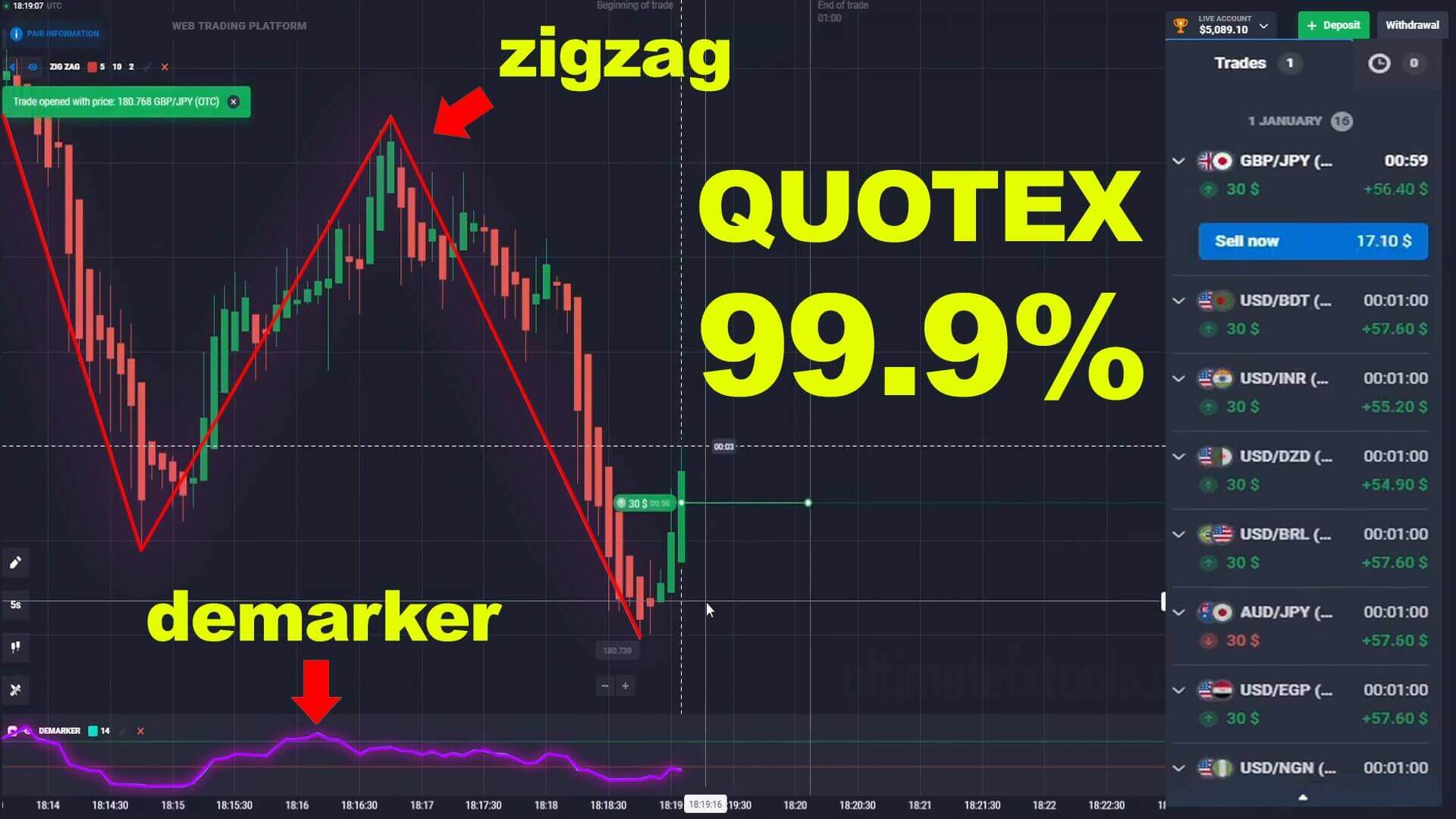
First, About That "99.9% Success Rate"
Let's be honest right at the top: the "99.9% success rate" in this title is a marketing figure, not a real statistic. No trading strategy has a fixed, knowable win rate. Markets change, spreads change, your timing changes, and the conditions that produced a good run last month can vanish tomorrow. Anyone who quotes you a precise number like 99.9%, 95%, or "80 to 90%" is selling confidence, not measuring reality. Treat any headline win rate as a red flag rather than a promise. What follows is an honest walk-through of how a ZigZag plus DeMarker setup works on Quotex, and where it breaks down.
What the Two Indicators Actually Do
This method combines two well-known tools for spotting where a short-term move may be running out of steam:
- ZigZag filters out small price noise and draws straight lines connecting significant swing highs and lows, so the underlying structure of the trend is easier to see at a glance.
- DeMarker (default period 14) is an exhaustion oscillator. It measures recent demand and prints a value between 0 and 1. Readings near the lower band suggest a market that may be oversold; readings near the upper band suggest it may be overbought.
The idea is straightforward: use ZigZag to see that price has reached a swing point, and use DeMarker to confirm that momentum at that point is stretched. When both line up, you have a candidate for a possible reversal.
The ZigZag Repaint Caveat You Must Understand
Here is the part most "high win rate" videos quietly skip: ZigZag repaints its most recent leg. The indicator only confirms a swing point after enough price movement has happened to prove it. Until that confirmation, the last line can extend, retract, or redraw as new candles arrive. So the flawless-looking signals you see on a historical chart were only obvious in hindsight. Live, the newest ZigZag leg is provisional and can change. If a strategy looks perfect on a replay, it is almost always because the repainting leg has already settled. Never take an entry on the assumption the current ZigZag line is final.
Settings and Entry Approach
Keep the tools on sensible defaults so you are reading real structure rather than curve-fitted noise:
- ZigZag: depth 12, deviation 5, backstep 3 (the common defaults) on a 1-minute chart.
- DeMarker: period 14, with reference levels drawn at roughly 0.3 and 0.7.
A cautious long (higher) setup looks like this: ZigZag has printed a confirmed low, and DeMarker is turning up out of its lower band. A short (lower) setup is the mirror image: a confirmed ZigZag high with DeMarker rolling down from its upper band. Because Quotex trades on fixed expiries, many traders read the signal on the 1-minute chart and match it to a one-minute expiry, occasionally stretching to two minutes in choppy conditions. Always let the candle fully close before you judge the signal.
When This Setup Fails
Oscillator-plus-swing methods struggle in the same places every trend tool does. In a strong, sustained trend DeMarker can sit pinned near an extreme for a long time while price keeps running, so "oversold" is not a reason to buy against momentum. During news spikes and thin OTC hours, ZigZag swings become erratic and the repaint problem gets worse. Skipping the ambiguous setups is far more useful than forcing every one.
Risk Management Comes First
No indicator removes losing trades, so survival depends on how you size and cap your risk. Stake a small, fixed fraction of your balance on each position, decide in advance how many trades you will take in a session, and stop for the day once you hit a preset loss limit. Do not chase losses by increasing your stake after a loss — that martingale-style approach can wipe an account in a short losing streak, which every strategy eventually produces. Practise the rules on a demo account before risking real money. The goal is steady, repeatable decisions and consistency, not one big result.
FAQ
Is the 99.9% success rate real?
No. It is a marketing number, not a measured outcome. No strategy has a fixed or guaranteed win rate, and losing trades are a normal part of trading fixed-expiry positions. Judge any method by how well you understand its logic and manage risk, not by a headline percentage.
Does ZigZag repaint?
Yes. Its most recent leg is provisional and can redraw as new candles form, so live signals never look as clean as they do on a historical chart. Only act once a swing point is confirmed, and combine it with DeMarker for context.
Which platforms and tools can I use this on?
ZigZag and DeMarker are standard on most trading platforms, including Quotex, IQ Option and Pocket Option. If you want the full library of indicators and strategies used across the site, it is all included in a single $39 lifetime plan. You can also compare related approaches like the Quotex 1-minute Supertrend + ZigZag strategy, this beginner-friendly Quotex easy strategy, and the Donchian Channel and Schaff Trend Cycle setup.
This content is for educational purposes only. Trading involves risk. Past results do not guarantee future outcomes. Always practice responsible money management and limit your daily trades to avoid large losses.


