Effective RSI Alert Strategy in IQ Option
The Relative Strength Index (RSI) is one of the most widely used momentum oscillators in trading. The RSI alert indicator takes that classic oscillator and adds an automatic notification, so instead of watching the chart every second you get a pop-up, sound, or push alert the moment RSI crosses a level you have chosen. On a 60-second IQ Option chart, where price moves quickly, that hands-free alert can help you spot a potential entry without staring at the screen.
What the RSI Alert Actually Does
RSI measures the speed and size of recent price changes on a scale from 0 to 100. Traders traditionally treat readings above 70 as "overbought" and below 30 as "oversold," suggesting momentum may be stretched. The alert version simply monitors those thresholds for you and fires a notification when the line crosses them, flagging a possible reversal or exhaustion point. It does not decide anything for you — it draws your attention to a condition so you can look at price action and make the call yourself.
Settings, Timeframe and Entry Rules
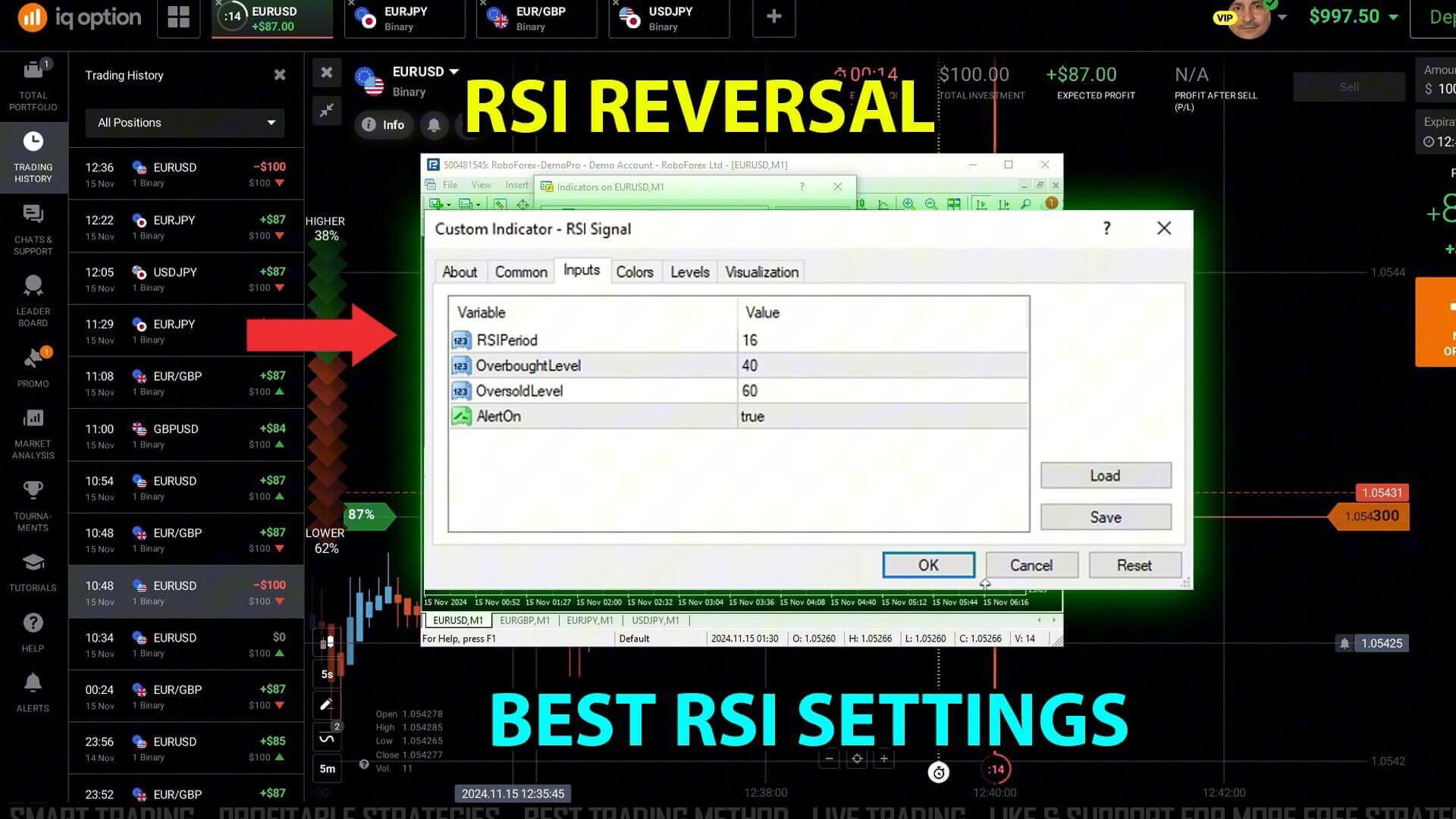
These values are a reasonable place to begin, not fixed "best" numbers. Test them on a demo account and adjust to your pair and session:
- Chart timeframe: the 1-minute (M1) candlestick chart, which aligns with 60-second expiries.
- RSI period: a shorter period such as 14 reacts faster to momentum; a longer one smooths out noise but lags more.
- Alert levels: the standard 70 / 30 overbought and oversold thresholds are a common default. Widening them (e.g. 80 / 20) produces fewer but stronger signals.
- Alerts: enable the notification so you are told when a level is touched, then confirm with the candle before acting.
- Pairs: liquid majors such as EUR/USD or EUR/GBP tend to give cleaner readings than thin, low-volume markets.
A basic entry idea: when RSI crosses back down out of overbought while the candle stalls, that hints at possible downside; when it crosses back up out of oversold, that hints at possible upside. Waiting for the crossback rather than the first touch filters out some noise.
Where RSI Falls Short
RSI is a mean-reversion tool, and its biggest weakness is strong trends. In a powerful move, RSI can sit in overbought or oversold territory for a long time and keep giving "reversal" signals while price marches straight on — every one of those is a false signal. On a 60-second chart the problem is amplified, because a single fast candle or a news spike can swing RSI hard with little warning. Treat the alert as a prompt to check the market, not as a command to enter. Pairing it with support and resistance or a simple trend filter, like the ideas in our IQ Option indicator settings guide, helps you skip signals that fight the dominant direction.
Realistic Expectations
Sixty-second trading is high-variance by nature. The short window leaves little room for a trade to recover if it moves against you, so results tend to swing more from one session to the next than they do on higher timeframes. Losing streaks are a normal part of any RSI-based approach — the aim is disciplined, repeatable entries over many trades, not a perfect record. Do not use a martingale or "double after a loss" scheme to chase back losses; position sizes can escalate dangerously fast and a short bad run can wipe out an account.
Risk Management
No indicator removes risk, so protect your capital first:
- Risk only a small, fixed percentage of your balance per trade so no single loss is damaging.
- Practice on a demo account until the setup and alerts feel second nature before risking real money.
- Set a daily loss limit and stop for the day once you hit it.
- Avoid trading straight through major news, when spreads widen and price can gap unpredictably.
- Keep a simple log of your trades so you can review what is and is not working.
For a broader momentum setup you can compare it against, see our IQ Option 1-minute strategy. The RSI alert indicator, along with our full library of tools, is available with lifetime access for $39.
Frequently Asked Questions
Does this indicator win every trade?
No. No indicator wins every trade, and this one is no exception. RSI produces false signals — especially during strong trends — and 60-second trading is inherently high-variance. Expect losing trades and losing streaks, and manage your risk accordingly.
What RSI settings should I use?
Start with a period of 14 and the standard 70 / 30 levels on the 1-minute chart, then adjust on a demo account to suit the pair and session you trade. There is no single "correct" setting that fits every market.
Can I use it on platforms other than IQ Option?
Yes. RSI is a standard oscillator, so the same alert approach works on most MetaTrader-linked charts and other trading platforms. The timeframe and entry logic stay the same regardless of where you place the trade.
This content is for educational purposes only and is not financial advice. Trading involves substantial risk; you can lose some or all of your capital. No result is guaranteed and past performance does not indicate future results. Trade only what you can afford to lose.