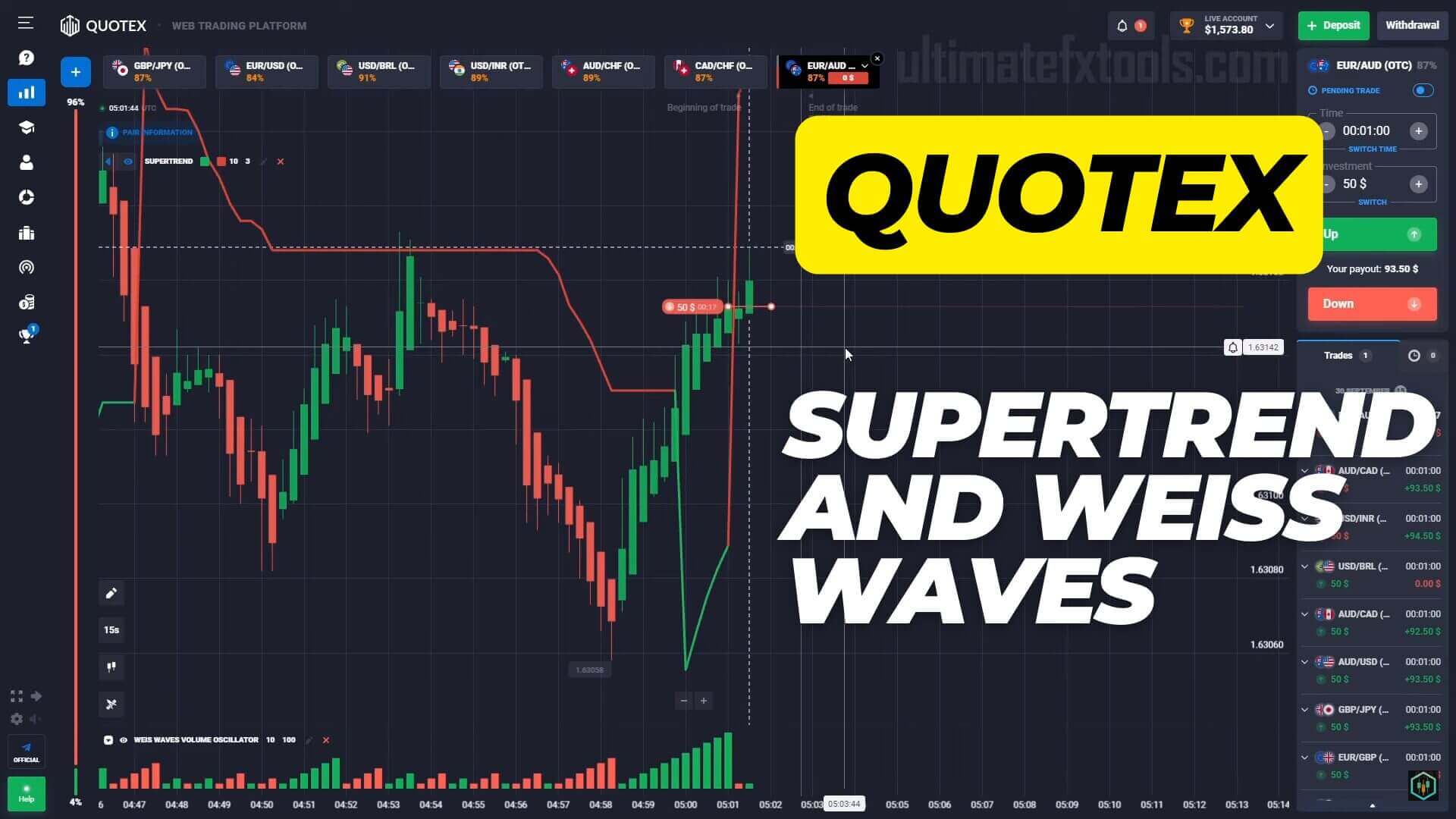
Trading Quotex with Super Trend Indicator and Weiss Waves Volume Oscillator
This Quotex strategy pairs two tools that answer different questions. The Super Trend Indicator tracks the direction of price using an ATR-based band, while the Weiss Waves Volume Oscillator measures the effort — the volume — behind each swing. On their own neither is enough, but read together they can help you judge whether a move has conviction behind it. Treat what follows as a framework for study, not a promise of a particular outcome.
What Super Trend and Weiss Waves Actually Do
Super Trend plots a trailing line above or below price. When price closes on the other side of the line, the indicator flips and colours the new direction. It is clean and easy to read in a trending market, but be honest about its main weakness: in flat, choppy, or ranging conditions it whipsaws, flipping back and forth and handing you a string of false signals. That limitation is exactly why a second, independent filter is useful.
Weiss Waves group consecutive candles into waves and sum the volume within each one, drawing the result as a histogram. A tall wave means a lot of participation pushed price in that direction; a shrinking wave suggests the effort behind the move is fading. Because it reads volume rather than price alone, it can hint that a trend is running out of fuel before Super Trend has flipped.
How the Two Combine
The idea is confirmation. You are looking for the Super Trend line to signal a direction while the Weiss Waves histogram agrees with it — a fresh, growing wave in the same direction as the flip. When Super Trend turns up but the volume waves are shrinking, that disagreement is a reason for caution, not a trade. Requiring both to line up filters out many of the whipsaw signals Super Trend produces on its own.
Settings, Timeframe and Entry Rules
- Timeframe: The 1-minute and 5-minute charts suit Quotex's short expiries; match your expiry roughly to the candle you trade.
- Super Trend: The common defaults (ATR period around 10, multiplier around 3) are a sensible starting point. Higher multipliers give fewer, slower signals; lower ones react faster but whipsaw more.
- Entry: Wait for the Super Trend line to flip, confirm a matching Weiss Waves wave is building in the same direction, then take the entry on the next candle.
- Market selection: Favour clean, directional conditions and step aside during flat, noisy chop where Super Trend is least reliable.
If you want to explore related setups, our Quotex Easy Strategy and Quotex 1-Minute Strategy use the same indicators in slightly different ways.
Realistic Expectations
No indicator combination reads the future. Both of these tools are lagging — they describe what price and volume have already done, and any signal can still fail. Expect losing trades to occur in normal runs, especially when the market turns sideways. The goal is not to avoid losses but to take setups where the odds are, in your judgement, reasonable, and to keep each loss small.
Risk Management
Use fixed-fractional staking: risk the same small, constant share of your balance on every trade — many traders keep this to 1–2% — regardless of whether the last trade won or lost. Set a hard per-session loss cap, and once you hit it, stop trading for the day. Each Quotex trade is independent: a loss does not make the next trade more likely to win.
Warning — do not use Martingale. The Martingale method tells you to double your stake after every loss until a win "recovers" everything. It feels safe but is not. An ordinary losing streak makes the required stake grow until it exceeds your balance, so a single extended run of losses can wipe out the account. Adding even "two or three steps" of Martingale does not add safety — it commits you to a much larger stake exactly when you are already losing. Avoid it, and be wary of any strategy that recommends it.
If you want every indicator referenced here ready to load on MT4/MT5, they are included with lifetime access for a one-time $39.
Frequently Asked Questions
Does this strategy win every trade?
No. No strategy wins every trade, and this one does not either. Both Super Trend and Weiss Waves are lagging indicators; signals fail regularly, particularly in choppy markets. Plan for losses and manage them with fixed staking.
What is the best timeframe for Quotex?
The 1-minute and 5-minute charts are the usual choice because they fit Quotex's short expiries. Match your expiry to the timeframe you analyse, and test on a demo account before risking real money.
Why does Super Trend give false signals?
Super Trend is built on the ATR and assumes price is trending. In flat or ranging conditions it whipsaws, flipping repeatedly with little follow-through. Confirming each flip against the Weiss Waves volume histogram is the main way this strategy tries to filter those out.
This content is for educational purposes only and is not financial advice. Trading involves substantial risk; you can lose some or all of your capital. No result is guaranteed and past performance does not indicate future results. Trade only what you can afford to lose.


