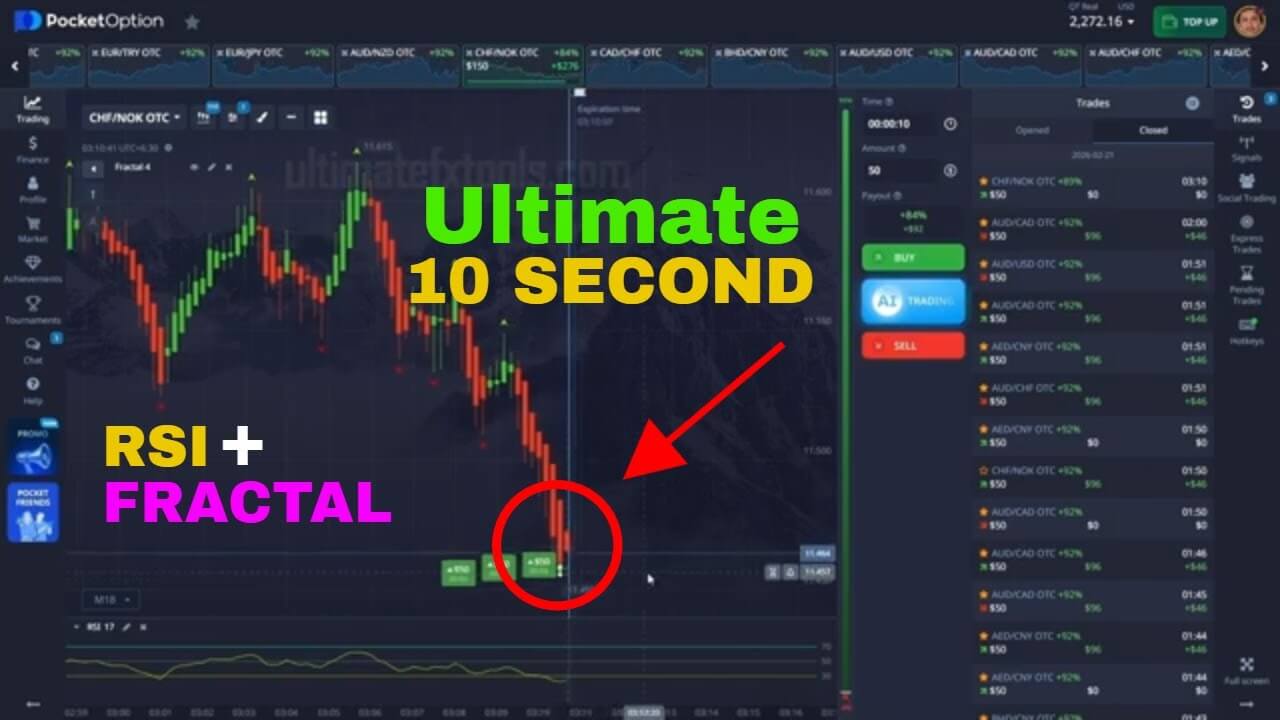
"Pocket Option 10 Seconds"
"Ultimate Strategy"
"RSI + Fractal Strategy"
What Is the Pocket Option 10-Second Strategy?
If you're looking for a fast-paced strategy on Pocket Option, the 10-second method (RSI + Fractal strategy) is more structured short-term method being tried with us.
Unlike longer timeframe strategies, 10-second trades demand precision, discipline, and lightning-fast decision-making. This strategy combines two powerful technical indicators — the Relative Strength Index (RSI) and a Fractal indicator — to filter out false signals and identify reversal points.
This method breaks down exactly how the strategy works, how to manage losing trades, and the golden rules every trader should follow.
What You Need to Get Started
Before placing a single trade, make sure you have the following set up on your Pocket Option chart:
- RSI — faster than the standard RSI, making it more responsive to ultra-short price moves
- Fractal Indicator — displays fractal arrows (highs and lows) that act as entry confirmation signals
- Simple Moving Average — SMA (optional) — helps identify the micro-trend direction on the short timeframe
- A Demo Account — non-negotiable before going live
How the Strategy Works: Step-by-Step
Step 1 — Set Up Your Chart
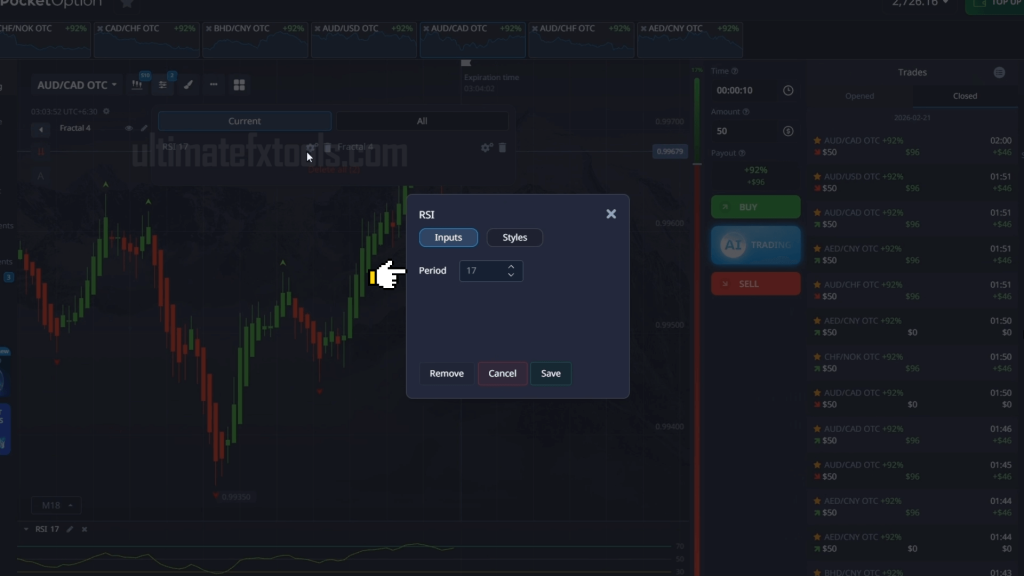
Open your Pocket Option chart and configure it for 10-second. Apply the following indicators:
- RSI with period = 17
- Fractal indicator showing recent fractal arrows (price highs and lows)
- Optional: SMA (period 20) to help read micro-trend direction
Keep your chart clean. Avoid clutter. Fewer distractions mean faster, clearer decisions.
Step 2 — Read the Indicators
RSI(17) Key Levels:
For 10-second trades, use tighter RSI zones to reduce noise:
- Overbought (Resistance): ~75–80 → potential SELL signal
- Oversold (Support): ~20–25 → potential BUY signal
Fractal Arrows as Confirmation:
The fractal indicator is your filter. It tells you whether the RSI signal is worth acting on.
- A bullish fractal (downward arrow) appearing when RSI is near the oversold zone = stronger BUY confirmation
- A bearish fractal (upward arrow) appearing when RSI is near the overbought zone = stronger SELL confirmation
SMA Direction (Optional):
If the SMA is sloping upward, favor BUY signals. If sloping downward, favor SELL signals. If it's flat, treat it as neutral.
Step 3 — Entry Rules
✅ BUY Signal (10-Second Call) — Enter When:
- RSI(17) reaches or approaches the oversold zone (around 25–30)
- A bullish fractal arrow (pointing down) has just appeared or is visible
- SMA is flat or slightly pointing upward
- Candle is green or showing upward momentum
✅ SELL Signal (10-Second Put) — Enter When:
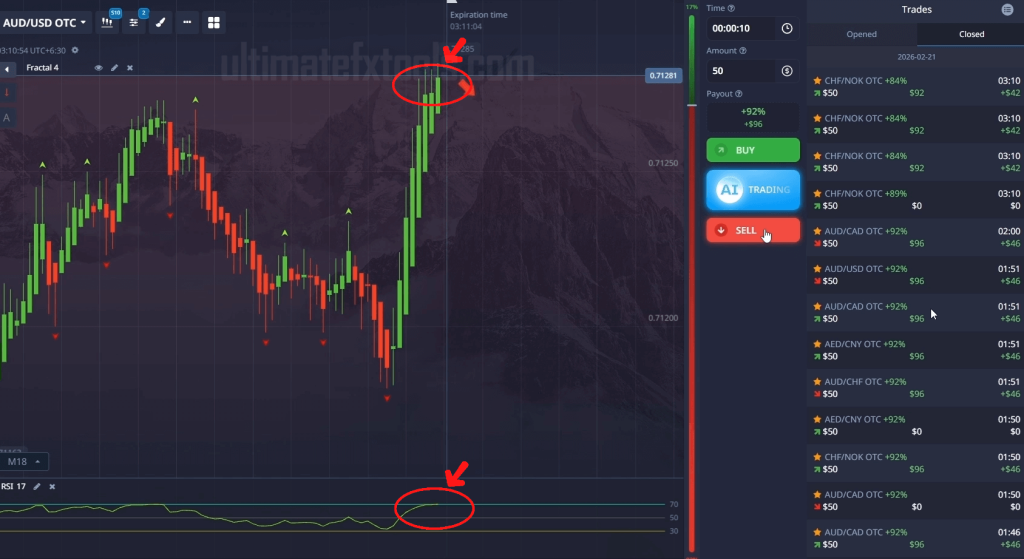
- RSI(17) reaches or approaches the overbought zone (around 75–80)
- A bearish fractal arrow (pointing up) has just appeared or is visible
- SMA is flat or slightly pointing downward
- Candle is red or showing downward momentum
💡 Key Rule: If RSI reaches the overbought or oversold zone but no fractal arrow appears, skip the trade. The fractal is your filter — no fractal, no trade.
Managing Losing Trades — Why the Triple Martingale Is a Trap
Some traders try to claw back a loss by tripling their stake on the next trade — a "triple martingale." This site used to describe that as a recovery system. It is not one. It is one of the fastest ways to lose an entire account, and this section explains plainly why you should never use it.
Each 10-second trade is an independent event. A losing trade does not make the next trade more likely to go your way, so increasing your stake after a loss does nothing to improve the next outcome — it only puts more money at risk on a bet with the same odds as before. Chasing a loss with a bigger stake is a bet on luck, not on your setup.
Here is what tripling after each loss actually does to a $50 base trade:
| Trade | Stake | What's really happening |
|---|---|---|
| Trade 1 | $50 | Base entry |
| Trade 2 | $150 | You've now committed $200 chasing one $50 loss |
| Trade 3 | $450 | Total at risk: $650 — and still no edge on the next trade |
A triple martingale grows the stake even steeper than a "double" martingale, so it blows up faster. A losing run of just a few trades in a row — completely normal on a noisy 10-second timeframe — pushes the required stake past your entire balance almost immediately. When that happens you are wiped out, and no later win can undo it.
What to do instead — fixed-fractional staking
Stake the same small fraction of your account on every trade, win or lose, and never raise it to recover:
- Risk the same 1–2% of your balance on every trade, regardless of the previous result
- Set a hard per-session loss cap — for example, stop for the day after 3 losing trades in a row, or after losing 5% of your balance, whichever comes first
- When you hit the cap, close the platform and walk away. Do not try to "make it back" today.
- Test everything on a demo account first, and only ever risk money you can afford to lose
Fixed staking keeps a losing streak survivable. Martingale — double or triple — turns a normal losing streak into a blown account. Do not use it.
Example Trade Scenario
Here's how a typical SELL setup would look in practice:
- RSI(17) climbs to ~78 — entering the overbought/resistance zone
- A bearish fractal arrow appears on a recent candle
- The SMA is flat or slightly declining
- A red candle is forming, confirming downward momentum
- You enter a 10-second PUT trade with $50
If the trade wins, fine. If it loses, keep your next stake exactly the same — do not increase it — and only enter again when RSI + fractal freshly confirm a fresh setup. If you've already hit your session loss cap, stop for the day.
Avoiding False Signals and Market Noise
The 10-second timeframe is extremely noisy. Here's how to protect yourself:
- No fractal = no trade. RSI alone on this timeframe produces too many false signals.
- Avoid trading during major news events or high-volatility periods. Payouts and spreads become unpredictable.
- If the market is whipsawing — RSI bouncing rapidly without smooth movement — step back and wait. Patience protects capital.
- Don't force trades. Fewer, better-quality entries beat high-volume random entries every time.
Tips for Success with This Strategy
1. Demo Test for Weeks First There are no shortcuts. Run this strategy exclusively on a demo account for several weeks. Track every trade and review your results before risking your investment.
2. Keep a Trading Journal Record your entry conditions, the RSI level, whether a fractal was present, and the outcome. Patterns in your journal will tell you what's working and what isn't.
3. Limit Your Daily Trades Set a maximum number of trades per day and stick to it. Overtrading on a 10-second timeframe is one of the fastest ways to drain an account.
4. Strict Bankroll Rules
- Base trade = no more than 1–2% of total account balance
- Set a daily loss limit and stop trading when you hit it
- Never chase losses emotionally
5. Execution Speed Matters On 10-second charts, every second counts. Ensure your internet connection is stable and your Pocket Option platform is running smoothly before trading sessions.
Final Thoughts — Is the 10-Second Strategy Right for You?
The Pocket Option 10-second RSI(17) + Fractal strategy is one of the more disciplined approaches to ultra-short-term trading. It's not for everyone — the speed, risk, and emotional pressure are significant.
But for traders who enjoy fast markets and are willing to put in the time to properly demo test and backtrack their trades, this method offers a structured framework with clear, rule-based entries.
The bottom line: master the setup on demo first, trade with discipline on live, and never skip the fractal confirmation.
⚠️ Trading on Pocket Option or any platform carries significant financial risk. This content is for educational purposes only and does not constitute financial advice. Trade responsibly.
Tags: #PocketOption #TradingStrategy #RSI17 #FractalIndicator #10SecondTrading #ShortTermTrading #DayTrading #TradingTips #PocketOptionStrategy
⚠️ Risk Disclaimer: 10-second trading is an ultra-high-risk, short-term approach. Past performance does not guarantee future results. Always practice on a demo account first and never trade with your investment you cannot afford to lose.