Trading Pocket Option with an RSI Signal Alert
This setup pairs a momentum reading from the Relative Strength Index (RSI) with the DeMarker indicator to time short-term entries on Pocket Option. It is a rule-based approach, not a shortcut. Short-expiry trades are high-variance by nature, and losing trades are a normal part of the process, so the goal here is a repeatable routine and disciplined risk control rather than any promise of a particular outcome.
The Indicators and Chart Setup
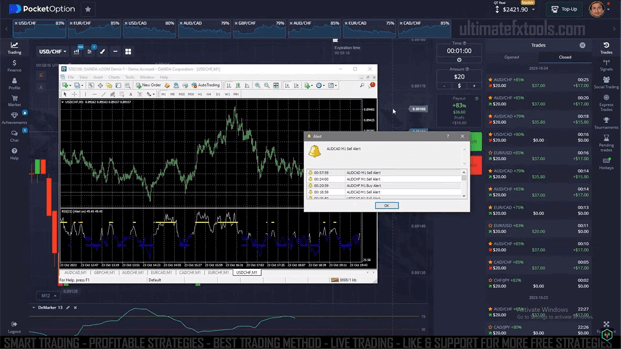
The RSI signal alert runs on the MetaTrader 4 platform and marks the chart when RSI reaches an overbought or oversold level, so you do not have to watch every candle. It is read alongside the DeMarker indicator, which helps confirm whether momentum is turning up or down. When both point the same way, the signal is stronger; when they disagree, it is usually better to skip the trade.
- Platform: MetaTrader 4 for reading indicators, with the entry placed on Pocket Option.
- Indicators: RSI signal alert plus the DeMarker lines for trend confirmation.
- Timeframe: A lower timeframe such as M1 or M5, matched to a short expiry.
- Pairs: Liquid majors and crosses like AUDCAD, EURUSD or GBPUSD.
Entry Rules
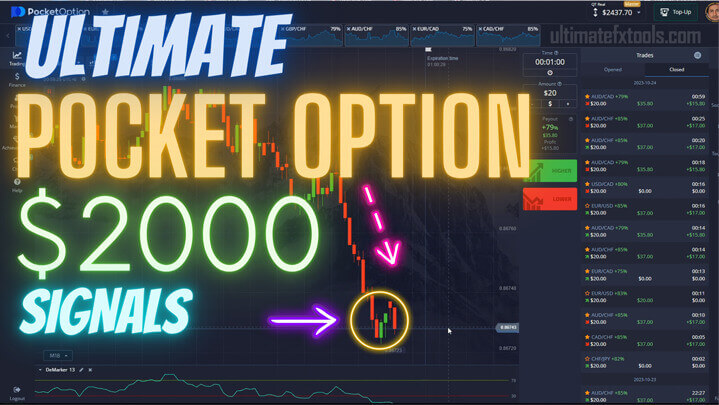
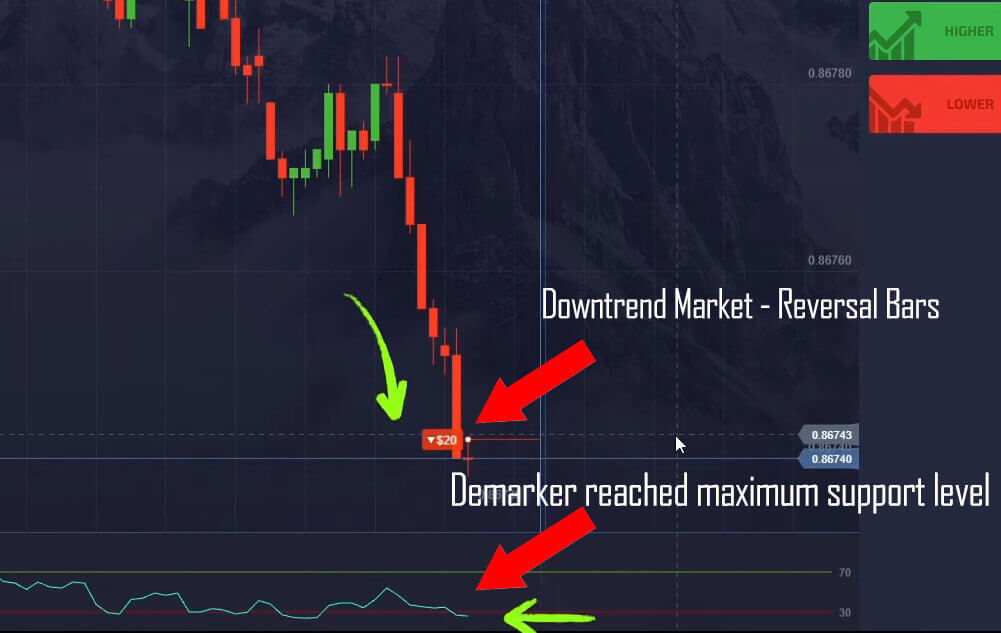
A sell setup forms when RSI signals from an overbought level while the DeMarker lines confirm a fading or downward move; a buy setup is the mirror image from oversold. In a live example on AUDCAD, a sell alert lined up with DeMarker showing a downtrend, giving a clean read to act on. Not every aligned signal works out, which is exactly why the setup leans on confirmation and a fixed expiry rather than gut feel. Wait for the alert, check that both tools agree, then place a short-expiry trade in that direction.
Risk Management
Risk control is what keeps you in the game long enough for a strategy to matter. Keep the stake on each trade small and fixed, around 1–2% of your account, and set a hard daily loss cap so a rough session ends before it does real damage.
- Fixed stake: Risk the same small amount each trade. Avoid martingale or doubling after a loss — every binary trade is independent, and doubling only concentrates risk until one losing streak wipes the account.
- Daily loss cap: Decide in advance how many losses end your session, and stop when you hit it.
- Practice first: Test the setup on a demo account until the rules feel automatic before risking real money.
Frequently Asked Questions
Does this strategy win every trade?
No. No indicator or signal wins every trade, and anyone claiming otherwise is not being honest. Short-expiry trading is high-variance, and losing trades are unavoidable. The value of the RSI signal alert is a consistent, rule-based way to spot setups — results still depend on discipline, risk control and market conditions.
Which timeframe and expiry should I use?
Match your expiry to your chart timeframe. If you read signals on the M1 or M5 chart, keep the expiry short and consistent so your results are comparable trade to trade. Changing expiry mid-session makes it impossible to judge whether the setup is working for you.
Where do I get the RSI signal alert indicator?
The RSI signal alert and the rest of the MT4/MT5 library are included with lifetime access for $39. If you want to compare approaches first, see our moving averages with DeMarker and Pocket Option trend WMA guides.
This content is for educational purposes only and is not financial advice. Trading involves substantial risk; you can lose some or all of your capital. No result is guaranteed and past performance does not indicate future results. Trade only what you can afford to lose.