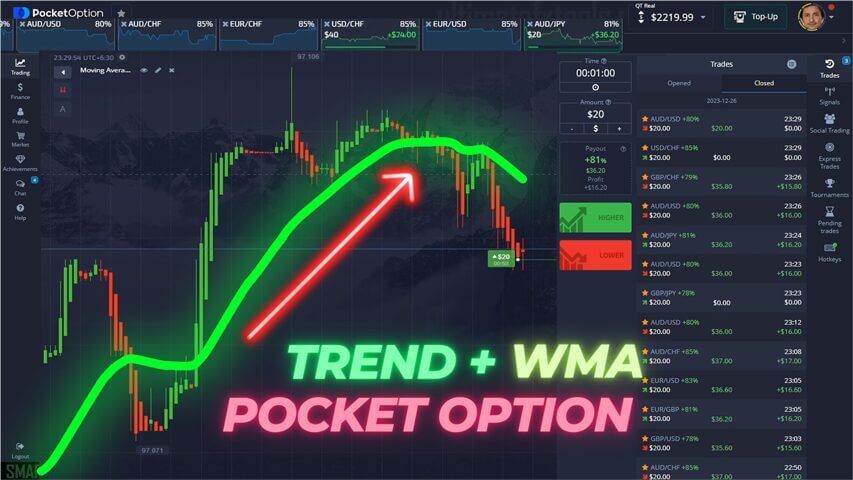
A Weighted Moving Average (WMA) puts more weight on recent prices, so it turns faster than a plain simple moving average when a trend shifts. This walkthrough pairs a single WMA with the Velocity X indicator on Pocket Option to build a rules-based trend-following setup. The idea is simple: use the WMA to define the direction of the market, and use Velocity X as a filter that flags when momentum lines up with that direction. It is an educational framework, not a signal service, and it will produce false signals in sideways conditions like every moving-average method does.
Pocket Option 2024 Strategy
The WMA acts as the trend anchor. When price holds above a rising WMA the bias is up; when price sits below a falling WMA the bias is down. Velocity X, built on the Dream X engine with on-chart alerts, is added as a momentum filter so you are not trading every touch of the average. The goal is to only act when the moving average and the momentum reading agree, which cuts down some of the noise you get in choppy ranges. Remember that a WMA still lags price. It confirms a move that has already started rather than predicting the next one, so entries are about following direction, not forecasting turns.
What the WMA trend setup is
This is a trend-continuation approach for short-expiry trades on Pocket Option. You are looking for moments where the average and the momentum filter point the same way, then taking a trade in that direction on a normal pullback toward the average. If the two disagree, you stand aside. Standing aside is a valid outcome and often the right one during flat, directionless markets.
Settings, timeframe and entry rules
Set your chart candles to a 5-second interval if you plan to trade 1-minute expiries; this keeps the candles readable at speed. Many traders also prefer Heiken Ashi candles here because the smoothing makes the prevailing trend easier to read, though standard candles work too. Add a Weighted Moving Average with a period of 42 and thicken the line for visibility.
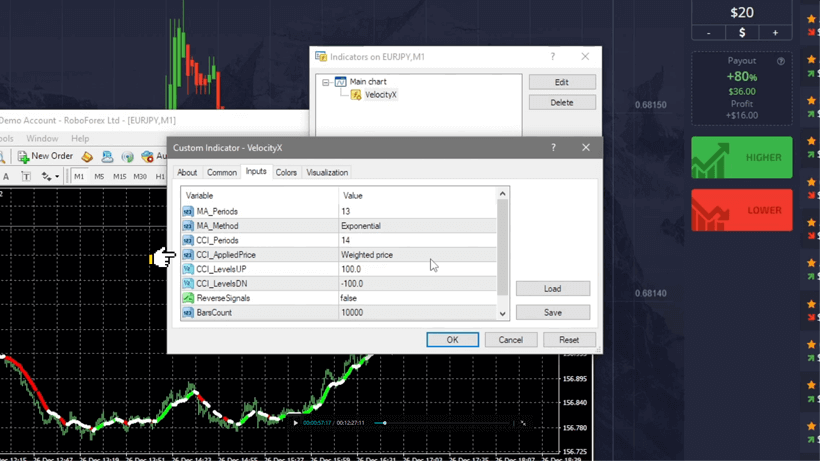
Configure Velocity X with these reference values, then adjust to the pair you trade:
- Moving average period: 13
- Moving average method: Exponential
- CCI period: 14
- CCI applied price: Weighted price
- CCI levels: -100 and +100
Entry rules are deliberately mechanical. For a higher (call) trade, wait for an up alert while price is pulling back toward or just below a rising WMA, signalling the trend may resume. For a lower (put) trade, wait for a down alert while price is stretched above a falling WMA. If the alert and the WMA slope disagree, skip the trade. Treat the reversal alerts as a filter, not a standalone trigger, and always confirm the WMA slope first.
Realistic expectations
No indicator combination removes losing trades. The WMA lags, so it can whipsaw during ranges and news spikes, and Velocity X will occasionally fire against the larger move. Test the setup on a demo account first, keep a written log of the conditions where it behaves well, and accept that some sessions simply will not offer clean setups. Consistency comes from following your rules, not from any single indicator. If you want the full Velocity X toolkit plus the rest of the library, it is included with lifetime access for $39.
Risk Management
Fast-expiry trading amplifies mistakes, so protect your capital before chasing setups. Use a fixed stake per trade — a small percentage of your account that stays the same whether the last trade won or lost. Avoid martingale (doubling after a loss): each binary trade is an independent event, so raising size after a loss does not improve your odds and can drain an account quickly. Set a hard daily loss cap and stop for the day once you hit it, no exceptions. Trade only pairs you have actually tested, and never risk money you cannot afford to lose.
FAQ
Does this strategy win every trade?
No. No strategy wins every trade. The WMA lags price and can whipsaw in choppy markets, and the Velocity X filter can produce false signals. The rules are meant to improve your discipline and selectivity, not to guarantee an outcome. Expect losing trades and manage them with a fixed stake and a daily loss cap.
Why a WMA instead of a simple moving average?
A Weighted Moving Average gives recent candles more influence, so it reacts to a change in direction sooner than a simple moving average of the same length. That responsiveness helps on fast timeframes, but the trade-off is more sensitivity to short-term noise. If you prefer a smoother line, compare it with a two-WMA crossover approach and see which reading suits your style.
Can I use Heiken Ashi candles with this?
Yes. Many traders combine this setup with Heiken Ashi because the smoothing makes the trend easier to follow. If you want to explore that further, see our Heiken Ashi long-candle guide. Just remember Heiken Ashi hides the real open and close, so use it to read direction, not exact entry price.
This content is for educational purposes only and is not financial advice. Trading involves substantial risk; you can lose some or all of your capital. No result is guaranteed and past performance does not indicate future results. Trade only what you can afford to lose.