How to Achieve a Good Rate with Zigzag and SMA
This Pocket Option setup pairs two well-known tools — the ZigZag indicator and a Simple Moving Average (SMA) — to trade short bursts in OTC (Over-The-Counter) markets. The idea is simple: use ZigZag to frame the current swing, use the SMA to confirm direction, and only act when the two agree. It is a structure for making clearer decisions, not a shortcut to easy money. Below you will find the exact settings, the entry rules, and an honest look at the caveats that most videos leave out.
What ZigZag and the SMA Actually Do
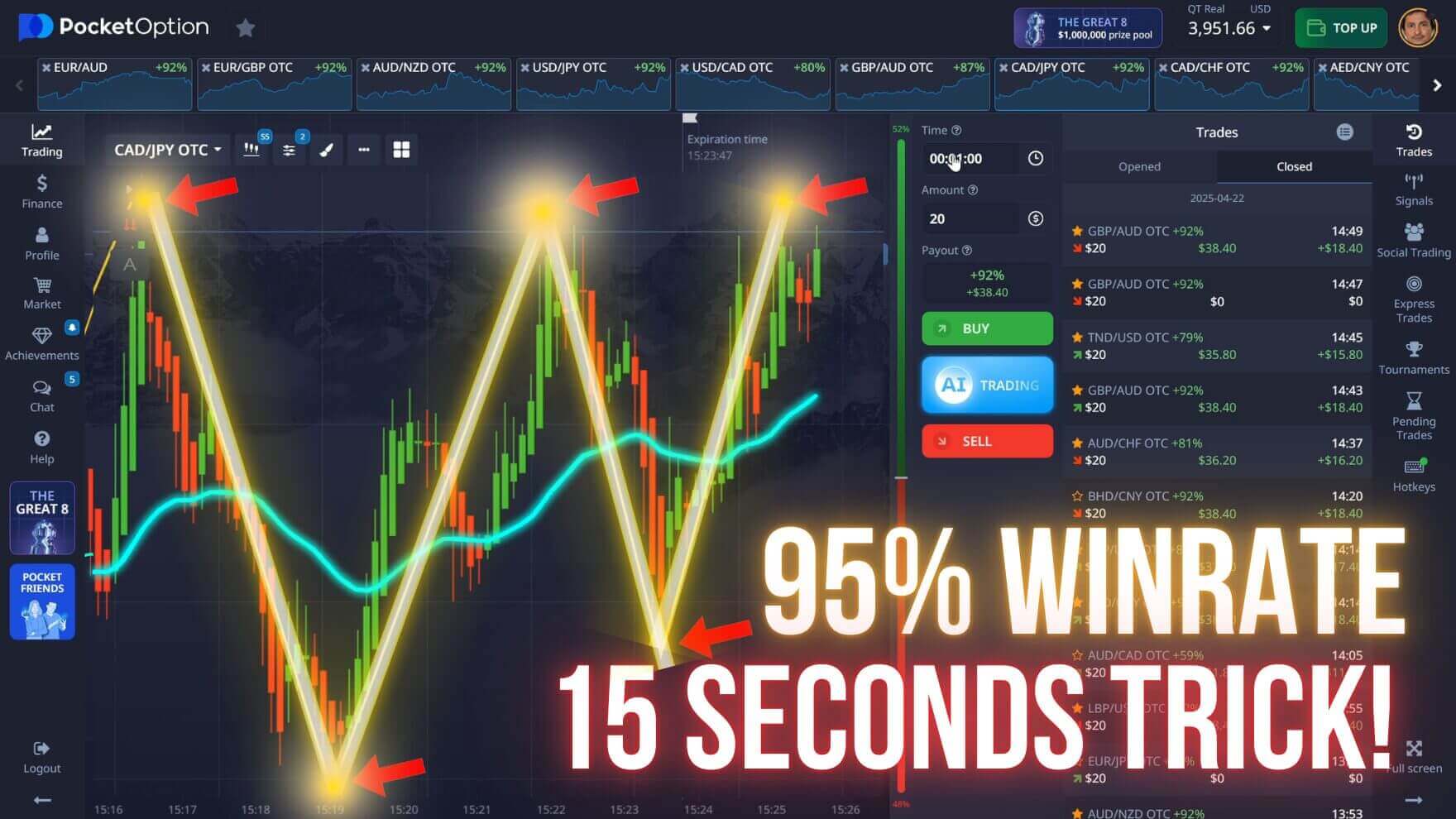
The ZigZag connects significant swing highs and lows while ignoring smaller wiggles, so a messy chart resolves into a cleaner sequence of legs. It is a filter for structure, not a predictor. The SMA — here set to a 37-period average — smooths price into a single line so you can read whether momentum is broadly up or down. On its own, neither tool gives a trade; together they give context. When price holds above a rising SMA and ZigZag is building an upward leg, the bias is bullish; the mirror image is bearish. If you like the moving-average style of confirmation, the Pocket Option Trend WMA strategy applies the same principle with a weighted average.
The Repaint Caveat You Must Understand
This is the single most important thing to know: ZigZag repaints. Its most recent leg is provisional and will redraw as new candles arrive. A point that looks like a confirmed reversal in real time can move — or disappear — once the swing extends. That means backtests scrolling through history look far cleaner than live trading ever will, because in hindsight every ZigZag point is already locked. Treat the current leg as a guess, not a signal, and wait for the SMA relationship and candle close to confirm before you commit. Anyone showing you a flawless ZigZag chart is showing you the past, where repaint has already resolved.
Why a "95% Win Rate" Is Unrealistic
You will see this strategy circulated with a "95% win rate" label, so let us be clear. That number usually comes from confusing two different things: a platform's payout percentage (the ROI you receive on a winning trade, often 80–92%) with the win rate (how often the trade actually finishes in your favour). They are not the same, and a high payout says nothing about how often you win. No indicator combination wins 95% of trades — not this one, not any. On a 15-second timeframe, price is dominated by noise, and even a disciplined trader will hit losing streaks. Plan for a realistic outcome where some setups fail, and judge the method over many trades rather than a lucky handful.
Timeframe and Entry Rules
Chart Settings
- Candle type: Heiken Ashi, for smoother trend reading (remember these average price too, so they also lag).
- Chart timeframe: 5-second candles.
- Trade duration: 15 seconds.
- SMA period: 37, applied to close.
Entry Checklist
- Buy bias: price crosses and holds above the SMA (37) while ZigZag is forming an upward leg.
- Sell bias: price crosses and holds below the SMA (37) while ZigZag is forming a downward leg.
- Prefer OTC pairs with a higher payout, such as EUR/USD-OTC or GBP/USD-OTC, and keep the duration fixed at 15 seconds.
- Stand aside when the SMA is flat or price is chopping across it — mixed signals are a reason to skip, not to force a trade.
Risk Management
Fast expiries can drain an account quickly, so structure matters more than any single win.
- Risk a small, fixed percentage of your balance per trade rather than a flat dollar amount that grows careless.
- Do not use martingale. Doubling after losses can wipe out an account during a normal losing streak — the exact scenario short expiries produce.
- Set a daily loss limit and a daily trade cap, and stop when you hit either.
- Practise on a demo account until the entry rules feel automatic, then start with the smallest stake.
For a slower, calmer alternative to ultra-short expiries, the Super Trend and Bollinger Bands setup is worth reviewing.
Frequently Asked Questions
Is the 95% win rate real?
No. That figure typically comes from mislabelling the platform's payout percentage as a win rate. No ZigZag and SMA combination wins 95% of trades; expect losing runs and evaluate results across many trades, not a short winning sequence.
Does the ZigZag indicator repaint?
Yes. Its latest leg is provisional and redraws as new candles print, so real-time signals are less reliable than a historical chart suggests. Always wait for the SMA relationship and candle close to confirm.
Where can I get the indicators?
The ZigZag and SMA are standard tools available on most platforms. If you want a full bundle of indicators and strategy guides, our $39 lifetime access covers 100+ tools for MT4 and MT5.
This content is for educational purposes only and is not financial advice. Trading involves substantial risk; you can lose some or all of your capital. No result is guaranteed and past performance does not indicate future results. Trade only what you can afford to lose.