Trading Reversals with the 15-Second Ichimoku + OsMA Setup on Pocket Option
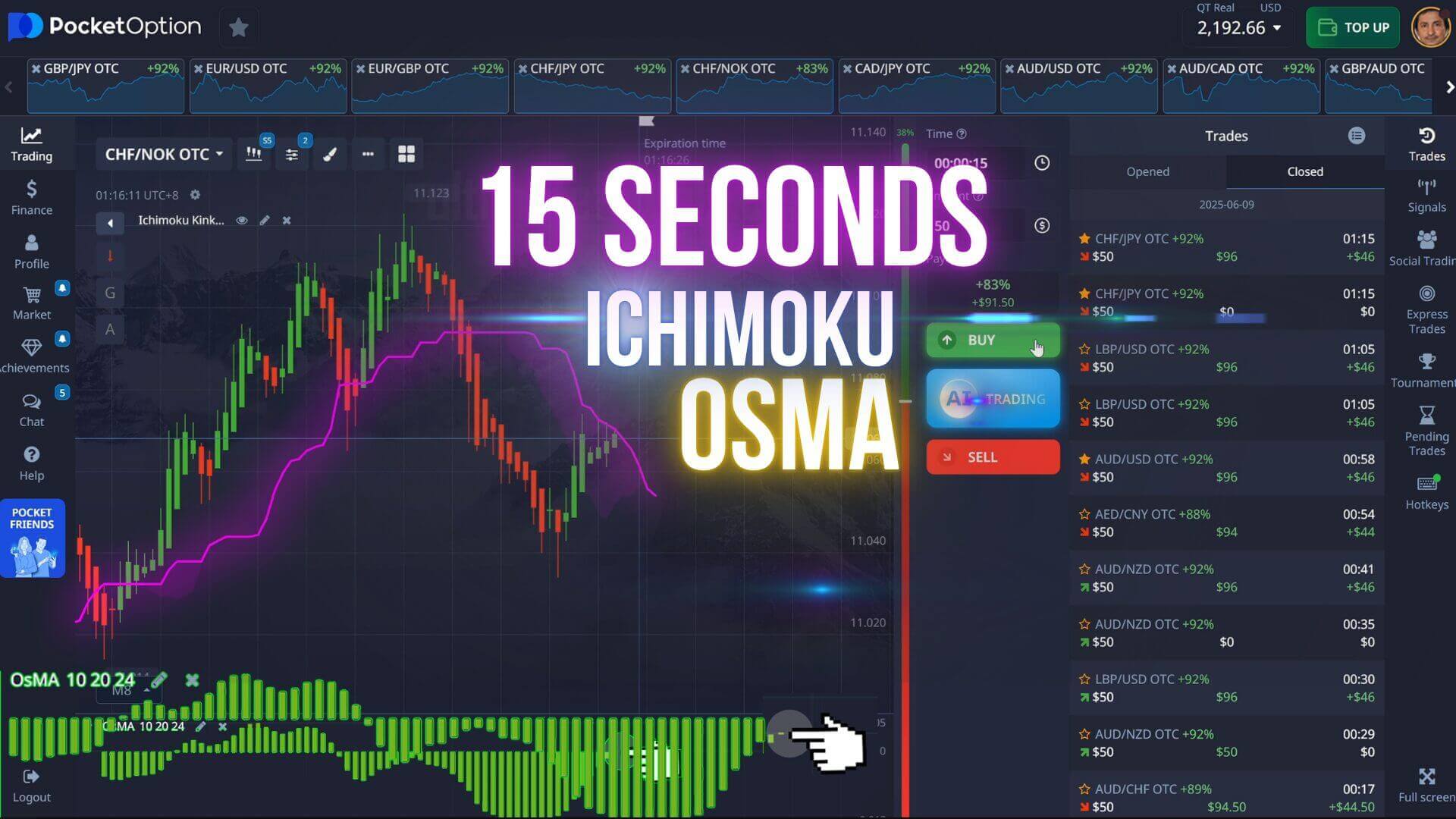
The 15-second reversal idea on Pocket Option OTC pairs tries to catch a short-term turn in price using two well-known tools: the Ichimoku Kinko Hyo and the OsMA (Moving Average of Oscillator, the histogram of a MACD). This is a fast, high-variance approach, so treat it as one framework to study rather than a shortcut. On a 15-second expiry there is very little time for a trade to recover if the read is wrong, and OTC price feeds behave differently from live markets. Test everything on a demo first and keep expectations grounded.
What Ichimoku and OsMA Actually Do
Ichimoku bundles several averages into one picture: the conversion and base lines, the cloud (Kumo), and the lagging span. Traders often watch price crossing the base line (the "purple" line in many Pocket Option colour schemes) as a hint that momentum may be shifting. Keep in mind Ichimoku is built from moving averages, so it lags — it confirms a move after it has begun rather than predicting it, and on a 15-second chart that lag is meaningful.
OsMA measures the gap between the MACD line and its signal line. When it climbs through its zero midline, short-term momentum is leaning up; when it falls through, momentum is leaning down. Its weakness is chop: in a flat, ranging OTC market OsMA whipsaws back and forth across the midline and hands you conflicting signals. The two tools are paired precisely so one can filter the other's noise, but no combination removes false signals entirely.
Settings, Timeframe, and Entry Rules
A common configuration for this setup:
- Chart: Heiken Ashi candles on a 5-second interval to smooth some of the noise.
- Expiry: a 15-second option.
- Indicators: Ichimoku with default periods, plus OsMA watched around its midline.
The entry logic waits for two things to agree:
- Price crosses the Ichimoku base line, hinting at a possible reversal.
- OsMA confirms in the same direction — below the midline for a down (put) idea, above it for an up (call) idea.
When price crosses down and OsMA is below its midline, some traders consider a down option; the mirror applies for an up option. If both signals do not line up, the cleaner choice is to skip the trade rather than force one. For a broader look at sizing and staying in the game, our Pocket Option risk trading guide is a useful companion, and the Pocket Option hack post covers a related fast-timeframe idea.
Where This Setup Breaks Down
Two failure modes matter most. First, the lag: because Ichimoku confirms late, a "reversal" signal can arrive as the move is already ending. Second, chop: sideways OTC conditions make OsMA cross its midline repeatedly, producing signals that go nowhere. On a 15-second expiry there is no room to wait out a bad entry. Treat consecutive stop-outs as a sign the market is not trending cleanly and step back.
Risk Management
Fast expiries are high-variance by nature, so protect your capital before chasing any signal:
- Risk only a small, fixed amount per trade that you can afford to lose.
- Warning about martingale: doubling your stake after a loss (a martingale progression) is dangerous. A short losing streak — which is normal on 15-second trades — can drain an account quickly. This strategy does not require martingale, and stacking size after losses is not a way to "recover." If anything, cut size or stop.
- Set a daily loss limit and walk away when you hit it.
- Practice on a demo account until the rules feel automatic, then start small.
If you want the full toolkit of indicators for MT4 and MT5, our $39 lifetime access bundles 100+ tools with a one-time payment.
FAQ
Does this strategy win every trade? No. No strategy wins every trade, and 15-second trades are especially high-variance. Ichimoku lags and OsMA whipsaws in flat markets, so losing runs are normal. Manage risk accordingly.
Why 5-second Heiken Ashi candles with a 15-second expiry? Heiken Ashi smooths price action so trend and reversal cues are easier to read on a fast chart, while the 15-second expiry gives the setup a little room to play out. It does not remove noise or false signals.
Can I use this on live (non-OTC) pairs? The same logic applies, but live markets react to news and liquidity differently from OTC feeds. Re-test the settings on the market you plan to trade before committing real money.
This content is for educational purposes only and is not financial advice. Trading involves substantial risk; you can lose some or all of your capital. No result is guaranteed and past performance does not indicate future results. Trade only what you can afford to lose.