Introducing the AO DPO MA
The AO DPO MA setup for IQ Option combines three classic indicators that each read the market from a different angle: the Awesome Oscillator (AO) for momentum, the Detrended Price Oscillator (DPO) for short-term price cycles, and a Moving Average (MA) for the underlying trend direction. The idea is simple — instead of trusting a single tool, you wait for all three to point the same way before you commit to a call or a put. When momentum, cycle position, and trend agree, the reading is far cleaner than any one indicator on its own.
Fast binary durations leave little room for second-guessing, so a repeatable checklist matters. This three-indicator stack gives you exactly that: the AO tells you whether buying or selling pressure is building, the DPO shows where price sits inside its recent swing, and the MA keeps you on the right side of the broader move. Read together, they help you filter out weak signals and only act when the chart lines up.
What Each Indicator Contributes
The Awesome Oscillator measures momentum by comparing a 5-period and 34-period midpoint moving average, plotted as a histogram around a zero line. Bars above zero signal building bullish momentum; bars below zero signal bearish pressure. The Detrended Price Oscillator strips out the longer trend to expose the shorter cycle, so its peaks and troughs highlight where price is stretched within its recent range. The Moving Average — a smoothed line over price — defines the trend: price above the MA leans bullish, price below leans bearish.
Recommended Settings
Keep the indicators close to their standard values so the readings stay reliable across assets:
- Awesome Oscillator (AO): default 5 / 34 (fast 5, slow 34) on the median price.
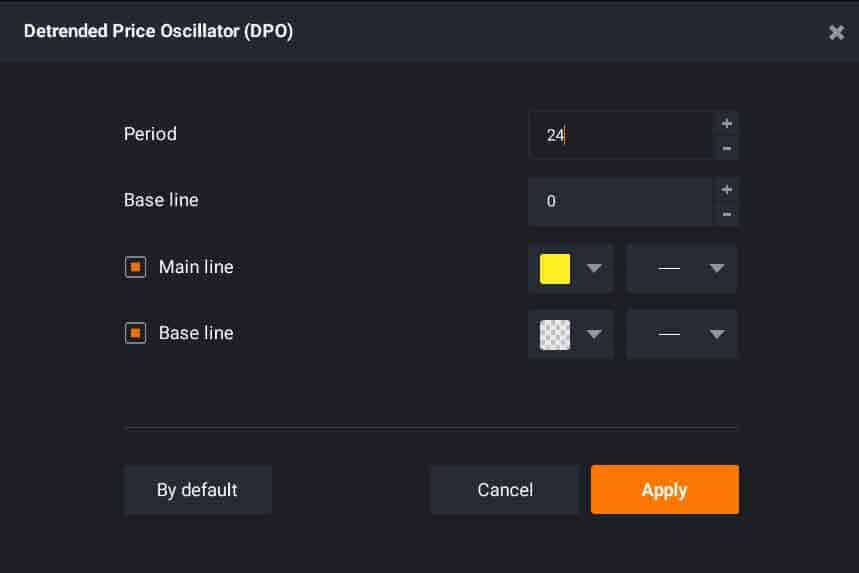
- Detrended Price Oscillator (DPO): period 14, applied to close price.
- Moving Average (MA): period 20 (a 20-period MA works well on lower timeframes; use EMA for a faster response or SMA for a smoother line).
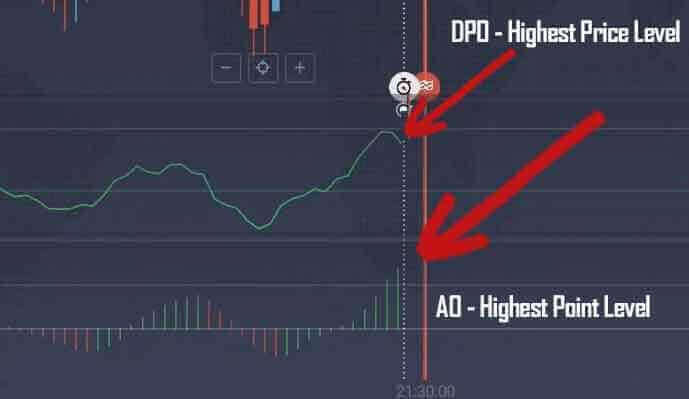
When the DPO reaches the highest price level, there's a possibility that price will turn down. And when the AO also reaches its highest peak for the trend, that is the position many traders watch for a sell. The mirror image applies at the lows — a stretched DPO trough plus an AO turning up from below zero points toward a possible move higher.
Buy / Call Rules
Only look for a call entry when all three tools align to the upside:
- Price is trading above the 20-period Moving Average (trend is up).
- The Awesome Oscillator histogram is above the zero line, or crossing up through it with growing green bars.
- The DPO is turning up from a low point in its cycle, confirming momentum is joining the trend.
When those three conditions appear together on a fresh candle, that is your call signal.
Sell / Put Rules
The put setup is the exact opposite:
- Price is trading below the 20-period Moving Average (trend is down).
- The Awesome Oscillator is below zero, or crossing down with growing red bars.
- The DPO is rolling over from a high point in its cycle.
Waiting for all three to agree keeps you out of choppy, sideways stretches where the MA is flat and the oscillators disagree.
Best Timeframe, Expiry & Risk
This setup reads cleanest on the 1-minute chart with a 1 to 2 minute expiry, giving each indicator enough candles to form a clear signal. Shorter durations such as 15 or 30 seconds are possible once you are comfortable, but they demand faster reads and are less forgiving. Whatever you choose, keep your stake small and fixed — risking only a modest, consistent amount per trade protects your balance during the inevitable losing runs. Treat the three-indicator agreement as a filter, not a promise, and skip the trade whenever the tools conflict.
Want the compiled indicator files and the full IQ Option strategy library in one place? See our pricing page for lifetime access to every tool on the site.
Related IQ Option Guides
Study the individual pieces of this setup in more depth: our breakdown of the best IQ Option indicator settings covers the Detrended Price Oscillator in detail, while binary options with the Awesome Oscillator and momentum focuses on reading AO shifts. For the packaged version of this method, review the IQ Option script guide.
FAQ
Do I need all three indicators to agree before entering?
Yes — the whole point of the AO DPO MA setup is confirmation. The Moving Average sets the trend bias, the Awesome Oscillator confirms momentum, and the DPO times the cycle. Acting only when all three align filters out most of the low-quality signals a single indicator would give you.
Can I use an EMA instead of an SMA for the moving average?
You can. An EMA (exponential moving average) reacts faster to recent price and suits shorter expiries, while an SMA (simple moving average) is smoother and produces fewer whipsaws. Keep the period around 20 either way and pick the responsiveness that matches your timeframe.
What timeframe works best for this setup?
The 1-minute chart paired with a 1 to 2 minute expiry is the most balanced choice, giving the DPO and AO enough candles to form clear readings. Faster charts are possible but require quicker decisions and offer less margin for error.
This content is for educational purposes only. Trading involves risk. Past results do not guarantee future outcomes. Always practice responsible money management and limit your daily trades to avoid large losses.