IQ Option Short Term Trading with Breakout Indicator And Awesome Oscillator
The 60-second breakout is one of the fastest setups a short-term trader can attempt on IQ Option. The idea is simple: when price pushes decisively past a level it has been respecting, that move sometimes carries on long enough to close a one-minute position in your favour. In practice, the very short timeframe makes this a high-variance approach. Many breakouts fail, price snaps back, and a minute is not much room for a trade to recover. This guide explains what the setup is, how the indicators fit together, and where the real risks sit.
What a Breakout Setup Actually Is
A breakout happens when price moves beyond a defined support or resistance level that has been holding. The theory is that once a level breaks, orders stacked around it get triggered and momentum builds in the direction of the break. That momentum is what a 60-second trader is trying to ride. The problem is that not every break is genuine. A false breakout pokes through the level, traps traders who chased it, then reverses. On a one-minute expiry there is very little time to tell a real move from a fake one, which is why confirmation matters more than speed.
Indicators, Timeframe and Entry Rules
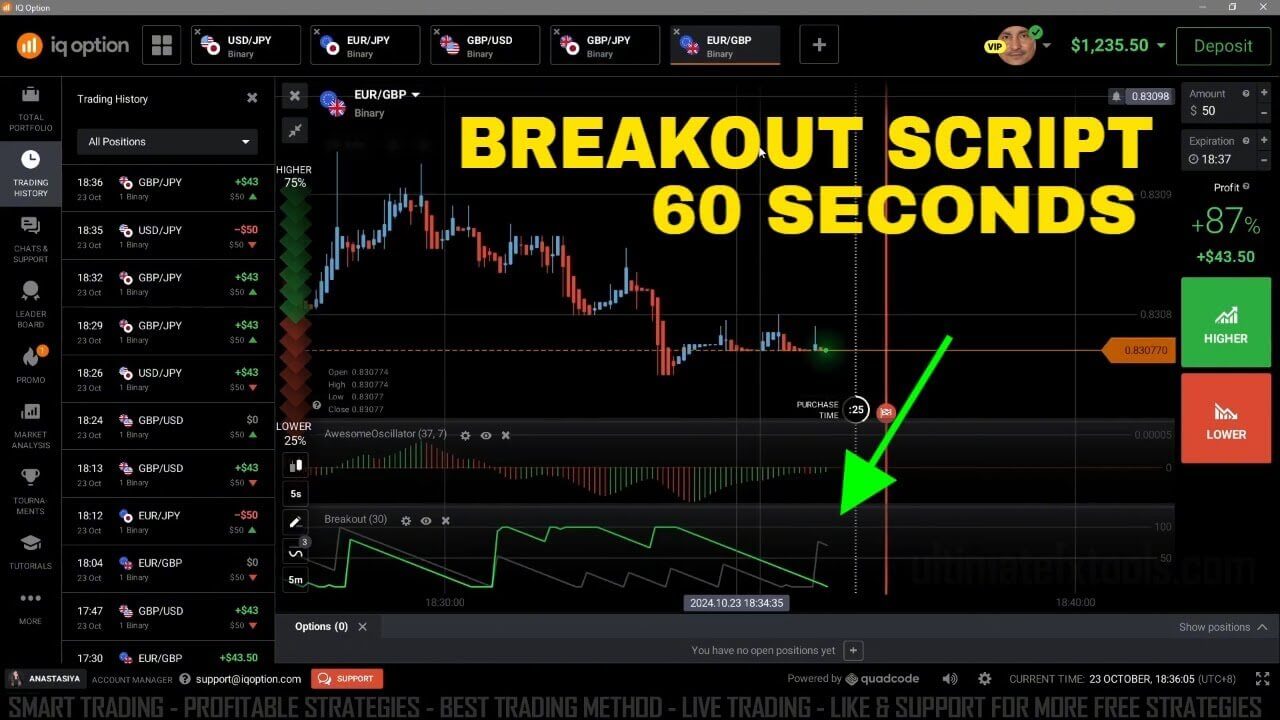
This method pairs a Breakout Indicator with the Awesome Oscillator. The Breakout Indicator marks when price crosses a support or resistance boundary. The Awesome Oscillator measures momentum by comparing recent price to a longer average, helping you gauge whether the move has force behind it or is just noise.
- Timeframe: a short candle period with a 1-minute expiry keeps the setup and the trade window aligned. Faster candle settings react quickly but also produce more false signals.
- Entry idea: wait for the Breakout Indicator to signal a cross while the Awesome Oscillator agrees with the direction of the break. Alignment between the two is the filter that removes some of the weakest signals.
- Confirmation: patience beats reaction. If the two tools disagree, there is no trade. Standing aside is a valid outcome.
Some traders also add an arrow tool such as the buy and sell arrow script as a visual prompt, but an arrow is only a cue to check your rules, not a reason to click on its own.
Why Breakouts Fail on 60 Seconds
Short expiries are unforgiving. Spread, a brief hesitation at the level, or a single opposing candle can turn a promising break into a loss before the minute is up. False breakouts are common around round numbers and session opens, where price often tests a level twice before committing. Treat every signal as a probability, not a certainty, and accept that a string of losses is a normal part of any fast method. No indicator combination removes that variance.
Risk Management
Because the timeframe is volatile, position sizing is the part you can actually control. Risk only a small percentage of your account on any single trade so that a run of losing minutes does not damage the account. Decide in advance how many trades you will take in a session and when you will stop for the day. Avoid martingale-style stake doubling after a loss — on a high-variance 60-second setup it can escalate a bad streak into a wipeout very quickly. Keeping stakes flat and small is the safer discipline.
Realistic Expectations
Used together, the Breakout Indicator and Awesome Oscillator give you a structured way to read short-term momentum, but they do not predict the next candle. Some sessions will offer clean setups; many will not. If you want a slightly longer window to work with, the IQ Option 1-minute strategy gives price more room to develop than the 60-second version. Judge any approach over many trades on a practice account before risking real money.
Watch: IQ Option 60 Seconds Breakout
The full Breakout Indicator, arrow script and the rest of the tool library are included with lifetime access for a one-time $39.
Frequently Asked Questions
Does this strategy win every trade?
No. Breakouts fail regularly, especially on a 60-second expiry where there is little time for a move to develop. The indicators help you filter setups, but losing trades are unavoidable and expected. Manage risk on the assumption that any single trade can lose.
What candle and expiry settings should I use?
A short candle period paired with a 1-minute expiry keeps the chart and the trade window in sync. Faster settings give more signals but more false ones too. Test different settings on a demo account and keep what you can trade consistently.
Do I need both indicators?
The point of using two is confirmation — the Awesome Oscillator helps weed out weak breakout signals. You can trade a breakout alone, but you lose that filter and will likely act on more low-quality moves.
This content is for educational purposes only and is not financial advice. Trading involves substantial risk; you can lose some or all of your capital. No result is guaranteed and past performance does not indicate future results. Trade only what you can afford to lose.