IQ Option Trading with CCV2 and Breakout Indicator
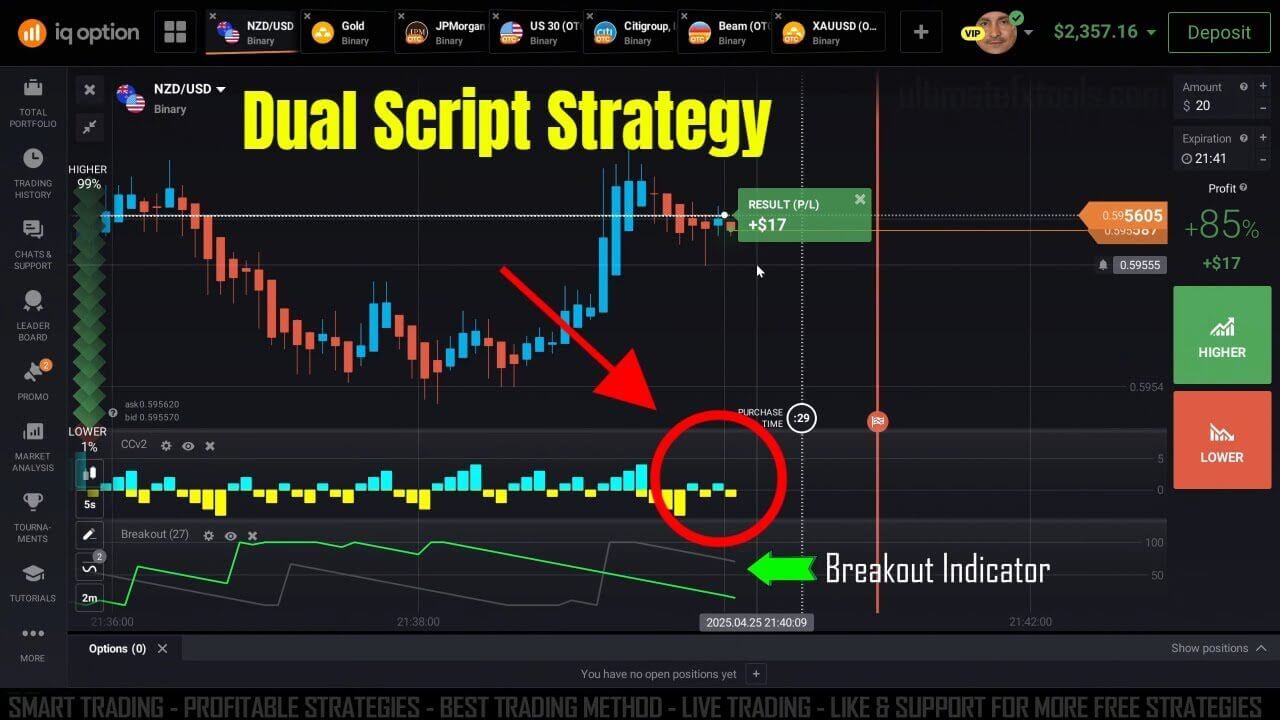
The IQ Option Dual Script approach pairs two on-chart tools — the Consecutive Candles Version 2 (CCV2) indicator and a Breakout indicator — so that you are not relying on a single signal to make a decision. The idea is simple: one tool reads candle momentum, the other watches for price pushing through a level, and you only act when both point the same way. This does not remove risk, and short-term binary trading remains one of the harder ways to trade, but a two-part filter can help you skip some of the low-quality setups you might otherwise take on impulse.
What the Two Scripts Do
CCV2 tracks runs of same-coloured candles. A long run of consecutive candles can signal building momentum, but it can also signal exhaustion just before a pause or pullback — context matters. The Breakout indicator marks where price is stretching past a recent high or low. On their own, either tool fires often; used together, you wait for agreement before considering an entry.

False Breakouts and Repaint — Read This First
Be honest with yourself about two limitations before you rely on this setup. First, breakouts fail often. Price frequently pokes past a level and then snaps back — the classic false breakout — trapping traders who entered on the initial push. Fast timeframes make this worse because a single spike can trigger a signal that is gone a few seconds later.
Second, on-chart scripts can repaint. A signal that looks perfect on a closed candle may shift, move, or disappear as new ticks arrive, because the calculation updates until the candle finishes. What you see in a screenshot or a replay is not always what you would have been able to act on live. Treat any signal as provisional until the candle closes, and never assume a marker that appears mid-candle will still be there at the end of it.
Timeframe and Entry Rules
This is a very short-term method, typically used on fast charts for 30-second to one-minute expiries. A workable routine:
- Wait for alignment: only look for an entry when CCV2 momentum and the breakout direction agree.
- Prefer closed candles: let the signal candle finish rather than acting on a mid-candle flicker.
- Skip choppy, low-volatility periods: ranging conditions produce the most false breakouts.
- Trade fewer, cleaner setups: quality over quantity reduces the impact of the inevitable losers.
If the two tools disagree, or the market is drifting sideways, the correct action is often to do nothing. For a slower variation of the same idea, see the IQ Option 1-minute strategy.
Realistic Expectations
No indicator combination wins every trade, and this one is no exception. Some sessions will produce clean, aligned signals; others will chop you up with fake-outs. The goal of pairing two tools is not certainty — it is filtering, so you take fewer marginal trades. Start on a demo account, keep a record of what actually happens, and judge the method on a large sample rather than one or two good runs.
Risk Management
Because these are rapid, all-or-nothing trades, risk control is what keeps you in the game. Risk only a small, fixed amount per trade — many traders cap it at 1–2% of their account — and never chase losses. Avoid martingale-style stake doubling: increasing your size after a loss can wipe out an account in a short losing streak, and a fast timeframe can deliver that streak quickly. Set a daily loss limit, and stop for the day when you hit it. Trade only money you can genuinely afford to lose.
Does this strategy win every trade?
No. No strategy wins every trade, and anyone who claims otherwise is not being straight with you. Breakouts fail regularly and signals can repaint, so losing trades are a normal part of using this method. Manage risk so no single trade or bad streak matters too much.
What timeframe works best for the dual script?
It is built for very fast charts and short expiries, commonly 30 seconds to one minute. Faster timeframes carry more noise and more false signals, so many traders test both the shortest settings and a slightly slower one-minute approach to see which they can follow calmly.
Do I need to pay to use this strategy?
The concept — waiting for a momentum tool and a breakout tool to agree — you can practise with the free write-ups linked above. If you want the packaged CCV2 and Breakout scripts along with the full library, they are included with $39 lifetime access.
This content is for educational purposes only and is not financial advice. Trading involves substantial risk; you can lose some or all of your capital. No result is guaranteed and past performance does not indicate future results. Trade only what you can afford to lose.