IQ Option Weighted Moving Average Strategy
The Weighted Moving Average (WMA) is a trend-following tool that many traders add to their charts on the IQ Option platform. Like any moving average, it smooths price data into a single flowing line, but it does so with an important difference: it gives more weight to the most recent candles and less weight to older ones. Because newer prices carry the heaviest influence, the WMA reacts faster to fresh momentum than a plain average, which makes it useful for spotting the direction of the current move and the moments when that move begins to fade.
On IQ Option, the WMA is available directly from the indicators menu, so you can add it to any currency pair, OTC symbol, or asset without extra downloads. Traders use it to read the underlying trend, to time call and put entries as price interacts with the line, and to filter out choppy sideways conditions where signals are unreliable.
WMA vs SMA and EMA
All three are moving averages; the difference is how each distributes weight across the lookback period. A Simple Moving Average (SMA) treats every candle equally, so it is smooth but slow to turn. An Exponential Moving Average (EMA) weights recent prices more heavily, so it reacts quicker. The Weighted Moving Average uses a linear weighting where the newest candle gets the largest multiplier and each older candle progressively less. In practice the WMA hugs price closely and flags reversals a little earlier than the SMA, which on short IQ Option timeframes is often exactly what traders want.
WMA Settings on IQ Option
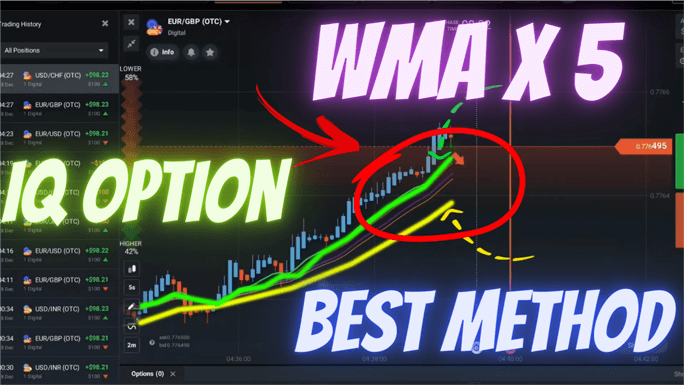
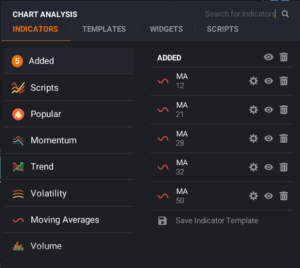
A single WMA can define the trend, but a multi-line setup gives a clearer read on strength and alignment. A common layered configuration uses five weighted moving averages with periods of 12, 21, 28, 32, and 50. The faster lines (12 and 21) track short-term momentum, the middle lines (28 and 32) act as a control zone, and the slowest line (50) frames the broader direction. When the fast lines sit above the slow line and the stack is fanned out in order, the trend is aligned; when they twist together and cross, momentum is stalling.
If a five-line stack feels crowded, you can simplify to a two-WMA setup — for example a fast WMA around 12 and a slower WMA around 50 — and read the crossover between them. This is a suggestion, not a fixed rule: adjust the periods to suit the asset and expiry you trade, and always confirm your chosen numbers on a demo chart before committing. The goal is a layout you can read at a glance, not the maximum number of lines.
To read more about how weighted averages are calculated, see this reference: Fidelity Learning Center — WMA.
Buy / Call and Sell / Put Rules
The signals come from how price and the WMA lines interact, not from the line alone. For a call (buy), look for price trading above the WMA stack with the faster lines sitting above the slower ones, then wait for price to pull back toward the fast WMA and bounce upward with a bullish candle — that continuation in the direction of the trend is your entry cue. For a put (sell), mirror it: price below the stack, faster lines below the slower ones, and a rejection off the WMA as price rolls back down with a bearish candle. When the lines are tangled and flat, there is no clear trend to trade, so the sensible action is to stand aside and wait for the stack to fan out again.
Best Timeframe, Expiry and Risk
The WMA method works on multiple timeframes, but many IQ Option traders apply it to the 1-minute and 5-minute charts and match the expiry to the chart — a 1-minute chart pairs naturally with a 1 to 5 minute expiry so the trade resolves within the same momentum swing. On risk, treat every entry as a probability, never a certainty: keep each position to a small fixed share of your balance, avoid revenge-trading after a loss, and cap the number of trades per session. Steady, disciplined sizing does far more for long-term consistency than chasing back-to-back entries. You can explore related setups in our IQ Option Rainbow MA trend strategy, the two-line Pocket Option 2 Weighted Moving Average method, and the combined moving averages with DeMarker guide. For the full library of indicators and tools, see our pricing page.
FAQ
What is a Weighted Moving Average on IQ Option?
It is a moving average that weights the most recent candles more heavily than older ones, so the line follows price closely and reacts quickly to new momentum. On IQ Option you add it from the indicators menu and use it to gauge trend direction and time your entries.
What WMA periods should I use?
A layered set of 12, 21, 28, 32 and 50 gives a detailed view of momentum and trend alignment. If you prefer something lighter, a fast WMA near 12 paired with a slower WMA near 50 also works well. Test any settings on a demo chart first and adjust them to the asset and expiry you trade.
Does the WMA strategy remove risk?
No. No indicator or method removes risk from trading. The WMA helps you read trend direction and structure your entries, but outcomes still vary. Focus on disciplined position sizing and consistent rules rather than expecting a fixed result.
This content is for educational purposes only. Trading involves risk. Past results do not guarantee future outcomes. Always practice responsible money management and limit your daily trades to avoid large losses.