The "Hack" Is Really Just the Stochastic Oscillator
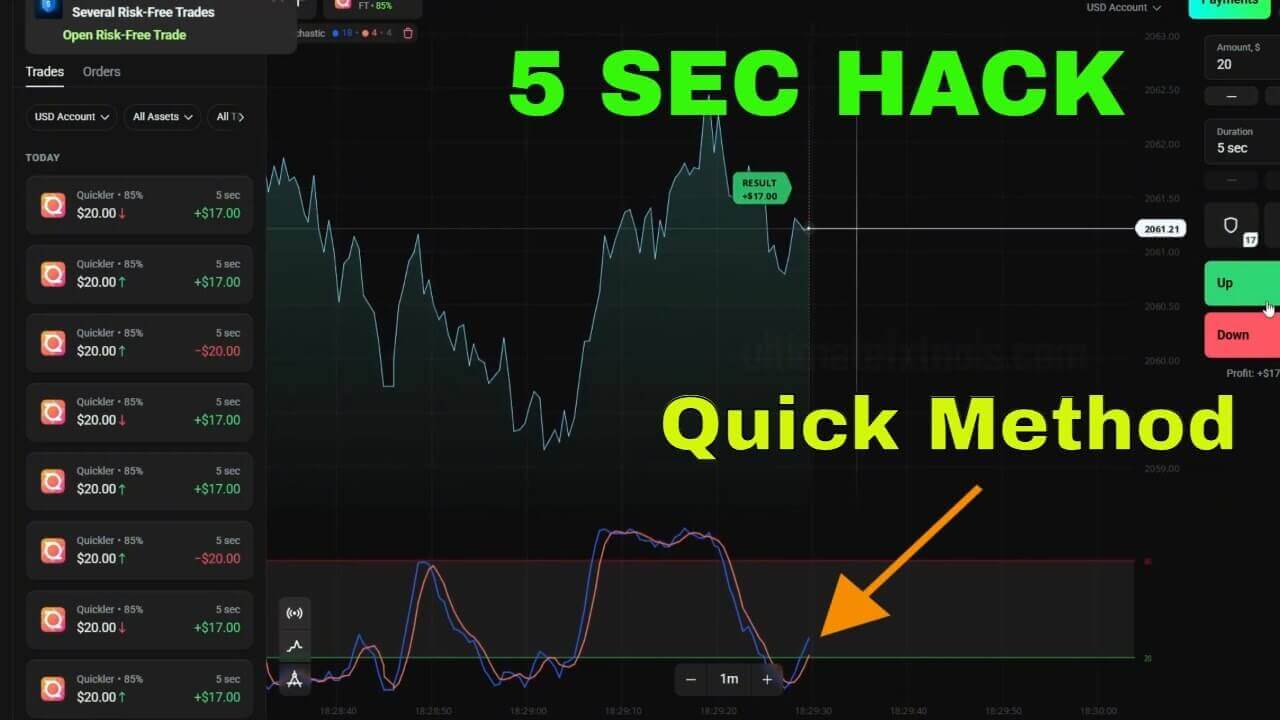
Let's be clear from the first line: there is no hack for Olymp Trade or any other trading platform. In trading communities the word "hack" is casual slang for a repeatable technique, not an actual exploit. What people call the "5 seconds Quickler hack" is simply a way of reading the Stochastic oscillator on a very short expiry. Understanding the tool honestly is far more useful than chasing a shortcut that does not exist.
What the Stochastic Oscillator Actually Does
The Stochastic is a momentum oscillator. It measures where the latest close sits relative to the high-low range over a set number of candles, and plots that as two lines: a faster %K line and a slower %D line, which is a moving average of %K. Both travel on a scale from 0 to 100. Readings above 80 are called overbought and readings below 20 oversold, marked by the horizontal levels on the indicator box.
The key thing to accept is that these signals are early but noisy. A cross of the two lines near an extreme hints that momentum may be turning, but the oscillator can stay pinned at 80 or 20 for a long time while a strong trend keeps running. "Overbought" does not mean "about to fall" — it means price has been rising quickly. Treat the Stochastic as a prompt to look closer, never as a command to trade.
Why 5-Second Quickler Is the Least Forgiving Timeframe
Quickler on Olymp Trade lets you take positions that expire in as little as 5 seconds — the least forgiving timeframe in short-term trading. In five seconds there is almost no room for a read to be right eventually; the candle either goes your way immediately or it does not. Spreads, execution lag, and random tick noise all weigh more heavily when the window is that small. Slower expiries give a setup time to develop; a 5-second expiry does not. Go in expecting a high proportion of losing trades no matter how clean the signal looks, and size every position accordingly.
Setup and Recommended Settings
Add the Stochastic oscillator to your chart and keep the configuration simple so the lines react without flickering on every tick:
- %K period: 5
- %D period: 3
- Slowing / smoothing: 3
- Overbought / oversold levels: 80 and 20
Watch a single liquid asset you know well, and let each candle finish before judging the lines. For a slower, easier-to-read alternative, compare the reads in the Olymp Trade Quickler 5 second strategy and the momentum version in Quickler with Wave Trend.
Entry Logic
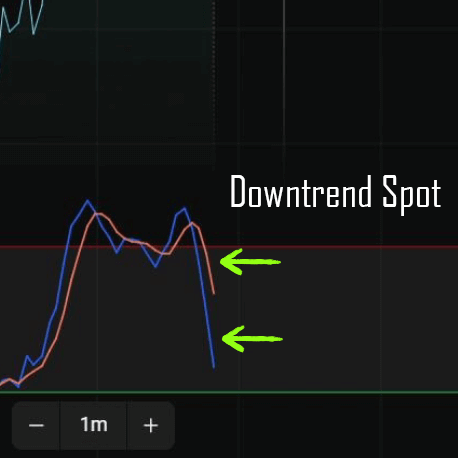
- Possible move down: both Stochastic lines are up near the 80 level and beginning to roll over together, with %K crossing below %D. This flags momentum cooling from a high — a reason to consider a down position, not a guarantee of one.
- Possible move up: both lines are down near the 20 level and starting to turn up together, with %K crossing above %D. This flags momentum lifting off a low.
- Stand aside: the lines are tangled in the middle of the range with no clear direction, or they are pinned at an extreme while price keeps trending. Doing nothing is a valid, often better, decision.
When This Approach Fails
The Stochastic's biggest weakness is trending markets. When price runs hard in one direction, the oscillator plants itself in overbought or oversold and gives repeated counter-trend signals that keep failing. It works best in ranging, sideways conditions and struggles the moment a real trend appears. On a 5-second expiry there is no time to recover from a bad read, so the discipline that matters most is risk management: stake a small, fixed fraction of your balance per trade, cap how many trades you take in a session, and stop for the day at a preset loss limit. Never try to win a loss back by doubling your next stake — that martingale habit turns a run of normal losses into a blown account. Practise the whole routine on a demo account until the reads feel automatic before you risk real money. For a different confirmation layer on the same expiry, see the Bollinger Bands and ZigZag Quickler method.
FAQ
Is there really a hack for Olymp Trade Quickler?
No. "Hack" is community slang for a technique, not a genuine exploit. This is just a structured way to read the Stochastic oscillator on a 5-second expiry. It highlights moments of shifting momentum; it does not change the odds or promise a result.
What settings should I use for the Stochastic?
A responsive starting point is %K 5, %D 3, slowing 3, with the 80 and 20 levels marked. Test it on a demo first and adjust to the asset you trade. Every indicator on the site is bundled in a single $39 lifetime plan if you want the full toolkit.
Why do so many of my 5-second trades still lose?
Five seconds is the least forgiving expiry there is, and the Stochastic gives early, noisy signals that can stay pinned at an extreme during a trend. Losing trades are normal. Consistency comes from strict risk control and skipping unclear setups, not from any single signal.
This content is for educational purposes only. Trading involves risk. Past results do not guarantee future outcomes. Always practice responsible money management and limit your daily trades to avoid large losses.