Pocket Option Working Strategy for Beginners - 5 Seconds Trading
When traders say a strategy "works," it rarely means what it sounds like. A working strategy is not one that avoids losing trades - no approach does that. It is a repeatable, rule-based routine that removes guesswork, keeps your decisions consistent, and lets you review your results objectively. On a fast-moving trading platform like Pocket Option, that structure matters more than any single setting, because short-expiry trades give you almost no time to think once a candle is forming.
This guide walks through a straightforward trend-following setup built around one indicator and a short candle timeframe. Treat it as a framework to practise on a demo account first - not a shortcut, and not a promise.
What the Strategy Uses
The core of this setup is a single volatility band plotted over price. Because Pocket Option mirrors many familiar tools, you can study the same logic in MetaTrader 4 before applying it live:
- Keltner Channel - an envelope built from an EMA and the Average True Range. Its outer lines help you read whether price is trending or stretched away from its average.
- A short candle timeframe - a 15-second chart with the candle timer switched on, so you always know how much of the current candle remains.
- Clean price action - you are mainly watching the direction and momentum of the candles as they interact with the channel.
Keep the Keltner Channel on its default period and multiplier while you learn the pattern; only change the visual style. Adding more indicators tends to create conflicting signals rather than clarity.
Timeframe and Entry Rules
The idea is to trade in the direction the market is already leaning, not against it:
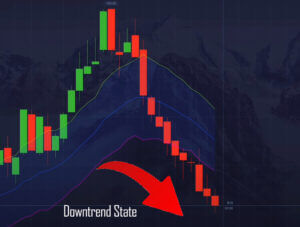
- Identify the trend using the Keltner Channel. Price riding along or pushing the upper line suggests an uptrend; pressure toward the lower line suggests a downtrend.
- In an uptrend, wait for a strong bullish candle pushing toward the upper line after a pullback. Watch it develop for a few seconds before committing.
- If momentum holds in that direction, enter a short-expiry trade with the trend. Mirror the logic for downtrends.
- Skip choppy, sideways conditions where price is stuck inside the middle of the channel - those give the weakest signals.
Remember that the shortest expiries are the least forgiving. A 5-second window leaves no room to recover from a mistimed entry, so treat every trade as a small, deliberate test of the rules rather than a reaction.
Why No Strategy Always Works
Short-expiry trading is dominated by noise. Over a few seconds, price is influenced by random order flow that no indicator can predict, so even a well-followed setup will produce losing trades in normal, expected proportions. Any source claiming a method wins every time - or quoting a fixed win rate - is describing marketing, not markets. The honest goal is a routine you can follow consistently and improve through review, accepting that variance is part of the process.
A quick warning on Martingale: doubling your stake after a loss to "recover" can wipe out an account during a normal losing streak. Avoid it. If you want to explore other structured entries, our Pocket Option EMA strategies and this simple binary options approach cover complementary ideas using the same discipline.
Risk Management
Position sizing is what keeps a losing streak survivable. A few sensible habits:
- Risk a small, fixed fraction of your balance per trade - keeping it under 1% is a common conservative choice.
- Set a daily loss limit and stop when you hit it, win or lose.
- Practise on a demo account until the entry rules feel automatic before risking real money.
- Never trade funds you cannot afford to lose, and never chase a loss with a bigger stake.
Frequently Asked Questions
Does this strategy win every trade?
No. No strategy wins every trade. This is a structured, trend-following routine designed to keep your decisions consistent - it will still produce losing trades, which is normal and unavoidable in short-expiry trading.
Which timeframe should beginners start with?
Start slower than 5 seconds. A 15-second chart gives you more time to read the candle and the Keltner Channel before deciding, which makes the rules easier to learn. Move to shorter expiries only once the pattern is second nature.
Do I need paid tools to try this?
No. The Keltner Channel is a standard indicator you can add for free. If you later want a full library of ready-made indicators and strategy files for MT4 and MT5, our complete toolkit is available for a one-time $39 lifetime payment - but it is optional, not required to practise this setup.
This content is for educational purposes only and is not financial advice. Trading involves substantial risk; you can lose some or all of your capital. No result is guaranteed and past performance does not indicate future results. Trade only what you can afford to lose.