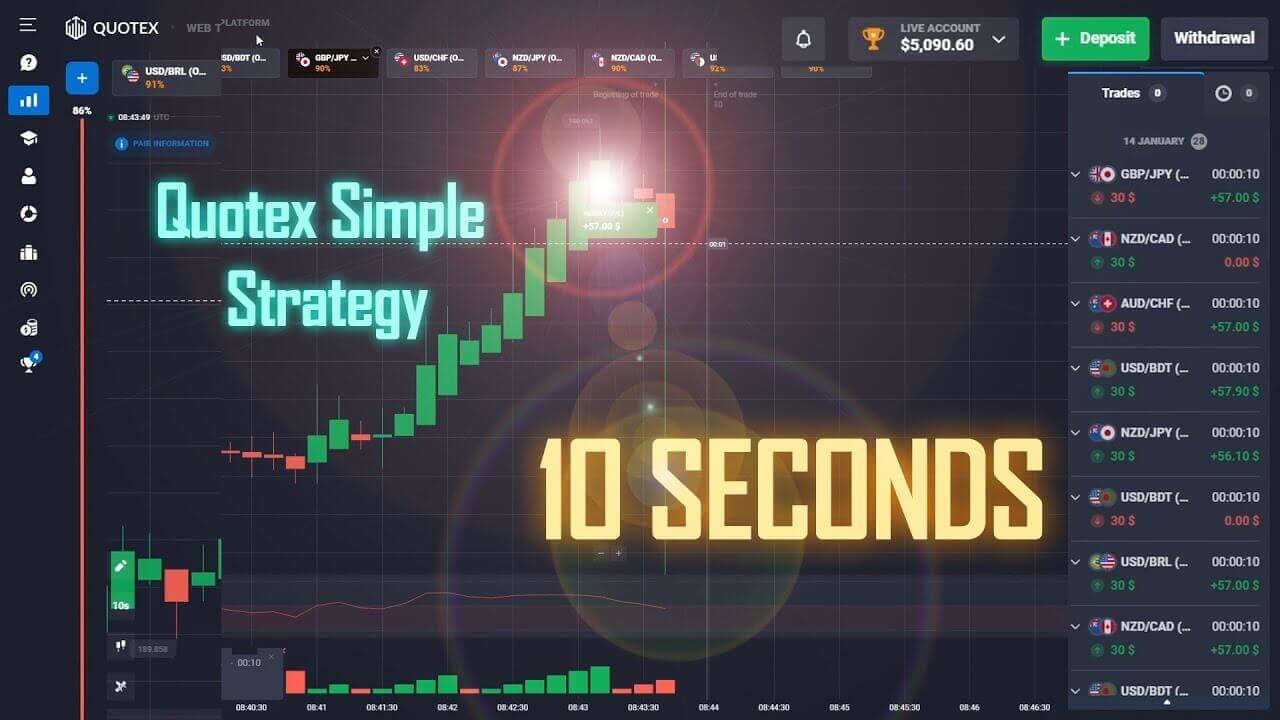
New Trading Strategy - Quotex 10 Seconds OTC
Let's deal with the headline first. Nobody beats the market on a binary options platform, and on OTC assets the idea barely makes sense — there is no market to beat. An OTC pair is not a quote from an open exchange with real buyers and sellers behind it. It is a synthetic price series generated by the trading platform itself, which is why OTC assets keep running on weekends when the real foreign exchange market is closed. What you can do is understand what you are reading, apply consistent rules and manage risk.
What OTC Actually Is, and Why It Behaves Differently
Real currency pairs move on order flow, with news, sessions and liquidity leaving fingerprints on the chart. An OTC series has none of that underneath it. It is produced by the platform, typically as a smoothed or randomised derivative of historical price behaviour, so there is something to trade when the market is shut. OTC charts often look cleaner and more "technical" than the real thing — ranges hold, patterns repeat — but that tidiness comes from how the series is generated, not from your reading being correct. Session opens, economic releases and real support levels mean nothing here. And your counterparty is the same company producing the price feed. None of that makes OTC unusable — it makes it a different instrument, so learn its rhythm on a demo account and never assume a method validated on real EUR/USD carries over unchanged.
The Setup
A short reversal method built on two indicators, on the fastest chart Quotex offers.
- Period / Expiry Time: 10 seconds
- Candle Bar: 10 seconds
- Trading Indicators: CCI Indicator and the Weis Waves Volume Oscillator
The Weis Waves Volume Oscillator groups price into waves and measures the effort behind each one, so a wave running out of participation shows up as shrinking bars. The CCI is the second opinion: whether the move still has push left in it. Neither indicator predicts anything — they describe what just happened, and you decide whether that is worth a trade.
Entry Logic
- Look for the wave to stall: a Weis wave whose bars stop expanding and begin to contract is the first hint the current push is losing effort.
- Wait for confirmation: a candle closing against the stalled wave, such as a green bar after a fading down-wave. Do not act on the wave alone.
- Check the CCI agrees: it should be turning the same way as your intended entry. If it is still driving the other way, the tools disagree and you skip.
- Stand aside by default: if the chart is flat or the indicators conflict, there is no trade. Most 10-second bars are noise, so skipping is the most-used rule here.
Why 10 Seconds Is the Least Forgiving Timeframe There Is
Be honest about what a 10-second expiry demands. At that resolution a single tick decides the outcome. Spread, execution latency and the half-second it takes to move the mouse are all large relative to the move you are trading, and no indicator tuning shrinks them. Your indicators read a tiny sample too: a CCI over a handful of 10-second bars is reacting to almost nothing. Payouts are asymmetric too: a loss costs your full stake while a win returns less, so near-misses damage the account faster than the chart suggests. Then there is you: ten seconds gives no time to reconsider, and the urge to size up after quick losses is what empties accounts.
For the same logic with breathing room, the Quotex 1 minute strategy gives more margin for error, and the Donchian Channel and Schaff Trend Cycle setup is a calmer way to read the same OTC pairs. For a stripped-back start see the Quotex easy strategy, or compare this 15-second OTC strategy.
Risk Rules
Trade a small, fixed fraction of your balance on every entry and never vary it based on how the last trade went. Set a hard daily loss limit and a cap on trades per session, and close the platform when you hit either. Never chase a loss by doubling up. Run the method on demo across many sessions before real money is involved — the only way to learn how a synthetic pair moves. Consistency comes from repeating the same disciplined decision, not from any indicator.
FAQ
Can you actually beat the OTC market on Quotex?
No, and the framing is the problem. OTC prices are generated by the trading platform, not an open exchange, so there is no external market to outsmart. What you control is your rule set, your position size and your discipline. Losing trades are normal.
Is OTC the same as the real forex market?
No. OTC assets are synthetic series the platform runs continuously, including weekends when the real market is closed. Sessions, news events and real liquidity levels do not apply, so a method proven on live pairs may not carry over.
Do I need the paid indicators for this?
The CCI ships with most charting software, and the Weis Waves Volume Oscillator is widely available. The $39 lifetime plan bundles the full indicator library, but the entry logic above stands on its own.
This content is for educational purposes only. Trading involves risk. Past results do not guarantee future outcomes. Always practice responsible money management and limit your daily trades to avoid large losses.


