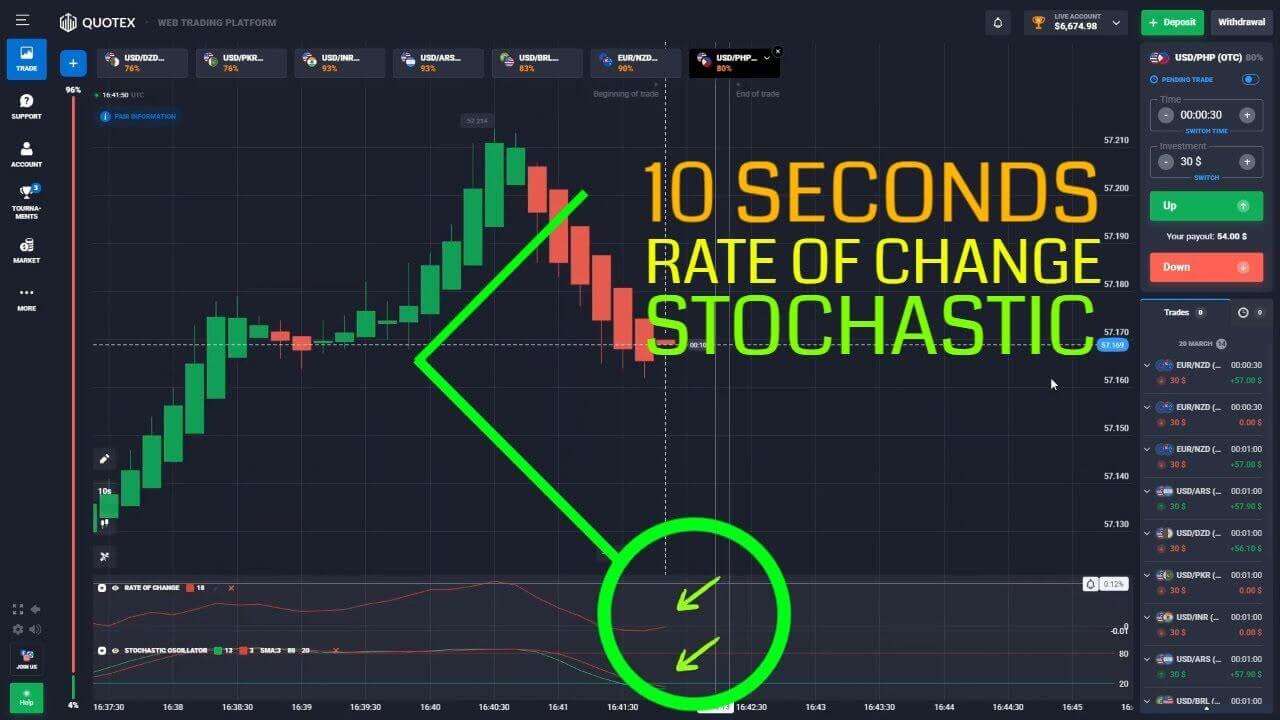
Quotex 10 Seconds Reversal
The Quotex 10 Seconds Reversal is a short-expiry method that pairs the Rate of Change (ROC) with the Stochastic Oscillator to spot moments where price may be exhausted and about to turn. Read this first: a 10-second expiry is the least forgiving timeframe in binary options. Over ten seconds, price movement is dominated by noise, so outcomes sit close to a coin flip and variance is extreme, and no indicator reliably predicts a move that short. This page explains how the setup is meant to work and, just as importantly, where and why it fails.
Why a 10-Second Expiry Is So Demanding
On longer expiries an indicator has time for its read to play out. Ten seconds gives it almost none, so a single spread widening, delayed tick or burst of momentum can decide the trade before your reasoning matters. Reversal signals are especially fragile here: they bet that price will turn, but in a strong trend price simply keeps going and a "reversal" becomes a losing trade against the dominant direction. Treat every 10-second signal as a low-confidence flag, not a prediction, and expect long streaks either way purely from chance.
Understanding the Two Indicators
The Rate of Change measures how fast price is moving over a set lookback. When ROC spikes to a peak and then rolls over, momentum is fading, which is the condition a reversal method looks for. The Stochastic Oscillator compares the close to its recent range and moves between 0 and 100. Readings near the upper 80 band suggest price is stretched to the upside; near the lower 20 band, to the downside. On their own neither line predicts a turn, but when both point the same way at an extreme, the case for a short-lived pause or pullback is a little stronger.
Recommended Settings
Keep both tools on conventional values so the reads are stable rather than jumpy. A common starting point is ROC on a 9-period lookback and a Stochastic set to 14, 3, 3 with the 80 and 20 levels marked. On Quotex, OTC pairs are the instruments trading around the clock, so this setup is usually applied to them. Remember that OTC pairs are synthetic, broker-driven price series rather than the live interbank market, so their behaviour can differ from the real currency pair of the same name. Keep the chart clean, watch one pair at a time, and always let the candle fully close before you act.
Reading a Reversal Setup
The idea is to act only when both indicators agree at an extreme, and to stand aside otherwise:
- Possible put (down): ROC peaks and turns down while both Stochastic lines cross near the upper 80 band, and the current candle closes showing rejection of the highs.
- Possible call (up): ROC bottoms and turns up while both Stochastic lines cross near the lower 20 band, and the candle closes showing rejection of the lows.
- Stand aside: the two indicators sit at mid-levels or disagree, or price is trending hard in one direction. A stretched Stochastic in a strong trend is not a reversal signal; it often just keeps getting more stretched.
When This Strategy Fails
The setup breaks down most in trending conditions, exactly when it looks most tempting. An overbought reading during a strong up-move invites a put that loses as price grinds higher, and ten seconds rarely gives a genuine turn time to develop. Avoid the temptation to raise stake size after a loss: chasing losses with a larger next trade (a martingale approach) does not fix a low-probability setup; it only concentrates your risk and can drain a balance quickly. Instead, stake a small, fixed fraction per trade, cap how many trades you take, and stop at a preset daily loss limit. Practise on a demo account first, and treat consistency of process, not a single result, as the goal.
If ultra-short expiries feel too random, longer readings are easier to manage. Compare this with the calmer Quotex easy strategy, step up to the Quotex 1 minute strategy, or study another two-indicator reversal read in Quotex Donchian Channel and Schaff Trend Cycle. For another very short OTC method, see the 15 seconds OTC strategy on Pocket Option.
FAQ
Can any indicator predict a 10-second reversal?
No. Ten seconds is too short for a reliable read; the outcome is dominated by noise and sits close to a coin flip. The ROC and Stochastic combination flags conditions where a turn is possible, but it does not predict one, and losing trades are a normal part of trading this timeframe.
Are OTC pairs the same as the real currency market?
Not exactly. OTC pairs on Quotex are synthetic, platform-generated price series that run when the underlying market is closed, so their moves can behave differently from the live pair. Read them on their own terms rather than assuming they mirror it.
Do I need to buy anything to try this?
No. ROC and the Stochastic Oscillator are built into most charting platforms, so you can test this on a demo account for free. If you later want the full toolkit used across our other strategies, every indicator is in a single $39 lifetime plan.
This content is for educational purposes only. Trading involves risk. Past results do not guarantee future outcomes. Always practice responsible money management and limit your daily trades to avoid large losses.


