6 Seconds Pocket Option Trading Strategy with Ichimoku Kinko Hyo and Demarker Indicator
Trading a 6-second expiry on the Pocket Option OTC market leaves almost no room for hesitation, so your indicators have to give a signal you can read at a glance. This strategy pairs the Ichimoku Kinko Hyo with the Demarker oscillator for exactly that reason. Thanks to one of our traders for sharing this fast method. On such a short timeframe the two lines that matter most for entries are the Tenkan-sen (conversion line) and the Kijun-sen (base line) — their crossover is what you watch, while the Demarker adds a second layer of confirmation before you commit to a call or a put.
Ichimoku Components That Matter for Fast Entries
Ichimoku Kinko Hyo is built from several plots, but for 6-second OTC trades you only need to focus on three of them:
- Tenkan-sen (conversion line): the faster of the two lines. It reacts quickly to recent price and is your early read on short-term direction.
- Kijun-sen (base line): the slower line that acts as a moving equilibrium. When the Tenkan-sen crosses it, momentum is shifting.
- The cloud (Kumo): the shaded area formed by the two Senkou spans. On a 6-second chart it is a background gauge of overall bias — price above the cloud leans bullish, below it leans bearish — rather than a precise entry trigger.
Recommended Settings
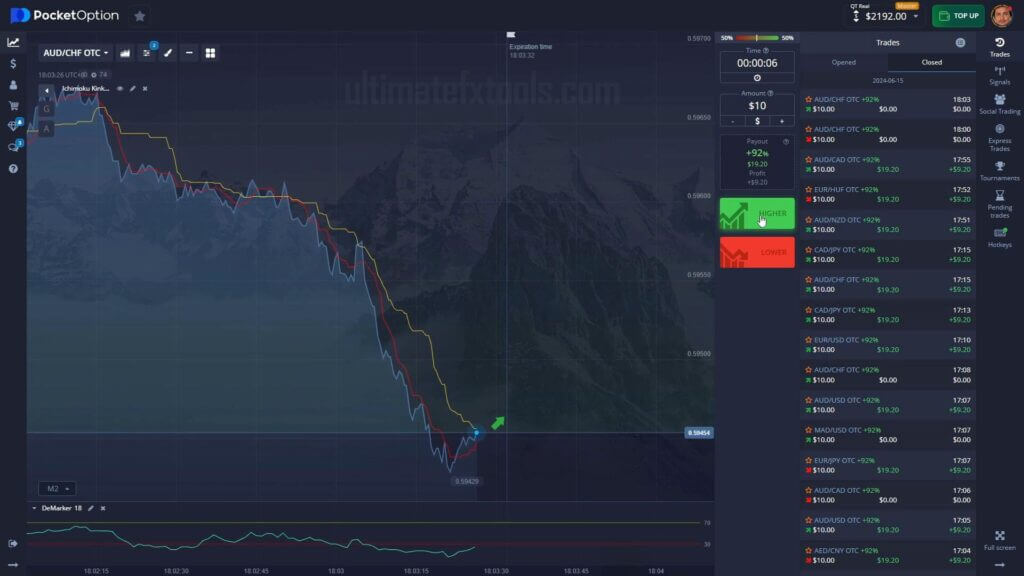
To keep the chart clean, set the Ichimoku to show only the two lines so their crossing point is easy to spot. The standard Ichimoku periods are Tenkan 9, Kijun 26, and Senkou Span B 52, and this setup uses those defaults so any Pocket Option or MetaTrader chart matches without extra tuning. Switch your chart to the line type so you follow clean price action instead of candle noise, and keep the Demarker in its own sub-window with its upper and lower reference bands visible. The screenshots below show the exact fields for both indicators:


Get the full indicator settings along with the rest of the library through a single lifetime plan.
Buy / Call and Sell / Put Rules
Because the trades are so short, wait for both indicators to agree before you click. The core rules are:
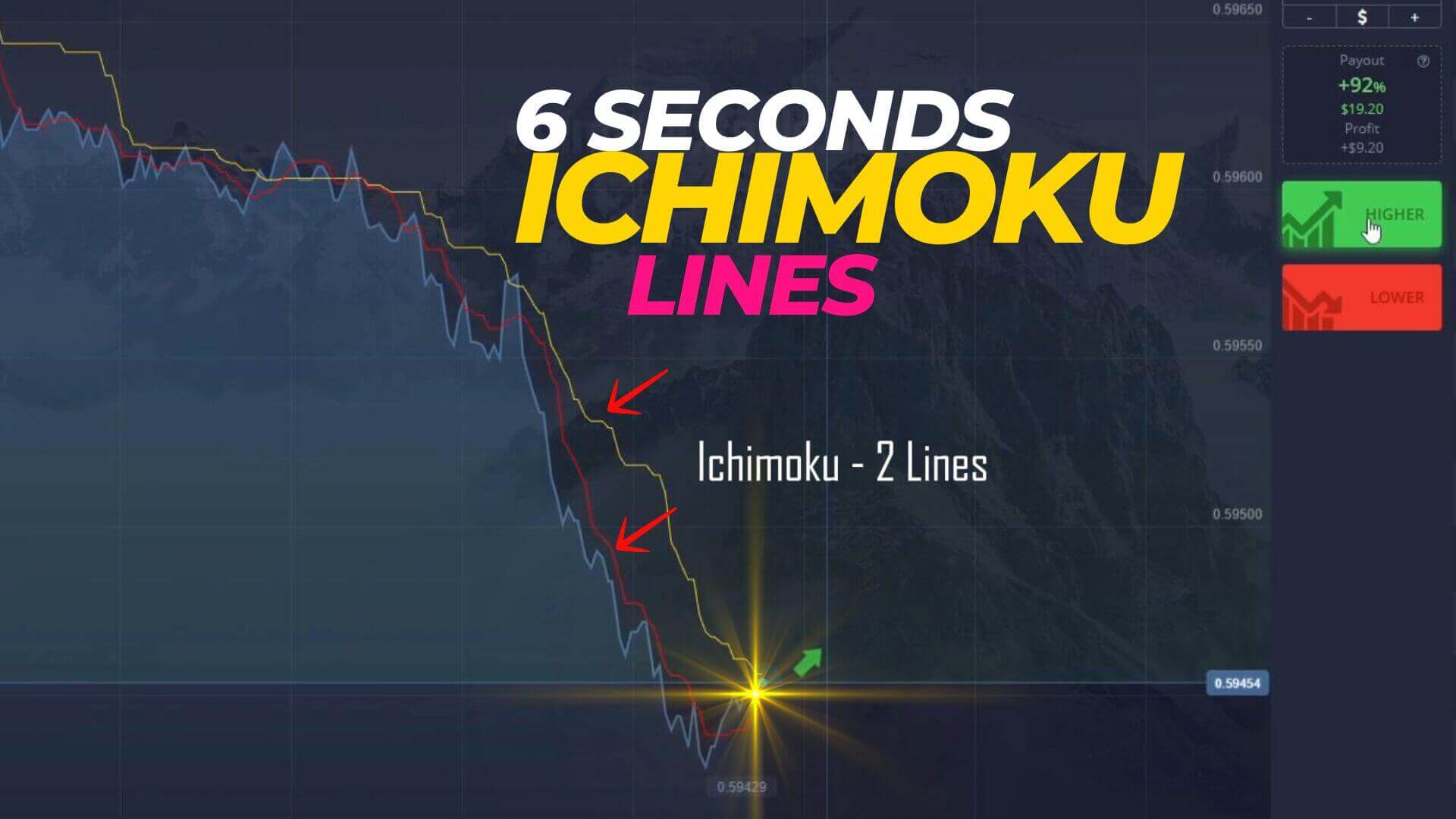
- Call (buy): when the price line touches the yellow (Tenkan) line from below and the Tenkan-sen crosses up through the Kijun-sen, look for the trend to turn upward. Confirm that the Demarker line has dipped below its lower band and is starting to curl back up, then place a call.
- Put (sell): when the Tenkan-sen crosses down through the Kijun-sen and the Demarker pushes above its upper band before turning down, momentum is rolling over. Place a put in the direction of the fresh cross.
- A Demarker reading that pierces its lower band is a common cue that a stretched move is due for a reversal, which is why it pairs well with the Ichimoku cross.
Skip any signal where the two lines are tangled together or the Demarker is sitting in the middle of its range — on a 6-second chart an unclear setup is a signal to stay out.
Timing and Risk for 6-Second Trades
Fast expiries reward patience between trades far more than speed during them. Wait for clear momentum and let the crossover and the Demarker line up before entering; a missed setup costs nothing, while a forced one costs a position. Trade a fixed, small stake so a run of losing trades never dents your balance, and set a daily cap on the number of trades — OTC pairs run even on weekends, which makes overtrading tempting. Test the method on a demo account first, and treat consistency over many trades as the goal rather than any single result.
Related Pocket Option Strategies
If you want to go deeper on this indicator, the Pocket Option 2 Lines Ichimoku guide breaks down the two-line setup on its own. New to weekend markets? Start with What is Pocket Option OTC. And for another quick-expiry approach, see the Powerful Pocket Option 5 Second Strategy.
FAQ
What Ichimoku settings should I use for 6-second trades?
This method uses the standard Ichimoku periods — Tenkan 9, Kijun 26, and Senkou Span B 52 — but hides everything except the Tenkan and Kijun lines so the crossover is easy to read on a fast chart.
Why add the Demarker to Ichimoku?
The Tenkan/Kijun cross tells you direction, while the Demarker flags when price is stretched and due to reverse. Requiring both to agree filters out weak signals that the Ichimoku cross alone might produce.
Can I trade this on the Pocket Option mobile app?
Yes. Both indicators are available on the Pocket Option platform and in MetaTrader, so the setup works on desktop and mobile. Just make sure the line chart type and both indicator windows are visible before you look for entries.
This content is for educational purposes only. Trading involves risk. Past results do not guarantee future outcomes. Always practice responsible money management and limit your daily trades to avoid large losses.