Why Three Moving Averages
A single moving average tells you almost nothing on a fast chart — price crosses back and forth over it constantly. This setup stacks three, each with a different job, all using indicators that are built into IQ Option for free (no custom files needed). A slow EMA 50 marks the broad trend, a medium EMA 30 sits between as a middle reference, and a faster SMA 20 acts as the signal line that actually triggers entries. The trade fires when the fast line crosses both slower lines, and you confirm with the candles before clicking.
The logic is ordinary moving-average crossover logic, but the three-line stack forces some discipline: you are not reacting to every wiggle of one average, you are waiting for the fast line to clear the whole cluster. That is a slower, more selective signal than a two-line cross — which is exactly the point on a 5-second chart.
The Chart Setup on IQ Option
- Platform: IQ Option (Binary, fixed-time trades) — shown on an Educational/demo account
- Candles: Japanese candlesticks, 5-second timeframe
- Trade duration: 2 minutes
- Indicators (all built-in, added via the Indicators → Moving Average panel):
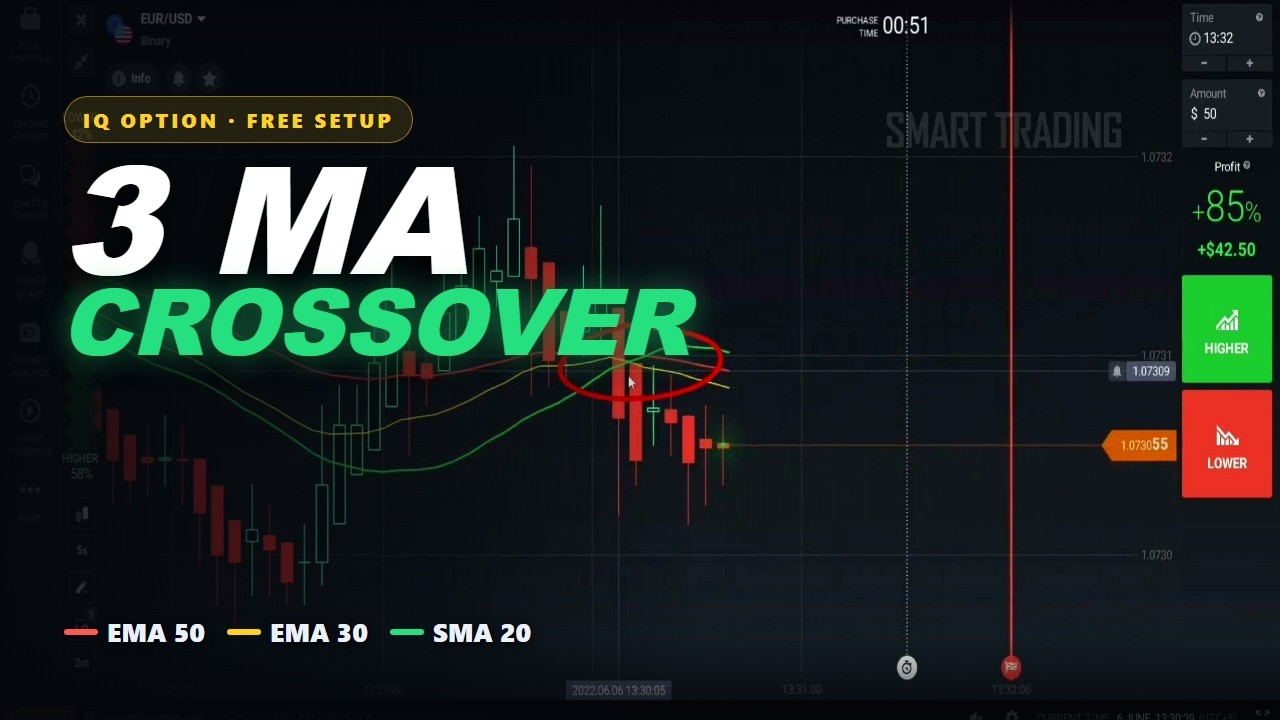
- EMA 50 — type EMA, period 50, colored red (bold/thick)
- EMA 30 — type EMA, period 30, colored yellow
- SMA 20 — type SMA, period 20, colored green (this is the signal line)
- Pairs traded: AUD/USD and EUR/USD at an 85% payout ($42.50 on a $50 stake)
- Stake: fixed $50 per trade
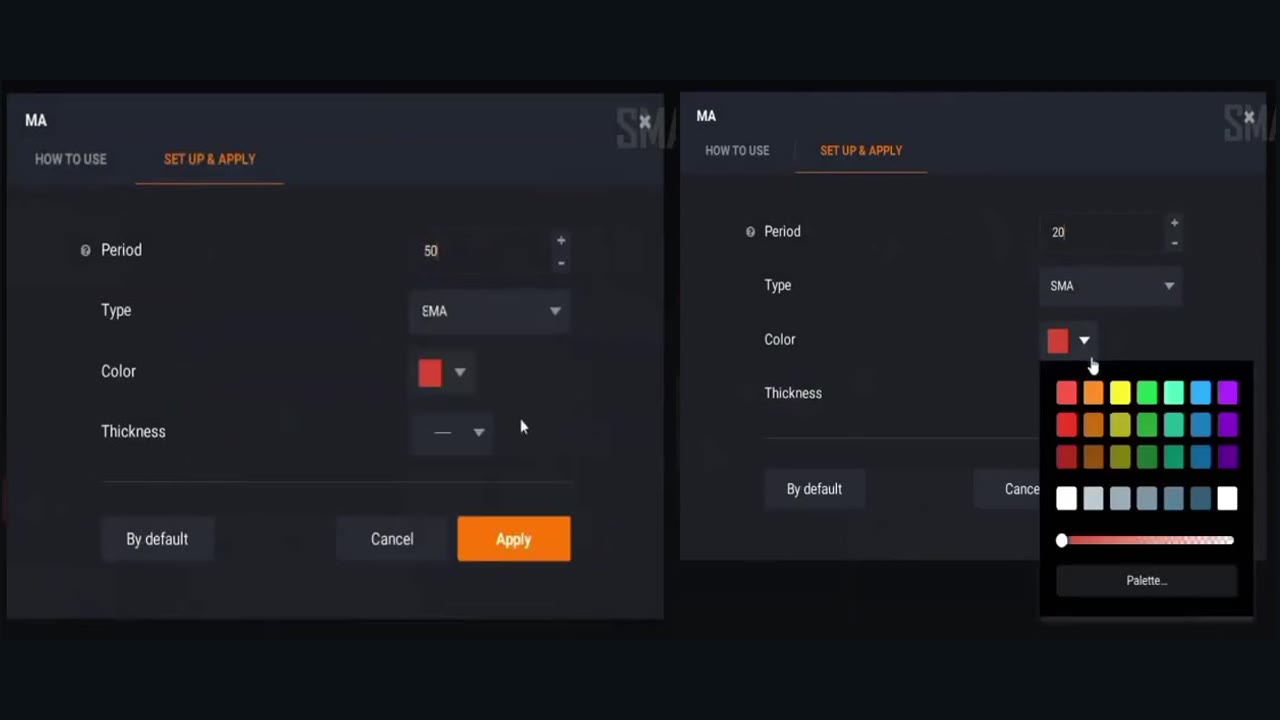
Each line is added the same way: open the Moving Average tool, set the Period, choose the Type (EMA or SMA), pick the Color, and apply. Do this three times. Matching the colors above keeps the read unambiguous — the moment the green line moves through the yellow and red, you know a signal is forming without squinting at the numbers.
The Entry Rule
The rule is deliberately simple, and you take it in one direction at a time:
- Green crosses up through both EMAs → look for a HIGHER (call) trade.
- Green crosses down through both EMAs → look for a LOWER (put) trade.
- Confirm with the candles. The cross alone is not the trigger — you want the candle at the cross to close in the direction of the trade (a bearish candle for a LOWER, a bullish one for a HIGHER). If the candles are indecisive, you skip.
- Set the expiry to 2 minutes, keep the stake fixed, and enter.
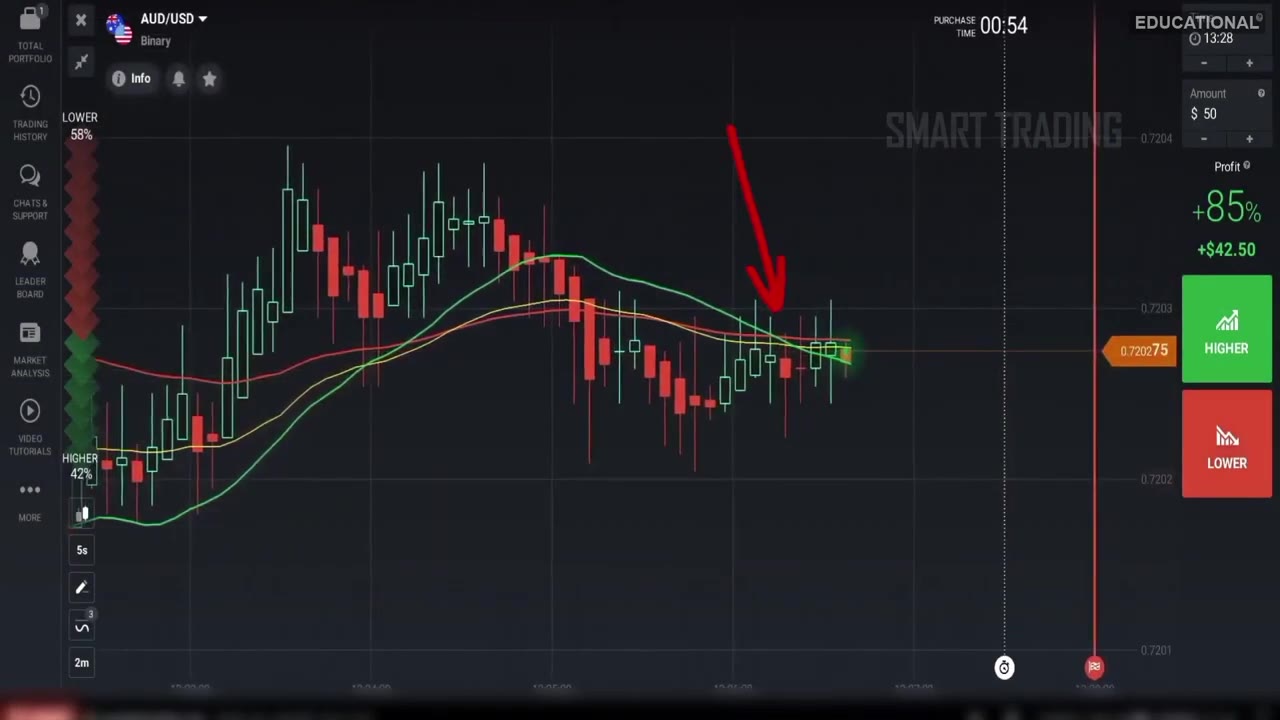
In the frame above, on AUD/USD, the green line rolls over and cuts down through both the yellow and red EMAs while the candles turn over with it — that is the LOWER signal the strategy is built to catch. The two slower EMAs had flattened and started to slope down, so the cross is happening with the broader trend rather than against it, which is the higher-quality version of this signal.
The Live Trades — Including a Break-Even
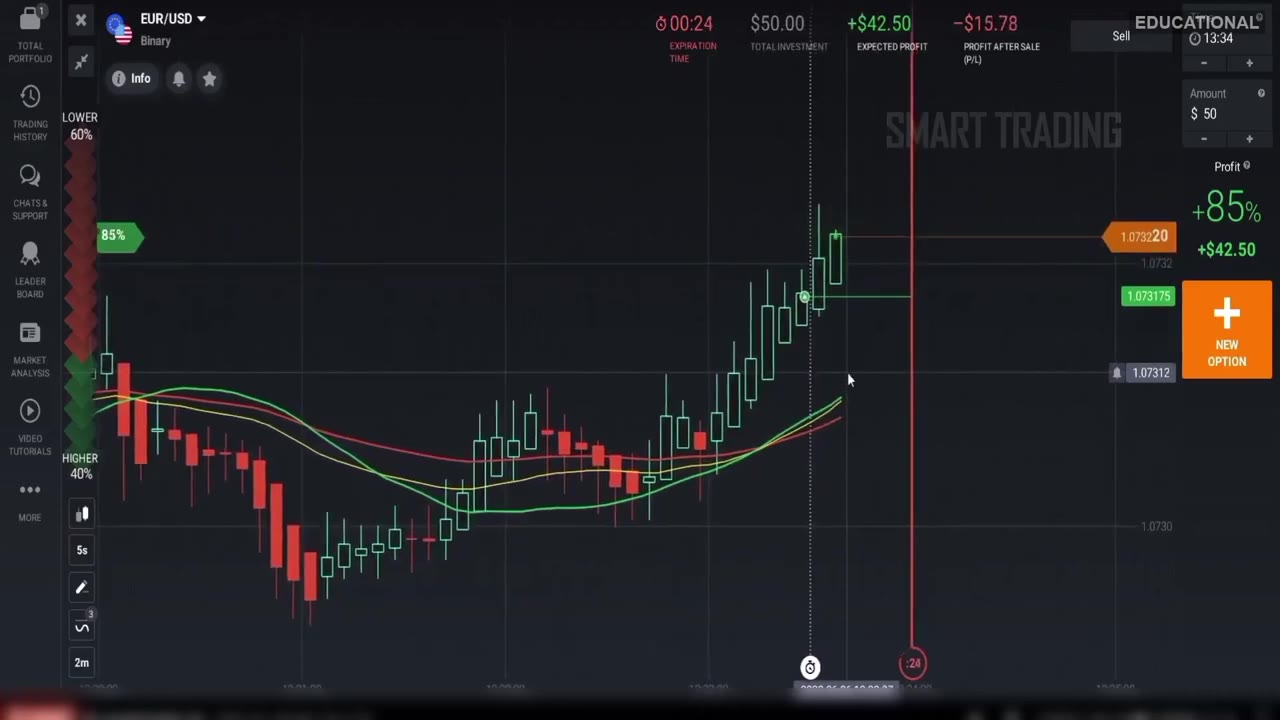
The video runs the setup live with fixed $50 stakes. The clean signals do what they should: a downward cross on AUD/USD with confirming red candles, and a bullish cross on EUR/USD where price pushes up off the moving-average cluster toward a winning close (the panel shows the expected +$42.50 at the 85% payout). But the video is honest about the other reality — not every setup pays. One trade is shown grinding out to roughly break-even, where price crosses the lines but then stalls and chops sideways into expiry instead of running. On a 2-minute expiry, a signal that fires just before the market goes flat is exactly how a crossover trade fizzles.
Watch the Full Setup & Trades
See the three moving averages configured from scratch, every crossover, and each trade to expiry — including the break-even:
Honest Weaknesses
This is a solid teaching setup, but be clear-eyed about where it struggles — which is why it earns a middle rating, not a high one:
- Moving averages lag. By the time the fast line has cleared both slower ones, a chunk of the move is already gone. On a 2-minute expiry that lag can be the difference between a win and the break-even shown in the video.
- Whipsaw in flat markets. When price is ranging, the green line crosses back and forth repeatedly, firing signals that go nowhere. The candle-confirmation step exists specifically to filter these — use it strictly.
- 5-second candles are noisy. A very short timeframe means more false crosses per hour. Fewer, cleaner trades on quieter conditions beat forcing every cross.
- 85% is a fixed-time payout, not an edge. A win pays $42.50 but a loss costs the full $50, so you need a win rate comfortably above break-even just to stay level. The crossover does not guarantee that — your selectivity does.
Risk Management Rules
- Only trade a cross that agrees with the slope of the two EMAs — skip counter-trend crosses.
- Always wait for the candle at the cross to confirm; no confirmation, no trade.
- Keep the stake fixed (the video uses a constant $50). Never increase it to win back a loss.
- Set a hard daily loss cap and stop when you hit it, win or lose.
- Practice the whole routine on a demo account — the video itself is on an Educational account — until the entries are second nature.
The Verdict
A fair 3 out of 5. The strengths are real: it uses only free, built-in indicators, the three-line stack is a more disciplined signal than a two-line cross, and the video is refreshingly honest — it shows a break-even trade instead of pretending every cross prints money. But the weaknesses are just as real: moving averages lag, 5-second candles whipsaw, and a 2-minute expiry gives a lagging signal little room to be right. It is a good structure for learning how crossovers behave and for practicing candle confirmation, rather than a set-and-forget money-maker. Treat it as a framework to build discipline on a demo account, keep the stake fixed, and respect that the selectivity — not the crossover — is what decides the outcome.
#IQOption #MovingAverage #MACrossover #TradingStrategy #EMA #SMA #5SecondCandles #FixedTimeTrades #BinaryOptions
This content is for educational purposes only and is not financial advice. Trading involves substantial risk; you can lose some or all of your capital. No result is guaranteed and past performance does not indicate future results. Trade only what you can afford to lose.