IQ Option Cheat 2023 - What the Alligator Strategy Really Is
Let's clear up the name first. There is no secret button, code, or exploit that beats IQ Option - a trading platform cannot be "cheated" into paying out. In the binary options community, "cheat" is simply slang for a shortcut or a repeatable technique that makes a decision faster. The technique on this page is the Alligator indicator: a way to read whether a market is trending or resting so you can time a 1 to 5 minute position with a clear rule instead of a guess. Treat it as decision support, not a way around risk.
What the Alligator Indicator Measures
The Alligator, created by Bill Williams, is built from three smoothed moving averages that are each shifted forward on the chart so they lead price:
- Jaw (blue): a 13-period smoothed average, shifted 8 bars ahead - the slowest, longest-term line.
- Teeth (red): an 8-period smoothed average, shifted 5 bars ahead - the middle line.
- Lips (green): a 5-period smoothed average, shifted 3 bars ahead - the fastest line, closest to price.
When the three lines are twisted together and flat, the "alligator is sleeping" - the market is consolidating and there is no trend worth trading. When the lines fan out and separate in order, the "alligator is feeding" - a trend is underway. So the distance and direction between the lines is the whole message: widening lines mean momentum, converging lines mean the move is fading.
Setting It Up on IQ Option
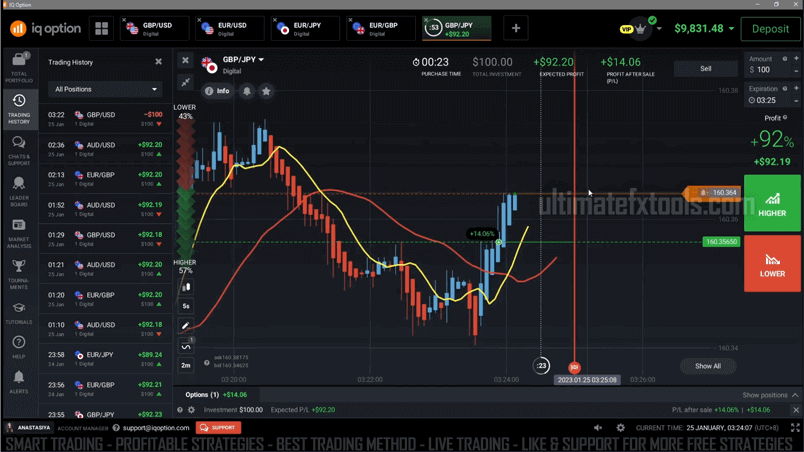
IQ Option includes the Alligator in its indicator list, so nothing needs to be downloaded. Start with the standard Bill Williams values - Jaw 13 (shift 8), Teeth 8 (shift 5), Lips 5 (shift 3). For a faster 1 to 5 minute style, some traders lower each line's period by roughly one point so the lines react sooner, but do this only after you have watched how the defaults behave, because shorter periods produce more false twists. Pair a 5-second candle with a 2-minute chart window for a close-up read, or use a 1-minute candle when conditions are choppy. Keep the chart clean so the three lines and the price candles stay easy to separate at a glance.
Reading an Entry
The rule is deliberately simple so it can be applied calmly inside a short expiry:
- Higher (call): the green Lips crosses above the red Teeth and blue Jaw, all three lines fan upward in order, and price is trading above them. That combination points to momentum building to the upside.
- Lower (put): the green Lips crosses below the Teeth and Jaw, the lines fan downward in order, and price sits beneath them.
- Stand aside: the three lines are tangled and flat. A sleeping alligator is a signal to wait, not to trade - most losing entries come from forcing a position while the lines are still knotted together.
When the Alligator Fails
No indicator removes losing trades, and the Alligator has a known weakness: it lags. Because the lines are smoothed and shifted forward, they confirm a move only after it has begun, so entries can arrive late and reversals can whipsaw you in a sideways market. It performs worst during low-volatility ranges and around news spikes, when the lines cross back and forth without follow-through. Manage that reality with position sizing rather than hope: stake a small, fixed fraction of your balance per trade, cap how many trades you take in a session, and set a daily loss limit you actually stop at. Practise the read on a demo account until the crossovers are obvious before risking real funds - consistency comes from disciplined rules, not from any single entry.
Want to go deeper on this indicator? Compare the approach in our Alligator trading strategy for binary options and the fractal and Alligator combination, then see how a fast entry fits the IQ Option 1-minute strategy.
FAQ
Is the IQ Option "cheat" a real hack?
No. Nothing here exploits or breaks the platform. "Cheat" is community slang for a quick, repeatable technique - in this case reading the Alligator indicator. It cannot force a payout and it does not remove risk. Losing trades are a normal part of binary options.
What are the best Alligator settings for IQ Option?
The standard Bill Williams defaults are Jaw 13 (shift 8), Teeth 8 (shift 5) and Lips 5 (shift 3). For a 1 to 5 minute style you can shorten each period slightly for a faster reaction, paired with a 5-second candle on a 2-minute window. Test any change on a demo account first.
Do I need to pay for this indicator?
The Alligator is built into IQ Option at no cost. If you want the wider library of MT4/MT5 indicators and strategies used across this site, they are included in a single $39 lifetime plan.
This content is for educational purposes only. Trading involves risk. Past results do not guarantee future outcomes. Always practice responsible money management and limit your daily trades to avoid large losses.