The Alligator Indicator for Binary and Fixed-Time Options
☆☆☆☆☆ Rated 4 out of 5
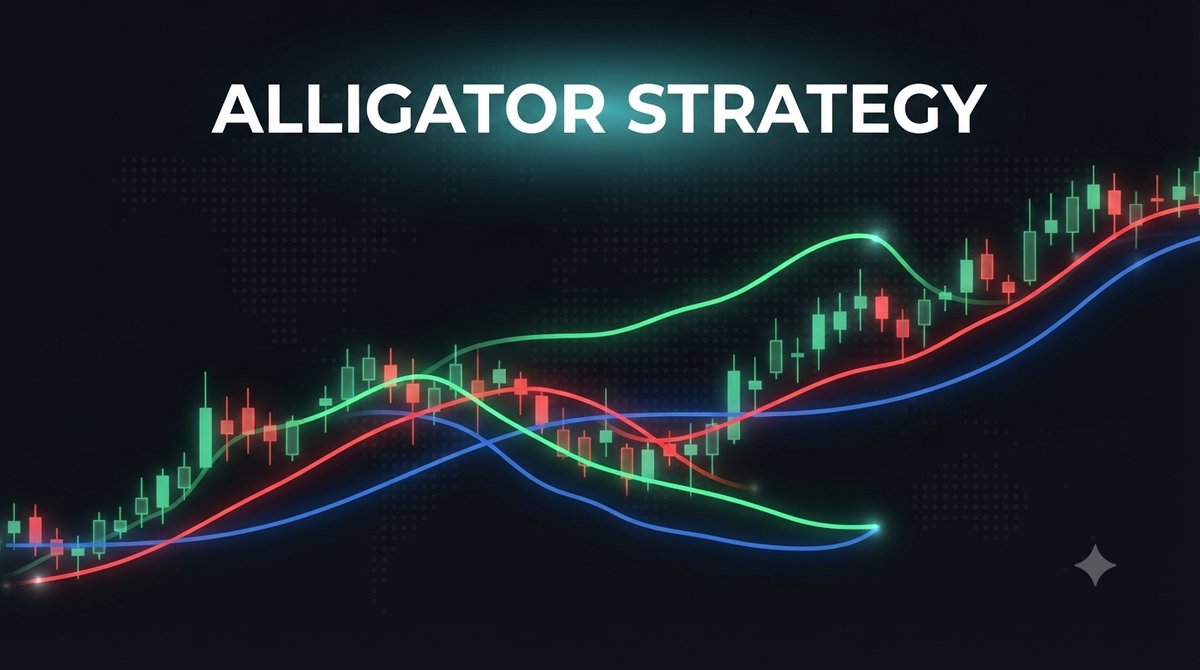
The Alligator is a trend indicator created by Bill Williams. Instead of a single line, it plots three smoothed moving averages (SMMAs) that Williams named after the parts of an alligator's mouth: the jaw, the teeth, and the lips. Each line is calculated on the median price and shifted forward in time, so the three curves lean on one another as price develops. Read together, they answer one simple question that matters for short-expiry trading: is the market trending, or is it resting in a flat range?
That distinction is the whole point of the tool. When the three lines are tangled together the "Alligator is sleeping," which usually signals a sideways, choppy market where direction is unclear. When the lines separate and travel in the same direction, the "Alligator is eating," which points to a clean trend you can lean into. For binary and fixed-time options, where you only need to judge whether price will be higher or lower at expiry, that trend-versus-range read is often more useful than trying to forecast an exact target.
The Three Lines and Their Default Settings
Each line is a smoothed moving average of the median price ((high + low) / 2), shifted into the future by a set number of bars. The standard Bill Williams defaults are:
- Jaw (blue line) — 13-period SMMA, shifted 8 bars forward. The slowest line and the base of the trend.
- Teeth (red line) — 8-period SMMA, shifted 5 bars forward. The middle line and the balance point.
- Lips (green line) — 5-period SMMA, shifted 3 bars forward. The fastest line and the first to react to a new move.
These 13/8, 8/5 and 5/3 values are the classic starting point on MT4 and MT5. Some traders shorten the periods on very fast expiries to make the lips react sooner, but it is best to learn the tool on the defaults first before changing anything.
Reading the Alligator: Sleeping, Eating, and Sated
Williams described three states, and each one tells you what to do:
- Sleeping — the jaw, teeth and lips are intertwined and moving flat. The market is ranging and has no clear direction. This is a wait-and-watch state, not an entry.
- Waking / eating — the lines fan out and separate, stacked in order and pointing the same way. The trend is underway and the Alligator is "feeding" on price.
- Sated — after an extended run the lines begin to converge and flatten again. Momentum is fading and the move may be ending, so late entries carry more risk.
The wider the gap between the three lines, the stronger the trend. When they pinch back together, treat it as a signal that the current move is losing steam.
Buy/Call and Sell/Put Rules
The cleanest signals come when the lines fan out in the correct order:
- Call / Buy (uptrend) — price is above all three lines, and the lines are stacked with the green lips on top, red teeth in the middle, and blue jaw at the bottom, all sloping up. Consider a call entry as the lines open apart.
- Put / Sell (downtrend) — price is below all three lines, and the order flips: green lips at the bottom, red teeth in the middle, blue jaw on top, all sloping down. Consider a put entry as the lines open apart.
When the three lines are braided together, take no trade. Many traders confirm an Alligator signal with a momentum tool such as Stochastic before committing, which helps filter out false starts when the market is only pretending to break out.
Best Timeframe, Expiry, and Risk
The Alligator adapts to any timeframe, but the expiry should match the chart. On a 1-minute chart, keep expiries short (around 1 to 3 minutes); on a 5-minute chart, a 5 to 15 minute expiry gives a fanned-out signal room to play out. Trade in the direction the lines are pointing and avoid counter-trend entries while the Alligator is clearly eating.
Because no indicator is right every time, keep each position to a small, fixed share of your balance and cap the number of trades you take per session. Practising the read on a demo account first is the safest way to get comfortable with how the three lines behave in live conditions.
If you want ready-made Alligator and trend tools for MT4 and MT5, see the related guides below or explore the full toolkit on our pricing page.
Related Reading
- Fractal Indicator with Alligator for Binary Options
- 30-Second Mobile Trading with the Alligator Indicator
- Easy Trend Method for Pocket Option
FAQ
What does the Alligator indicator actually measure?
It measures whether a market is trending or ranging using three smoothed moving averages. When the lines separate and align, a trend is present; when they weave together and flatten, the market is range-bound and direction is unclear.
What are the default Alligator settings?
The Bill Williams defaults are a 13-period jaw shifted 8 bars, an 8-period teeth shifted 5 bars, and a 5-period lips shifted 3 bars, all based on median price. These 13/8, 8/5 and 5/3 values are the standard preset on MT4 and MT5.
Can I use the Alligator on its own for binary options?
You can, but many traders pair it with a momentum indicator such as Stochastic to confirm entries and filter false breakouts. Combining the trend read with a confirmation tool tends to give clearer, more selective signals than either one alone.
This content is for educational purposes only. Trading involves risk. Past results do not guarantee future outcomes. Always practice responsible money management and limit your daily trades to avoid large losses.