The Fractal + Alligator Strategy Explained
The Fractal Alligator method pairs two indicators created by Bill Williams: the Alligator, which describes the state of the trend, and the Fractal, which marks turning points in price. The Alligator tells you whether the market is trending or resting, and the Fractal tells you where a recent swing formed. This page explains what each measures, why they are used together, how to set them up, and where the pairing falls short — an educational walkthrough, not a signal service, so you still confirm context and manage risk on every position.
What the Alligator Measures
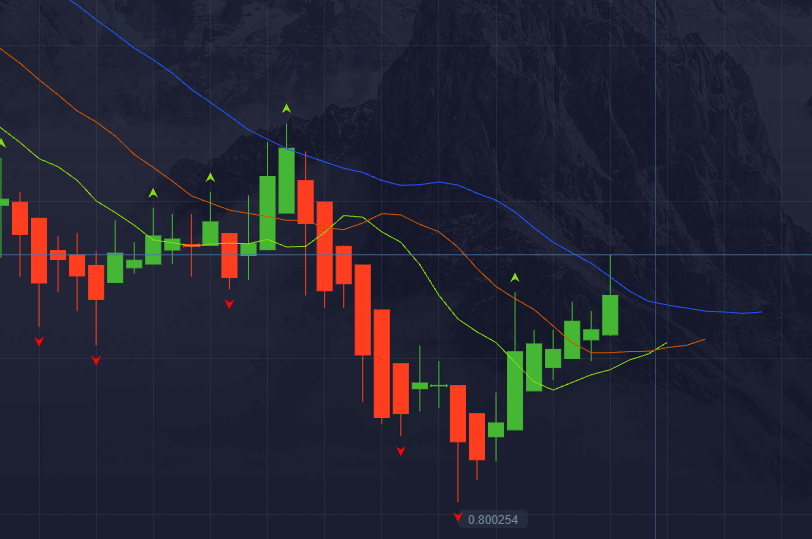
The Alligator is made of three smoothed moving averages shifted forward so they project slightly ahead of the current candle: the jaw (slowest, blue line), the teeth (middle, red line), and the lips (fastest, green line). When the three lines are tangled together, the "alligator is sleeping" — the market is consolidating with no clear trend. When they fan out and separate in order, the "alligator is feeding" and a trend is underway. Reading the lines is about structure, not a trigger: an uptrend shows the lips above the teeth above the jaw, and a downtrend shows the reverse.
What a Fractal Marks — and Its Lag Limitation
A Fractal identifies a short-term swing point using a five-bar pattern. An up (buy-side) fractal appears when a candle's high is higher than the two highs on each side of it; a down (sell-side) fractal forms when a candle's low is lower than the two lows on either side. The important limitation is timing: because the pattern needs two bars to close after the middle candle before it can be validated, a Fractal only confirms two bars after the swing has already happened. It is a lagging, backward-confirming marker, not a live signal — treat each arrow as evidence that a swing formed, not an instruction to enter.
Why the Two Pair Well
The indicators cover different weaknesses. Fractals appear constantly, including in flat markets where most lead nowhere. The Alligator acts as a filter: when the lines are separated and trending, fractals that print in the direction of that trend carry more context than those appearing while the alligator is sleeping. Using the trend to qualify the swing is the whole point of the combination.
Recommended Settings
Both tools are built into MetaTrader and most charting platforms, so no custom files are needed:
- Alligator: keep Bill Williams' defaults — Jaw: 13-period smoothed moving average shifted 8 bars forward; Teeth: 8-period shifted 5 bars forward; Lips: 5-period shifted 3 bars forward. Apply to the Median Price (HL/2).
- Fractal: the standard five-bar setting, which needs two candles on each side of the central bar to confirm.
- Trade a few liquid instruments you know well, and let each candle fully close before acting on a fractal.
The Setup and Entry Logic
- Uptrend context: the Alligator lines are fanned out with the green lips on top, above the red teeth, above the blue jaw. Look for a down-side (buy) fractal on a pullback toward the lines as a possible continuation higher.
- Downtrend context: the lines are stacked in reverse, lips below teeth below jaw. Look for an up-side (sell) fractal on a bounce back toward the lines.
- Stand aside: the lines are intertwined and flat. Fractals still print, but with no trend behind them the disciplined choice is usually to wait.
When the Strategy Fails
Because the Fractal confirms late, the swing it marks may already be several candles old by the time the arrow is valid, so chasing it can mean entering after the easy move is gone. The Alligator also lags at turning points, producing false starts in range-bound markets. No indicator removes losing trades. Risk management is what keeps you in the game: stake a small fixed fraction of your balance per position, cap trades per session, and stop for the day at a preset loss limit. Never try to recover a loss by increasing the next stake — averaging down or doubling up after a loss can erase an account quickly. Practice on a demo account until the reads feel automatic before risking real funds.
FAQ
Is the Fractal Alligator strategy accurate enough to trade on its own?
No setup is accurate on its own. The Fractal's two-bar delay and the Alligator's lag mean both can be late. Use them together as context, confirm with price action, and focus on consistency in your risk management rather than any single entry.
What settings should I use for the Alligator and Fractal?
Bill Williams' defaults are the standard starting point: Alligator jaw 13/8, teeth 8/5, lips 5/3 on the median price, and the classic five-bar Fractal. Study them on a demo first, and adjust the timeframe rather than the periods if signals feel too frequent.
Where can I get these indicators?
The Alligator and Fractal are built into MetaTrader and most platforms at no cost. For a full library of ready-to-use indicators and strategy guides, they are bundled in the single $39 lifetime plan. To go deeper, see our Alligator trading strategy, this look at Fractal Chaos with ADX, and a mobile take on 30-second Alligator trading.
This content is for educational purposes only. Trading involves risk. Past results do not guarantee future outcomes. Always practice responsible money management and limit your daily trades to avoid large losses.