Best 1 Minute Binary Options Trading Strategy
A 1-minute binary options setup tries to read very short-term price movement and act on it within a single one-minute candle, often using a lower time frame such as 15-second candles to time the entry. It is fast, it is demanding, and it appeals to traders who want frequent signals. This page walks through how the setup is built, where it works, and just as importantly where it falls apart. If you came here searching for the "most profitable" 1-minute method, the honest starting point is that no such fixed method exists.
What This 1-Minute Strategy Actually Is
The idea is simple to describe: watch a fast-moving instrument, wait for a specific alignment of momentum and trend, and place a short-duration trade in that direction. On a 1-minute expiry there is very little time for a move to develop, so the entry timing has to be tight. Traders typically pair a trend filter with a momentum reading and only act when both agree. It is a scalping mindset applied to binary options, and it is best learned first on a demo account with no money at stake.
Why "Most Profitable" Is Misleading
Let's be direct: labelling any strategy the "most profitable" is marketing, not a fact. Binary options pay a fixed amount when a trade finishes in the money and cost the full stake when it does not, so the maths is unforgiving on short expiries. Market conditions shift constantly, spreads and payout percentages vary between trading platforms, and a setup that behaved well last week can string together losing trades this week. Profitability is not a property of the strategy alone; it depends on the instrument, the session, your discipline, and plain variance. Losing trades are a normal, expected part of trading this way, and anyone promising otherwise is selling a story.
Indicators, Time Frame and Entry Rules
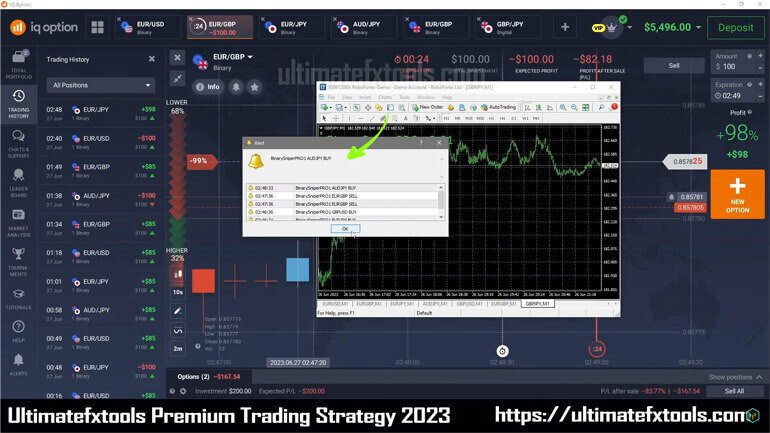
A common build for this style uses a fast moving average as a trend filter, a momentum oscillator such as RSI or the Binary Sniper Pro signal set, and a lower time frame like 15-second candles to fine-tune the moment of entry. A basic rule set might look like this:
- Confirm short-term direction with the trend filter before considering any trade.
- Wait for the momentum reading to move out of an extreme and turn back toward the trend.
- Enter only when both the trend and momentum agree; skip the signal when they conflict.
- Favour clean, liquid market hours and avoid trading straight into major news releases.
Treat these as a template to test, not a formula that prints money. Settings that suit one pair or session often need adjusting for another.
Realistic Expectations
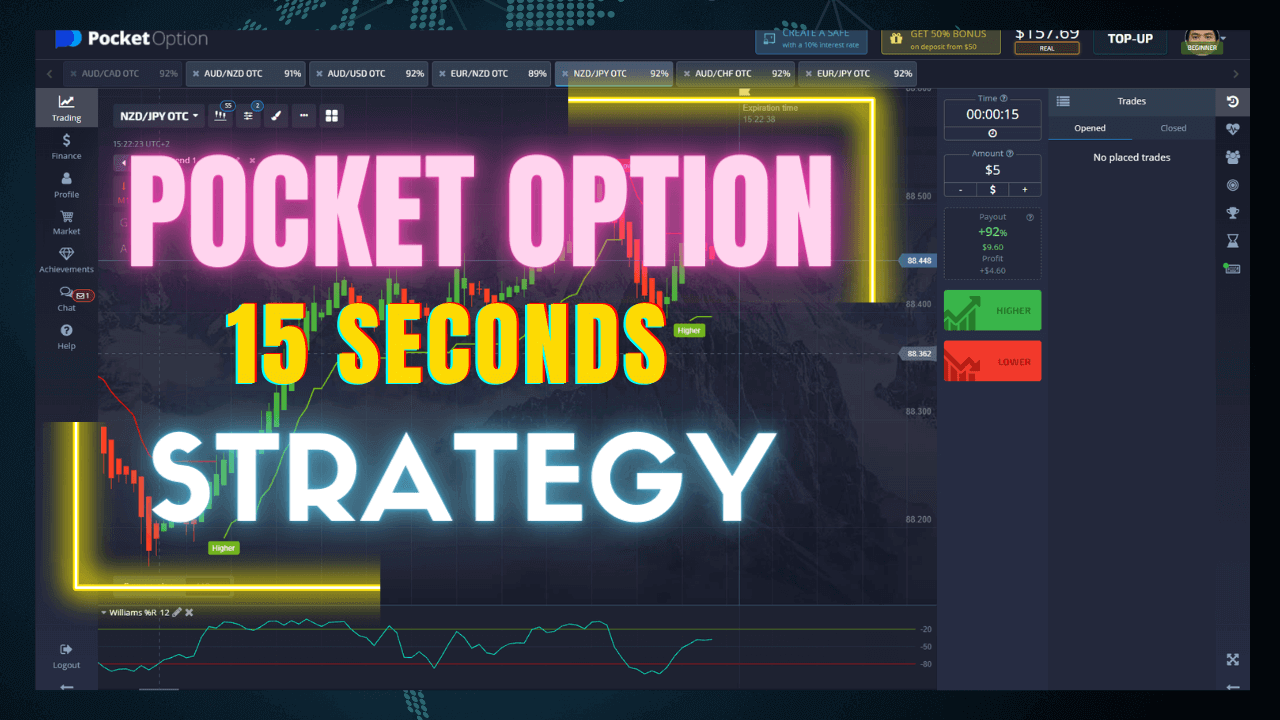
On a 1-minute time frame, noise is high and a single unexpected tick can flip the outcome. Expect stretches of winning and losing trades regardless of how good the setup looks in hindsight. The goal is not to win every trade but to follow a repeatable process, keep records, and see whether your edge holds up over a large sample. Compare this fast approach with a slightly slower one like the 15 seconds OTC strategy to understand how time frame changes the trade-offs.
Risk Management
Because each trade risks the full stake, position sizing is everything. Keep each trade to a small, fixed fraction of your account so that a losing run cannot wipe you out. Do not use martingale or any doubling-after-a-loss scheme: it feels clever until a normal losing streak turns a small drawdown into a blown account, and short expiries produce those streaks regularly. Set a daily loss limit, walk away when you hit it, and never trade money you cannot afford to lose. If you want the underlying indicators to test this setup yourself, they are included with lifetime access for a one-time $39.
Frequently Asked Questions
Is this the most profitable 1-minute strategy, and does it always win? No. There is no strategy that is reliably "most profitable" or that always wins. Every approach produces losing trades, and results depend on the market, the trading platform, and your own discipline. Treat frequent, tight entries as higher risk, not a guaranteed edge.
Which indicators does it use? A trend filter (such as a fast moving average), a momentum oscillator like RSI, and optionally the Binary Sniper Pro signal set on a 15-second time frame. The exact settings should be tested and adjusted per instrument.
Should I trade this with real money right away? No. Practise on a demo account until the process is second nature and you understand how it behaves in different sessions. Only then consider small live positions with strict risk limits.
This content is for educational purposes only and is not financial advice. Trading involves substantial risk; you can lose some or all of your capital. No result is guaranteed and past performance does not indicate future results. Trade only what you can afford to lose.