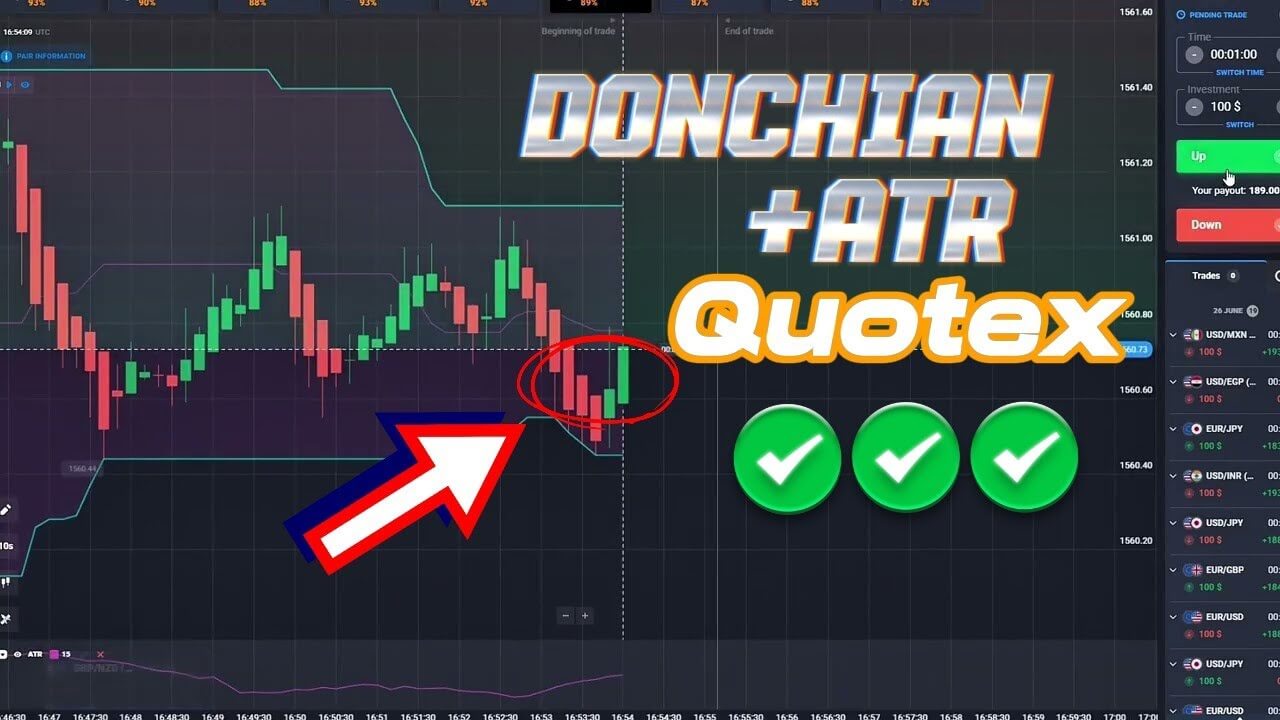
Let's settle the headline before anything else. A title that promises a 90% win rate is marketing language, not a measurement. No trading strategy has a fixed, knowable win rate — outcomes shift with the pair, the session, volatility and plain luck, and any page that hands you a tidy percentage is guessing. What the Donchian Channel and ATR pairing can genuinely do is give you a repeatable, rules-based way to read a Quotex chart. Treat every signal below as decision support, then manage the risk yourself on each trade.
What the Donchian Channel Actually Marks
The Donchian Channel plots three lines from the last N candles: the upper band is the highest high over that lookback, the lower band is the lowest low, and the middle line is the average of the two. That is all it does — it is a breakout and range tool, not a crystal ball. When price pushes through the upper band it is making a fresh high for the period; when it drops through the lower band it is making a fresh low. The middle line acts as a rough centre of the recent range, which is why a cross of that line is used here as a momentum cue rather than a guarantee of anything.
What ATR Measures (and What It Doesn't)
Average True Range measures volatility — the average size of recent candles — and nothing about direction. A rising ATR tells you the market is moving in bigger swings; a falling ATR tells you it is going quiet. ATR cannot tell you whether the next candle closes up or down, so leaning on it as a directional arrow is a common misunderstanding. Its real job in this setup is context: it helps you judge whether a Donchian break has enough energy behind it to be worth taking, and it frames how far price is likely to travel — useful when you size your risk or set a mental stop, not when you pick direction.
Chart Setup and Settings
- Donchian Channel period: 30
- ATR period: 15
- Chart timeframe: 10-second candles
- Trade duration: 1 minute per position
- Assets: a few liquid pairs you know well, rather than the whole watchlist
Load both indicators on a clean MetaTrader chart and read them against the matching Quotex asset. Let each candle fully close before you act on it — reading a half-formed 10-second candle is one of the fastest ways to talk yourself into a bad entry.
Entry Logic
- Up (call): price crosses above the Donchian middle line while ATR is rising, showing the move has expanding volatility behind it.
- Down (put): price crosses below the Donchian middle line while ATR is rising in step with the move.
- Stand aside: ATR is flat or fading, or price is chopping around the middle line with no clean break. These conditions produce the most losing trades, so skipping them matters more than catching every cross.
When This Setup Fails
The Donchian middle line whipsaws in a tight, directionless range, firing one crossover after another that reverses within a candle or two. A sudden news spike can throw price through a band and snap it straight back, so a "clean" signal still loses. And because ATR only reports volatility, a large ATR reading during erratic, two-sided trading can look like momentum when it is really just noise. This is why risk management, not the indicator, decides whether you last: stake a small fixed fraction per trade, cap the number of trades you take in a session, and stop for the day once you hit a preset loss limit. Never try to recover a loss by doubling your next stake — that habit turns one bad read into a blown balance.
Want to go deeper on these two tools? Compare the same pairing on a different setup in 1-Minute Quotex with ATR and Donchian, see how Donchian teams up with a cycle oscillator in Quotex Donchian Channel and Schaff Trend Cycle and its Donchian + Schaff Trend Cycle variation, or study ATR paired with a different filter in IQ Option ATR and Aroon.
Watch: Donchian + ATR on Quotex
FAQ
Does this really win 90%?
No — no strategy has a knowable win rate, and any page giving you a number is guessing. The "90%" in the title is a marketing label, not a tested result. Some sessions will string together wins and others will not; what you can control is your risk per trade and your discipline, which is where consistency actually comes from.
Can I use the Donchian + ATR combination on platforms other than Quotex?
Yes. The indicators live on your MetaTrader chart, so the same reading works when you trade IQ Option, Pocket Option, Olymp Trade or other trading platforms — you just match the asset and the expiry.
Do I need to buy anything to try it?
No. The Donchian Channel and ATR both ship with MetaTrader, so you can practise this on a demo account for free. If you later want the full library of custom indicators and strategies, that is covered by the single $39 lifetime plan.
This content is for educational purposes only. Trading involves risk. Past results do not guarantee future outcomes. Always practice responsible money management and limit your daily trades to avoid large losses.


