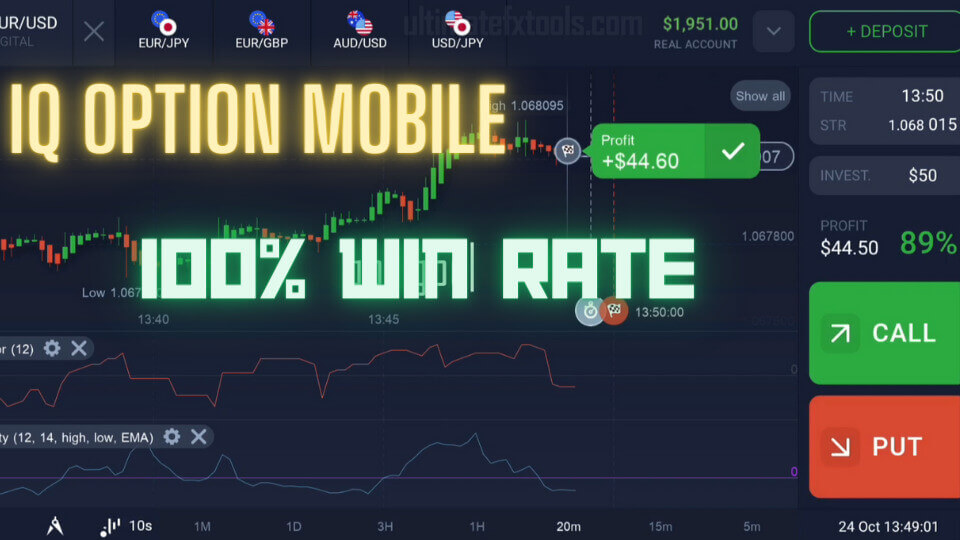
IQ Option Mobile App Strategy: Aroon Oscillator with Chaikin Volatility
The IQ Option mobile app puts a full charting workspace on your phone, and this strategy uses two of its built-in indicators — the Aroon Oscillator and Chaikin Volatility — to time short-expiry trades. One thing to understand up front: custom MT4 or MT5 indicators do not run inside the IQ Option app. The app only plots the tools already in its own indicator menu, so everything below uses tools you add directly on your phone. A reading here is decision support, not a promise: confirm context and manage risk on every trade.
What the Aroon Oscillator Measures
The Aroon Oscillator tracks how recently price made its highest high and lowest low over a set lookback window. It is the difference between two lines, Aroon Up and Aroon Down. When it is strongly positive, a fresh high happened recently and the market leans bullish; when it is strongly negative, a fresh low is the more recent event and momentum leans bearish. Readings near zero say neither a new high nor a new low has printed lately, which usually means the trend has stalled. In plain terms, Aroon measures trend freshness — how new the current directional push is — rather than raw price distance.
What Chaikin Volatility Measures
Chaikin Volatility looks at the trading range — the gap between each candle's high and low — and measures how fast that range is changing over time. A rising line means the range is expanding and the market is getting more active; a falling line means it is contracting and price is quietening down. It does not tell you direction. Instead it tells you whether conditions are heating up or cooling off — useful context for a short-expiry entry, since reversals often line up with volatility that has pulled back toward its middle rather than one still spiking.
Setting It Up on the Mobile App
Open a chart in the IQ Option app, tap the indicators button, and add both Aroon Oscillator and Chaikin Volatility from the built-in list. Sensible starting points are an Aroon period of 14 and a Chaikin Volatility setting of 10 (a 10-period range average read against a 10-period rate of change); adjust them to suit the pair and timeframe rather than treating any number as fixed. The original method reads a 10-second candle chart for a one-minute expiry, which keeps decisions fast; that speed also amplifies noise, so slower candles are worth testing as you learn the signals.
Reading an Entry
The two indicators work together: Aroon frames the direction and Chaikin frames the timing.
- Lower / down setup: the Aroon Oscillator is stretched near its upper extreme while the Chaikin Volatility line eases back toward its middle — a market that pushed hard and may be losing steam, hinting at a turn lower.
- Higher / up setup: the mirror image — Aroon stretched toward its lower extreme with Chaikin settling back toward the middle — points to a possible turn higher.
- Stand aside: Aroon sits near zero, or Chaikin is spiking sharply. A flat Aroon means no clear trend to fade, and a volatility spike means the range is still expanding — a poor moment to bet on a reversal.
When This Strategy Fails
Reversal reads struggle in a strong, one-directional trend: Aroon can stay pinned at an extreme while price keeps running, so fading it early leads to losses. Very fast candles add whipsaw, and news-driven markets can expand volatility in a way that overruns any signal. No indicator removes losing trades, so pairing Aroon with Chaikin is about filtering out the ambiguous setups, not chasing every wiggle. Protect yourself with basic risk control: stake a small, fixed fraction of your balance per trade, cap trades per session, and stop at a preset daily loss limit. Practice on an IQ Option demo account until the reads feel automatic before risking real money.
For related approaches, see how Aroon pairs with a volatility gauge in IQ Option ATR and Aroon, how it combines with a momentum filter in this RSI and Aroon 15-second candle method, and a broader phone-first workflow in this IQ Option mobile trading strategy.
FAQ
Can I use custom MT4 or MT5 indicators in the IQ Option app?
No. The IQ Option mobile app only runs the indicators built into its own menu, so custom MetaTrader tools will not load there. This strategy is designed around the native Aroon Oscillator and Chaikin Volatility for exactly that reason. If you prefer custom MetaTrader indicators, our full library on the $39 lifetime plan is built for MT4 and MT5 charts instead.
What do the Aroon Oscillator and Chaikin Volatility each tell me?
Aroon measures trend freshness — how recently a new high or low was made — so it hints at direction and whether a trend is stalling. Chaikin Volatility measures how fast the trading range is expanding or contracting, giving timing context. One frames direction, the other conditions.
Is this strategy suitable for beginners?
The rules are simple, but short expiries move quickly and demand discipline. Beginners should learn both indicators on a demo account first and focus on risk management before trading real funds. Consistency comes from skipping weak setups, not from trading more often.
This content is for educational purposes only. Trading involves risk. Past results do not guarantee future outcomes. Always practice responsible money management and limit your daily trades to avoid large losses.