Mastering the Pocket Option 5-Second Strategy
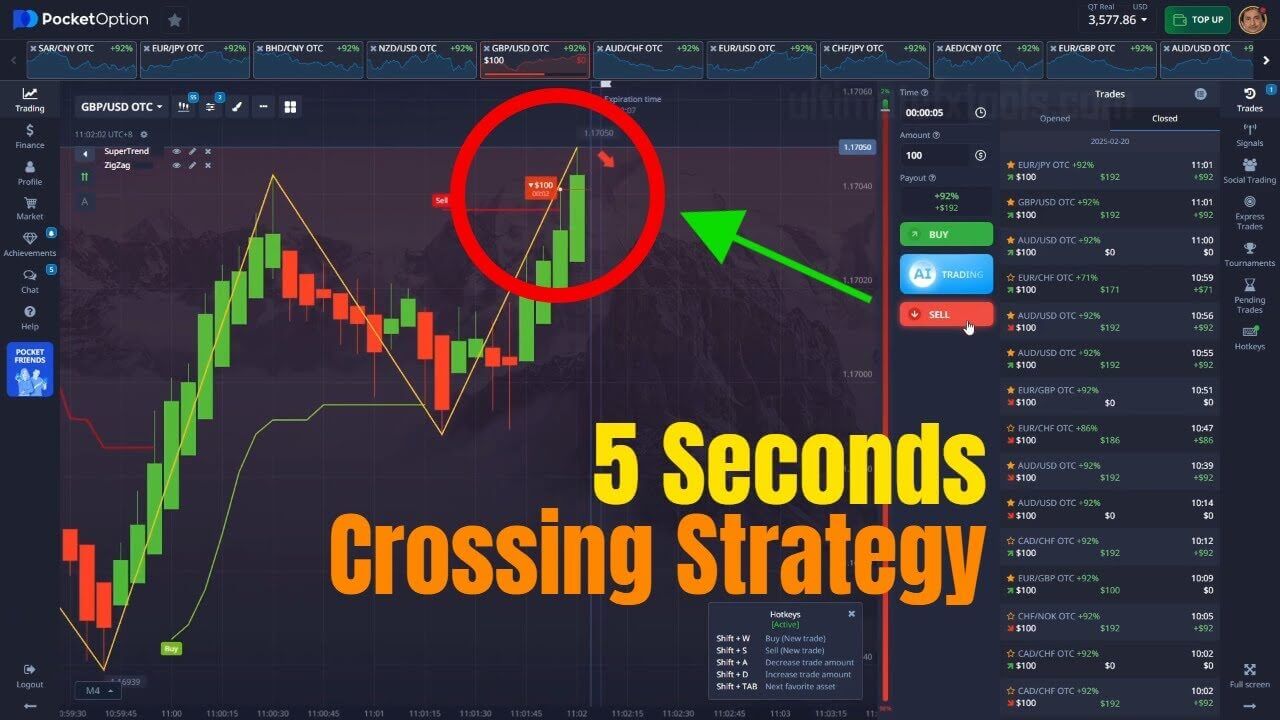
The Pocket Option 5-second strategy is a rapid, chart-reading method built around a single idea: catch a short momentum reversal the moment two indicators line up, then take a 5-second expiry in that direction. The tools behind it are the Supertrend indicator and the Zigzag indicator, read together on a fast Heiken Ashi chart. It is often called the "Crossing Method" because the trigger is the Zigzag turning against, or crossing, the Supertrend line.
Before anything else, be honest about the timeframe. A 5-second expiry is the least forgiving window in binary options. There is almost no time for a setup to develop or recover, so the outcome sits very close to a coin flip and is heavily affected by the spread and by execution latency. A fraction of a second between your click and the platform accepting the trade can flip a winner into a loser. Treat this strategy as a high-tempo skill to practise carefully, not a shortcut.
The Crossing Method Explained
The method waits for the Zigzag and Supertrend to agree on a short-term turn:
- Watch the Supertrend line: it colours the underlying trend — support below price in an up phase, resistance above price in a down phase.
- Wait for the Zigzag pivot: a fresh Zigzag leg forming into the Supertrend line marks a possible reversal point.
- Read Heiken Ashi for confirmation: a long candle changing colour at that pivot — a strong red or green tick — is your visual cue that momentum is actually turning rather than drifting.
When all three agree, you have a setup. When they disagree — the Zigzag turning up while the Supertrend still reads down — you stand aside. Skipping the unclear signals is the single most important habit for trading this method with any consistency.
Chart and Indicator Setup
Keep the chart clean so you can read it under time pressure:
- Chart type: Heiken Ashi candles on the fastest timeframe your platform allows (5-second or 15-second candles).
- Supertrend: a standard configuration (ATR period 10, multiplier 3) so the trend colour does not flip on every wick.
- Zigzag: default depth so only meaningful pivots print; a too-sensitive Zigzag repaints and gives false turns.
- Pairs: stick to one or two OTC or low-volume pairs you know well rather than jumping across the whole watchlist.
Entry Rules
- Call (up): the Supertrend flips to support, the Zigzag prints a low into it, and a green Heiken Ashi candle closes with a clear body. Take the 5-second call as the candle turns.
- Put (down): the Supertrend flips to resistance, the Zigzag prints a high into it, and a red Heiken Ashi candle closes with a clear body.
- Stand aside: the two indicators disagree, or price is flat with small doji-like candles. No trade is a valid decision.
For a slightly less frantic version of this reversal idea, compare it with the 15-second Pocket Option strategy, which gives a setup marginally more room to breathe.
When the Strategy Fails
The 5-second method breaks down in a few predictable ways. In fast, news-driven moves the spread widens and a "confirmed" candle can reverse before your expiry closes. In dead, ranging markets the Zigzag whipsaws and the Supertrend flips back and forth, firing signals that go nowhere. And because everything happens in seconds, latency on a slow connection quietly works against you. Recognising these conditions and not trading them protects you more than any settings tweak.
Managing Risk on Pocket Option
- Do Not Double Down: Never raise your stake after a loss to chase it back - each trade is independent, so doubling never improves the next outcome, and a normal losing run makes the stake exceed your balance and empties the account; use fixed-fractional staking with a hard per-session loss cap instead.
- Fixed, small stake: risk a small, constant fraction of your balance per trade so no single 5-second result can hurt you badly.
- Cap your session: set a maximum number of trades and a daily loss limit, then stop once you hit either — over-trading a fast method is how accounts drain.
- Practise on demo: run the rules on a demo account until the reads feel automatic before risking real funds.
For a repeatable Pocket Option routine, see the Pocket Option working strategy and this single-indicator Pocket Option guide.

FAQ
Is a 5-second expiry a good place to start?
No. The 5-second window is the hardest timeframe in binary options because outcomes are close to random and heavily affected by spread and latency. New traders are better off learning the Crossing Method on longer expiries first, then speeding up once the reads are second nature.
Which platforms and indicators does this need?
The signals come from the Supertrend and Zigzag indicators read on a Heiken Ashi chart, which works across Pocket Option and other trading platforms. Both indicators, and every other tool on the site, are included in the single $39 lifetime plan.
Can this strategy remove losing trades?
No. No indicator or method removes losing trades. The Crossing Method only aims to filter for clearer setups; consistent risk management and skipping unclear signals are what keep you in the game over time.
This content is for educational purposes only. Trading involves risk. Past results do not guarantee future outcomes. Always practice responsible money management and limit your daily trades to avoid large losses.