Quotex Supertrend Line Hack (10 Seconds Strategy)
The word "hack" here is a nickname for a shortcut technique, not a way to beat Quotex or the market. Nothing bypasses anything, and no setup wins every trade. This page describes how to read the Supertrend line on a very fast chart so a 10-second decision follows a rule instead of a gut feeling — a fixed reference for which side you may trade, and when to sit out.
What the Supertrend Line Actually Is
The Supertrend indicator is an ATR-based trailing band. It measures volatility with the Average True Range and offsets a band from price by a multiple of that value. The band only ratchets in the trend's direction — it never loosens. When price closes through it, the indicator flips: the line jumps to the other side of price and changes colour. Green under price means the last flip was bullish; red above price means bearish. That is the entire output — no oscillator, no divergence, no strength reading, just "which side am I on."
Why It Is a Lagging Filter, Not a Predictor
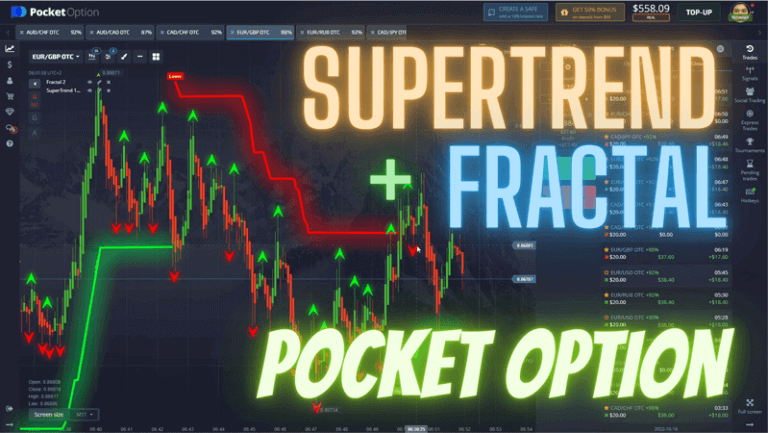
This is the part most 10-second traders get wrong. Supertrend cannot tell you what price will do next: every value comes from candles that have already closed, so it flips after the move that caused the flip. In a clean burst that lag is acceptable. In a flat market it shreds the setup — price wanders across the band and each flip arrives just in time to be wrong. Treat the line as a permission slip, not a signal: it answers "may I consider a call here?", not "will this candle close higher?" If you have used the Super Trend strategy on Pocket Option, the same logic carries across platforms.
Settings for a 10-Second Read
Default Supertrend settings (ATR period 10, multiplier 3) are built for slower charts and say little inside a ten-second window — the line barely moves while your trade opens and closes. For a faster read, shorten the ATR period to around 7 to 10 and cut the multiplier to roughly 1.5 to 2, tightening the band so flips register while the burst is alive. The trade-off: a tighter band flips more often, and more flips means more false ones. That is why the line is paired with a second read — a CCI or volatility filter — so a flip with no momentum behind it gets ignored instead of traded.


Entry Logic and Confirmation
The rules are short, because ten seconds leaves no room to deliberate:
- Call (up): the line has flipped green and sits below price, the filter agrees with the upside, and the candle is expanding rather than stalling.
- Put (down): the line has flipped red and sits above price, the filter agrees with the downside, and price is failing to reclaim the band.
- Stand aside: the line and the filter disagree, the line has flipped more than once in the last few candles, or the market is flat. Skipping these is the technique — traders who take every flip are not running this method.
Volatility is the precondition: this is a momentum-burst read, so it belongs in active sessions, not on a dead chart. For how the same tool behaves over longer windows, see the Quotex 10-second trading strategy and the 2x Supertrend approach on Quotex.
Why 10 Seconds Is the Least Forgiving Timeframe
A ten-second expiry is the harshest window a trader can pick. You are reading a lagging indicator on data that is mostly noise, and half a second of hesitation or platform latency can decide the outcome. There is no room to be right slowly, and a run of losses arrives far faster than on a one-minute chart because you take so many more trades per hour. The risk rules here are not garnish — they are the method. Stake a small fixed fraction of your balance (1–3%) per trade, cap the trades per session, and walk away at a preset daily loss limit. Practise on a demo account until the flips are obvious before real funds are involved. Consistency comes from the rules you refuse to break, not the indicator.
30 Seconds Supertrend CCI Quotex
FAQ
Is the Supertrend line hack a way to beat Quotex?
No. "Hack" is just a nickname. Supertrend is a public, well-documented ATR band anyone can plot — a fast, rule-based read on trend direction, nothing more. Losing trades are a normal part of short-expiry trading.
Can I use the Supertrend line on its own?
It works better as a confirmation tool than a standalone signal. A tightened Supertrend flips often, and many flips have no follow-through. A momentum or volatility filter is what turns a flip into a decision you can defend.
Do I need a paid indicator for this?
No. Supertrend and CCI are standard tools on most charts, so you can build this from what you already have. The alert-based versions and the rest of the MetaTrader library used across this site come with the single $39 lifetime plan. For a related read, compare the ADX and CCI combination on Quotex.
This content is for educational purposes only. Trading involves risk. Past results do not guarantee future outcomes. Always practice responsible money management and limit your daily trades to avoid large losses.