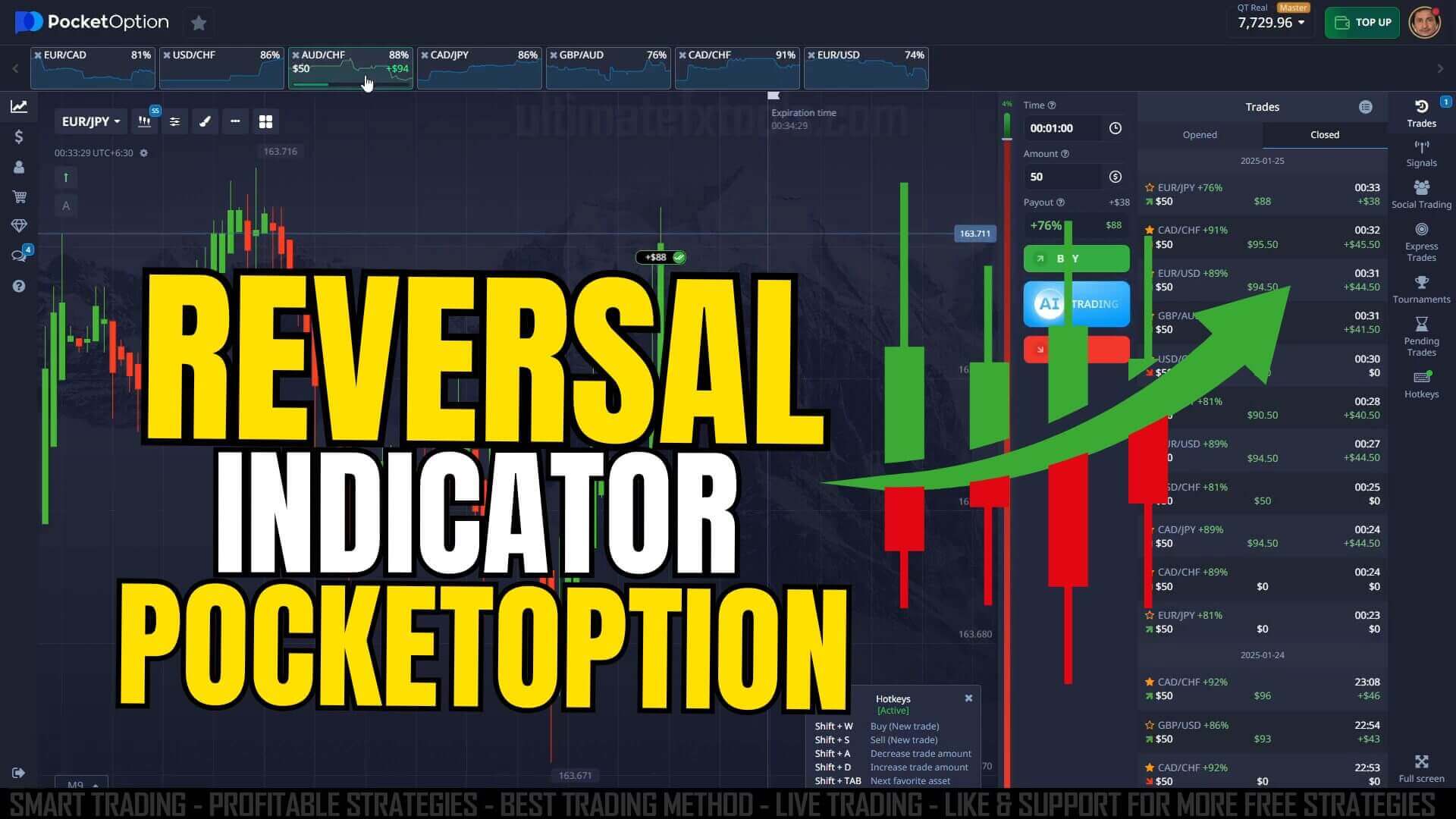
10 Best Pocket Option Hack Strategy
Despite the word "hack" in the title, there is no shortcut that beats the market. What actually helps is a small set of clear, rule-based setups that you understand and apply with discipline. This list collects ten popular Pocket Option strategy setups published on UltimateFXTools, each built around standard chart indicators and each with its own full guide and chart examples. If you feel overwhelmed by the number of strategies out there, use this as a starting shortlist: what each setup uses, what market condition it suits, and where to read the complete rules.
1. SuperTrend Trend-Riding
The SuperTrend strategy uses a single trend-following indicator that flips color when price crosses its line, giving simple visual buy and sell zones. It works best in clearly trending markets and struggles in sideways chop.
2. Two Weighted Moving Averages + DeMarker
A fast-paced 15-second setup that pairs two crossing Weighted Moving Averages with the DeMarker oscillator. The WMA cross defines direction while DeMarker helps filter early or exhausted moves, making it a popular choice for short-expiry trades on volatile pairs.
3. Keltner Channel Bounce
The Keltner Channel setup draws a volatility envelope around price and looks for reactions at the upper and lower bands on 15-second candles. It suits range-bound conditions where price repeatedly returns toward the channel midline rather than breaking away.
4. Heiken Ashi Long Candle
This Heiken Ashi method switches the chart to smoothed Heiken Ashi candles and enters in the direction of an unusually long-bodied candle on a 5-second period. The smoothing removes much of the noise of raw candlesticks, which makes momentum bursts easier to spot.
5. Vortex Indicator Crossover
The Vortex strategy uses the two-line Vortex indicator, available free inside the Pocket Option platform, to identify shifts between upward and downward pressure. Crossovers of the VI+ and VI- lines act as the core signal, best taken when a fresh trend is forming.
6. OsMA + EMA Combo
Combining a momentum histogram with a trend filter, the OsMA and EMA setup only takes OsMA signals that agree with the direction of the Exponential Moving Average. This two-layer confirmation is designed to reduce counter-trend entries in steadily moving markets.
7. Two-Line Ichimoku
Instead of the full five-component Ichimoku system, this simplified Ichimoku approach strips the indicator down to two key lines and trades their interaction with price. It is a good introduction to Ichimoku logic without the visual clutter of the complete cloud.
8. RSI + Bulls Power (Mobile OTC)
Built specifically for the Pocket Option mobile app, this RSI and Bulls Power strategy targets 5-second trades on OTC assets. RSI gauges overbought and oversold conditions while Bulls Power indicates whether buyers are actually in control, so both must agree before entry.
9. Accelerator Oscillator + Schaff Trend Cycle
The Accelerator Oscillator with Schaff Trend Cycle pairs an acceleration gauge with a cycle-based oscillator. The Schaff line signals when a swing may be turning, and the Accelerator confirms whether momentum supports the move — a useful combination when markets alternate between pushes and pauses.
10. Trending Breakout Method
The trending breakout method uses a specialized arrow tool to flag potential reversal and breakout points as price escapes a consolidation zone. It suits sessions with building volatility, where compressed ranges tend to resolve into a directional move.
How to Choose the Right Strategy
Do not try to trade all ten. Start by matching the timeframe to your temperament: 5- and 15-second setups demand fast, calm decision-making, while 1-minute-and-up approaches give you more room to think. Then pick one strategy, run it on a Pocket Option demo account until you can execute its rules without hesitation, and keep a simple log of your entries. Only after you can apply one setup with consistency should you consider adding a second — switching strategies after every losing trade is the most common beginner mistake.
FAQ
Do these strategies work on OTC assets?
Several of them — such as the RSI + Bulls Power mobile setup — were designed with OTC charts in mind, and most indicator-based setups can be applied to OTC pairs. OTC price feeds behave differently from live market sessions, though, so always demo-test on the exact asset type you plan to trade.
What timeframe should I use?
Each linked guide states its intended candle period, from 5-second scalping setups to 1-minute and longer approaches. Shorter timeframes produce more signals but also more noise; if you are new, start with longer expiries and shorten only once your execution is consistent.
Do I need paid indicators?
No — every strategy above uses indicators available for free inside the Pocket Option platform. If you later want custom MT4/MT5 tools with alerts and additional strategy guides, UltimateFXTools offers a $39 lifetime access package, but it is not required to trade anything on this list.
This content is for educational purposes only. Trading involves risk. Past results do not guarantee future outcomes. Always practice responsible money management and limit your daily trades to avoid large losses.